In 1979, the sci-fi horror film Alien introduced one of the most famous taglines in cinema history: “In space, no one can hear you scream.” Unlike most Hollywood science, this statement was rigorously, terrifyingly accurate.
For decades, this assertion has been the standard physics classroom answer.
We are taught that space is a vacuum, and because sound is a mechanical wave requiring a medium, silence is the only possibility.
Yet this absolute rule creates confusion when the public encounters “recordings” from space agencies, the eerie radio emissions of Saturn, the “voice” of a black hole, or the winds of Mars. If space is a vacuum, how are we hearing anything at all?
The confusion stems from the way we define “sound.” To a human, sound is a sensory experience.
To a physicist, however, sound is a mechanical dominance game.
It requires a material medium, a relay team of particles to transport energy from a source to a receiver.
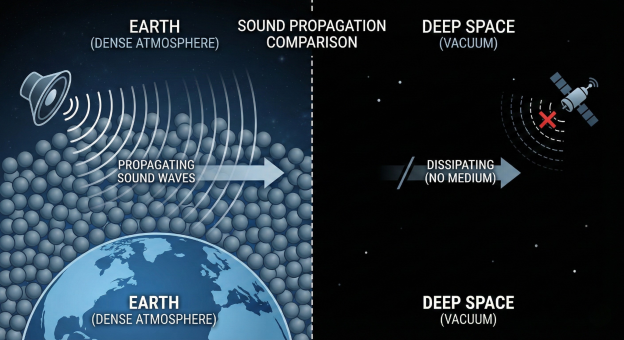
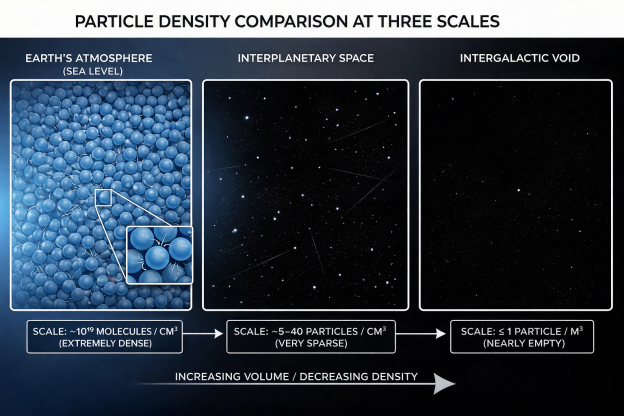
On Earth, this is straightforward. At sea level, our atmosphere is a crowded dance floor, containing approximately 10¹⁹ molecules per cubic centimeter.
When you speak, you push these molecules, causing them to collide with their neighbors approximately 100,000 times per second, which transmits the vibration at 343 m/s.
In the deep void of interplanetary space, that crowded dance floor empties out.
The particle density drops by roughly 18 orders of magnitude to just 5-40 particles per cubic centimeter.
In the voids between galaxies, it drops even further, to one particle per cubic meter. In such profound emptiness, particles are too isolated to collide.
There is nothing for a vibrating object to press against; thus, the chain reaction doesn’t happen.
However, scientific reality is far more nuanced than a simple “no.”
Space is not a uniform void; it is a complex environment of varying densities and states of matter.
The space between stars is very quiet, but we now know that sound-like things can happen in certain situations.
The physics of sound in space is not about things that are impossible. Finding the edge cases where the rules change is the focus.
For example, sound waves can travel through the thin atmosphere of Mars, and sound can “tunnel” across vacuum gaps using piezoelectric effects.
We need to stop thinking of space as empty nothingness and start seeing it as a landscape with very strict physical limits.
First Principles: The Anatomy of a Sound Wave
Before we can understand why space is quiet, we need to understand how loud sounds are.
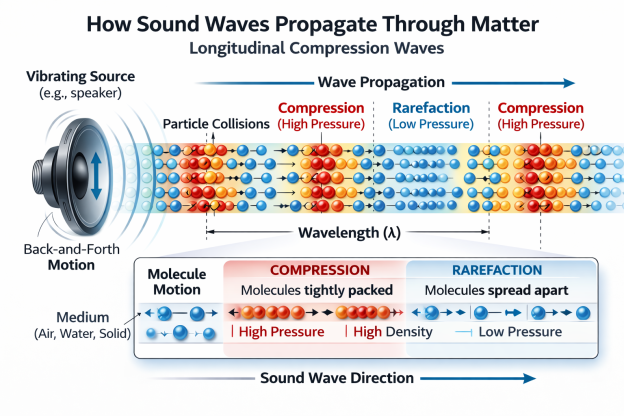
In everyday life, we imagine sound as something magical, like music floating through the air. But in physics, sound is just motion.
At its core, sound is a mechanical wave, which is a disturbance that moves through matter by making particles hit each other.
Electromagnetic waves, like light, radio waves, and X-rays, are oscillations of electric and magnetic fields that flow freely through space.
Mechanical waves, on the other hand, are uninvited guests. There must be a host medium for them to appear.
Particle density is the most important variable to consider because of its dependence on a host.
For a sound wave to propagate, there has to be a chain of molecules that are close enough to each other to “hand off” the energy of the wave to their neighbors.
The atmosphere on Earth is very full. There are around  molecules in one cubic centimeter of air at sea level.
These molecules are always moving around quickly and hitting each other about 10 billion times a second.
When a speaker cone pushes out, it squeezes these molecules together.
This generates a pressure wave that travels through the network of collisions at around 343 meters per second. Now think about what it’s like to be in space between planets.
The number of particles drops from  to only 5 to 40 per cubic centimeter.
It lowers considerably more in the huge spaces between galaxy clusters, to about $10^{-6}$ particles per cubic centimeter.
The “chain” is broken in this setting. The particles are so far apart that they hardly ever interact with each other.
If a spaceship blows up in deep space, the gas that expands might hit a few stray protons, but there is no solid medium to transport a pressure wave.
The energy just turns into heat and the movement of individual particles, and it never comes together to make the sound we hear.
The Bell Jar: A Lesson in Impedance
The classic “Bell Jar” experiment that you can find in physics courses all over the world is the best example of this idea.
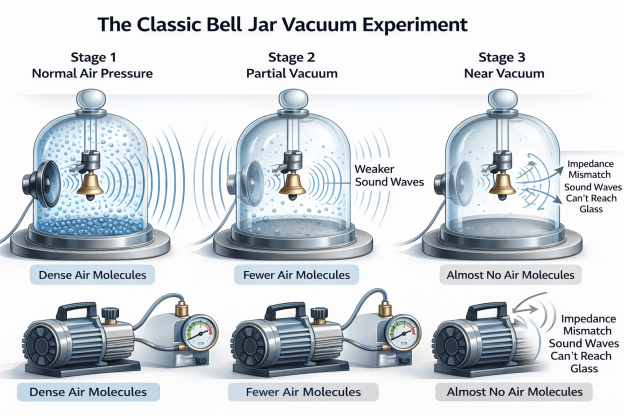
A glass jar holds an electric bell, and as a pump takes out the air, the sound of the bell ringing steadily fades away.
However, for the scientifically curious, there is a nuance here that often goes unmentioned.
Standard laboratory vacuum pumps cannot create a “true” vacuum; they leave behind millions of molecules. Why, then, does the sound vanish?
The silence is mostly because of impedance mismatch. As the air within the jar gets thinner, the sound waves inside the jar behave very differently than the sound waves outside the jar.
The sound waves within are now moving through thin, low-pressure air, which makes it hard for them to transfer their energy to the thick glass walls.
Instead of going through, they bounce back. The quiet you hear isn’t only because the sound has ended; it’s because the bridge between the vacuum and your ears has broken.
In deep space, sound can’t travel because there’s no medium, and even if there were, the density difference would keep it isolated.
The Atmosphere Exception: Sound on Other Worlds
The phrase “in space” describes a location, not just a condition.
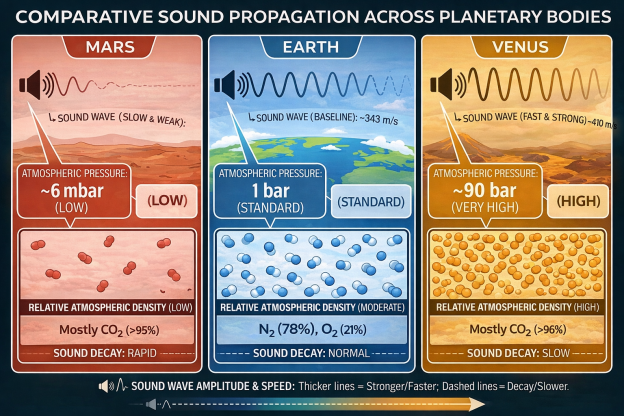
The planets are so far apart; thus, sound can’t travel between them. However, the planets themselves typically have atmospheres.
This situation makes an important difference in how we comprehend physics.
Sound travels according to classical acoustic principles anywhere there is a gas or liquid medium with a high enough density.
To learn how strange places change how we hear sound, we just need to look at the planets next to us.
The Thin Air of Mars
In February 2021, NASA’s Perseverance rover sent the first microphone to another planet to record noises. This made the theory real.
Researchers that looked at these recordings confirmed that sound waves do travel through the Martian atmosphere, which is mostly carbon dioxide.
But an astronaut on Mars would hear a very strange soundscape.
At the surface of Mars, sound travels at around 240 meters per second, which is a lot slower than the 343 meters per second that it does on Earth.
This is because carbon dioxide has a lower molecular weight and the atmosphere is less dense.
It has exceptionally low acoustic impedance since the atmosphere is so thin. This means that sound doesn’t easily move from a source to the air around it.
If you were to drop a wrench on Mars, it would produce a sound approximately 20 decibels weaker than it would on Earth.
Additionally, carbon dioxide is a highly absorptive gas. It rapidly drains acoustic energy at all frequencies, causing noises to decay entirely over very short distances.
Yet, despite these extreme limitations, sound definitively travels. An astronaut could still hear close-range impacts or equipment operating through this thin medium.
The Crushing Pressure of Venus
Venus is a roar, whereas Mars is a whisper. The air on Venus is 90 times heavier than the air on Earth at sea level because the pressure on the surface is 90 atmospheres.
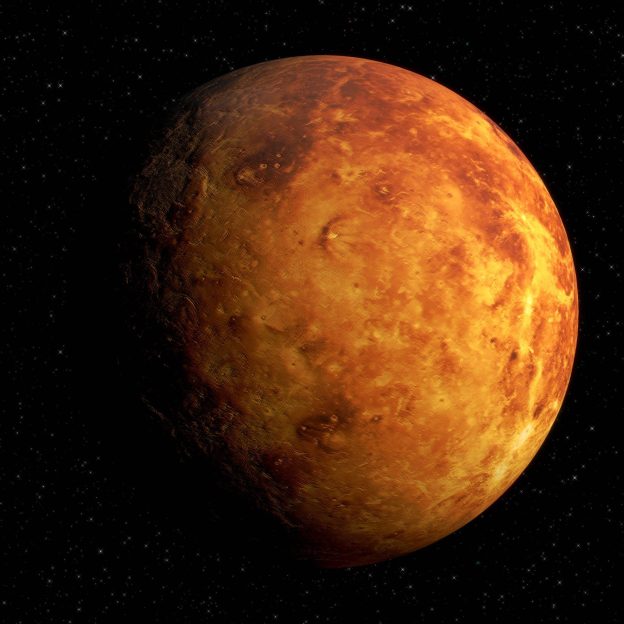
In this thick carbon dioxide atmosphere, when temperatures are above 730 Kelvin, the way sound works changes a lot.
Sound waves on Venus travel at about 410 meters per second, which is quicker than they do on Earth.
The acoustic impedance is enormous, sitting at roughly 27 kilopascals per second per meter, which is nearly 30 times our terrestrial baseline.
Because the molecules are packed so tightly, vibrations couple into the atmosphere with incredible efficiency.
A hypothetical observer would find the Venusian atmosphere highly conducive to sound propagation.
Titan’s Deep Freeze
Saturn’s moon Titan presents a third, uniquely strange acoustic environment.
Titan possesses a thick, nitrogen-rich atmosphere that is actually denser than Earth’s. However, the surface is locked in a deep freeze at roughly 94 Kelvin.
Temperature dictates how quickly gas molecules bounce around. Because Titan is frigid, molecular motion is sluggish, and sound propagates at a mere 200 meters per second.
This is the slowest sound speed of all the terrestrial environments in our solar system.
Despite the creeping pace of these waves, the thick nitrogen air ensures that acoustic transmission occurs readily across the moon’s surface.
Look no farther than our interplanetary neighbors for guidance.
While deep space serves as an effective sound barrier, the addition of an atmosphere bubble causes the universe to vibrate.
Breaking the Rules: Acoustic Tunneling & Plasma Waves
The transition from a breathable atmosphere to the hard vacuum of deep space is not a sudden drop-off. It is a gradual fading out.
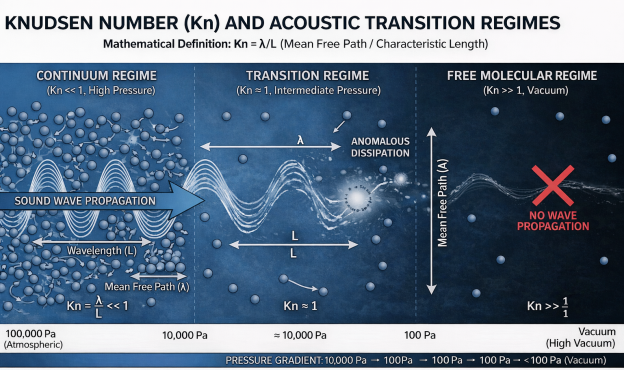
As atmospheric pressure decreases, the classical rules of physics begin to break down. To understand this gray area, physicists use a metric called the Knudsen number, denoted as  .
.
The Knudsen number is a ratio defined as  .
.
In this case,  stands for the mean free path, which is the average distance a molecule moves before hitting another molecule. L stands for the acoustic wavelength.
When the Knudsen number is very small, particles collide frequently, and classical sound waves travel normally.
However, as pressure drops and the Knudsen number approaches 1, the distance between particles becomes roughly equal to the wavelength of the sound itself.
In this transition regime, behavior becomes highly anomalous. Sound energy is rapidly absorbed by viscothermal dissipation rather than moving forward.
Below approximately 100 Pascals, acoustic attenuation becomes so extreme that the wave character is entirely ambiguous.
But what happens when we look beyond neutral gases? Space is filled with exotic matter and strange quantum loopholes that allow sound-like phenomena to break the classical rules.
The Plasma Exception: Ion Acoustic Waves
Much of the matter in our solar system does not exist as a standard gas. It exists as plasma, a state of matter where electrons are stripped from their atoms.
In the plasma environments of planetary ionospheres and magnetospheres, acoustic-like phenomena can propagate despite incredibly low particle densities.
These are known as ion acoustic waves. They are collective oscillations of ions and electrons, behaving much like the density waves we see in neutral gases.
However, because plasmas are partially ionized, these waves are driven by electromagnetic forces rather than simple mechanical collisions.
If you were floating in the Earth’s magnetosphere, you could not hear these waves.
They involve the electromagnetic-mediated oscillations of charged particles, not the mechanical vibration of neutral molecules that human eardrums require.
Also, their frequencies are usually between kilohertz and megahertz, which is much higher than what humans can hear.
They are called acoustic waves only because of the arithmetic that describes how they move across space, not because they can be heard.
Jumping the Gap: Acoustic Tunneling
Perhaps the most bizarre exception to the “no sound in a vacuum” rule was rigorously proven in 2023.
Physicists Zhuoran Geng and Ilari Maasilta of the University of Jyväskylä published the first definitive proof that sound can actually “tunnel” across a complete vacuum gap.
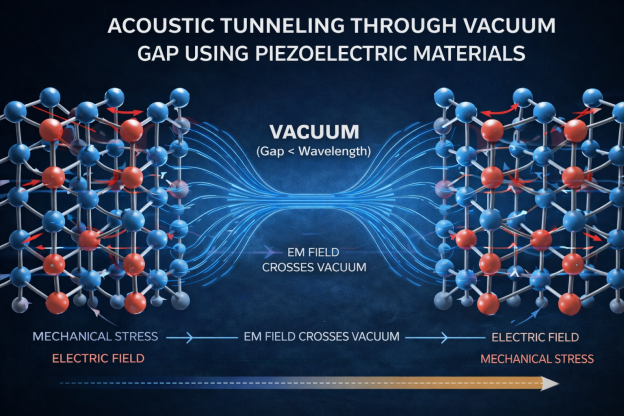
This breakthrough relies on piezoelectric materials, which are special crystals, like zinc oxide, that turn mechanical stress into an electric charge.
The researchers noted that this process closely mirrors quantum mechanical tunneling, where particles appear on the opposite side of a barrier without ever actually traversing the space in between. Hence, they named the phenomenon “acoustic tunneling”.
However, this does not mean astronauts can shout to each other in orbit. The phenomenon comes with severe physical limitations.
The primary constraint is that the vacuum gap must be smaller than the wavelength of the sound being transmitted.
For human-audible frequencies between 20 Hz and 20 kHz, wavelengths range from 17 meters to 17 millimeters.
Trying to align microscopic crystals over huge gaps is highly impractical. Consequently, this tunneling effect is only truly feasible for microscopic gaps using ultrasonic and hypersonic frequencies.
Furthermore, this mechanism requires specially prepared piezoelectric materials that do not naturally float around in deep space.
Acoustic tunneling is a genuine loophole in classical physics. It proves that wave information can cross a void through electromagnetic transduction, but it is fundamentally distinct from conventional sound propagation.
Sonification: How We “Hear” the Invisible
When you scroll through social media, you might occasionally stumble across a viral video claiming to play the “sound” of a distant nebula, a pulsating star, or the magnetic field of a planet.
These clips are undeniably eerie and captivating. They also heavily reinforce the exact media-driven misconceptions that confuse our understanding of basic physics.
Given our understanding that the hard vacuum of interstellar space cannot carry a mechanical wave, could you clarify what we are actually hearing in these audio files?
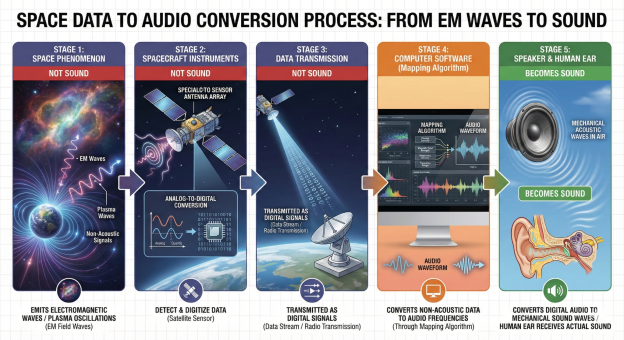
The answer lies in a process of indirect signal conversion. Space agencies are not flying traditional microphones through the void to record these events.
Instead, they are recording data that isn’t sound and changing it into a form that people can understand.
Our minds are made to live on Earth, which makes us see the universe as if it were a person.
We naturally expect loud noises to come from big physical occurrences, so it’s easy for our brains to accept these audio clips as real recordings.
To help the public and scientists intuitively grasp complex datasets, researchers often take readings of electromagnetic waves, light frequencies, or ion oscillations and map them to audible pitches.
This translation process is a brilliant analytical and educational tool, but it frequently falls victim to imprecise terminology in popular science writing.
When a science communicator describes an electromagnetic fluctuation as an “acoustic phenomenon,” it blurs the line between a literal mechanical wave and a metaphorical sound.
Careless science communication can inadvertently convince the public that spaceships roar and pulsars hum in the literal sense.
In reality, the source events for these audio clips propagate through mechanisms that are entirely foreign to classical acoustic physics.
They are self-sustaining oscillations of electric and magnetic fields. We only “hear” them because a computer program on Earth acted as an artificial medium.
The software converts a silent stream of digital space data into a mechanical vibration, which then radiates from your desk speakers into the air of your room.
Conclusion: A New Way to Listen
The famous cinematic warning that “in space, no one can hear you scream” is physically accurate in a fundamental sense.
If you are floating in the hard vacuum of interplanetary or interstellar space, your voice has no medium to carry it.
Yet, a complete scientific understanding requires us to recognize both this dominant reality and the important exceptions.
Space is vast, but it is not uniformly empty. It contains planets wrapped in distinct atmospheres, pressurized spacecraft carrying human crews, and highly charged plasma environments.
In these specific domains, the rules change. We know that sound propagates through the carbon dioxide of Mars and the thick nitrogen of Titan.
We know that mechanical vibrations easily transmit through the solid structures of our space stations, allowing astronauts to hear the internal hum of machinery.
We even know that at the extreme edges of laboratory physics, sound-like signals can traverse microscopic vacuum gaps via piezoelectric transduction.
This nuanced perspective is exactly how modern physics operates. We begin by establishing general principles in the classroom, such as the fact that mechanical waves strictly require a material medium.
Then, researchers push outward, rigorously analyzing the boundary conditions and the strange exceptions where those classical rules break down.
The universe is not a silent, dead void. It is a highly complex physical environment that simply refuses to play by the acoustic rules we are used to on Earth.
The next time you look up at the night sky, do not imagine absolute silence. Instead, imagine a universe vibrating with kinetic energy, waiting for us to build the right tools to listen.