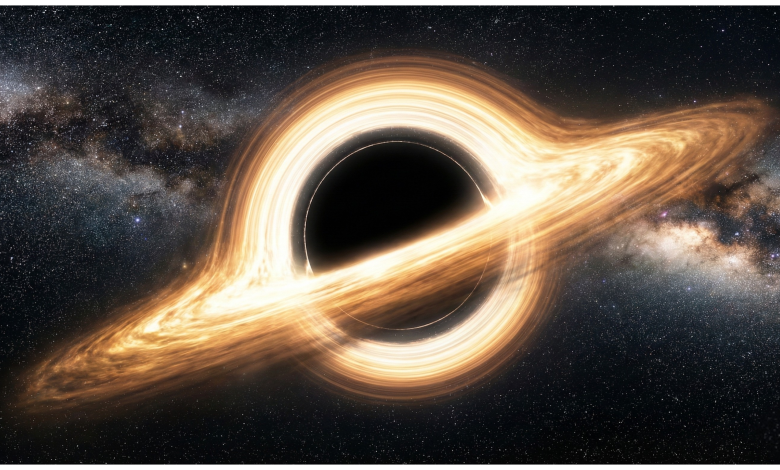
Black holes are often described as cosmic objects so powerful that they warp space and time around them.
This warping isn’t just a dramatic figure of speech.
It has real effects on how time passes. Near a black hole, time itself slows down compared to farther away.
In other words, black holes literally bend time.
This mind-bending phenomenon was predicted by Albert Einstein’s theory of general relativity over a century ago.
Scientists and writers alike have been fascinated by it ever since. Science fiction movies like Interstellar have even popularized the idea.
In the film, an hour near a black hole equates to seven years back on Earth.
That extreme example is fiction. But it’s rooted in real physics.
To understand how black holes can slow time, we need to explore a few key ideas.
These include spacetime, gravity, and gravitational time dilation.
Lets delve into this and break down how black holes warp spacetime and affect the flow of time. We will also look at what happens to time from different perspectives.
By the end, you’ll see why black holes are not just massive objects that swallow light. They are also natural time-bending laboratories that teach us about the universe’s most fundamental fabric.
What Is Space-Time, and Why Does Gravity Affect Time?
To understand how black holes bend time, it helps to start with Einstein’s concept of space-time.
Space-time is a unified fabric.
It combines the three dimensions of space with the fourth dimension of time into one continuum.
Massive objects like stars and planets cause this fabric to curve. Black holes, with their extreme density, warp space-time even more dramatically.
We often use the analogy of a heavy bowling ball on a trampoline. The ball’s weight creates a dip in the stretchy surface of the trampoline.
Similarly, a massive object creates a “dent” in space-time.
Gravity, in Einstein’s theory, isn’t a force pulling things directly. Instead, gravity is the result of curved space-time.
Objects (and light) follow the curves in space-time created by mass.
One consequence of this curvature is that time can run at different rates. It depends on how deep you are in a gravitational well.
Stronger gravity means more curvature of space-time. In turn, greater curvature makes time flow more slowly compared to areas with weaker gravity[1].
In essence, gravity affects time. This phenomenon is known as gravitational time dilation.
Even here on Earth, this effect can be measured. Earth’s gravity is much weaker than a black hole’s, but it still causes a tiny slowing of time.
Scientists have confirmed this by comparing precise atomic clocks at different altitudes. For example, clocks on airplanes tick a little faster than identical clocks on the ground[2].
And clocks aboard the International Space Station also tick slightly faster than those on Earth’s surface[3].
These differences amount to mere fractions of a second. But they prove that gravity really does influence the passage of time.
What Is Gravitational Time Dilation?
Gravitational time dilation describes how time slows down in a strong gravitational field. It’s a key prediction of Einstein’s general relativity.
In simple terms, someone in stronger gravity will age more slowly than someone in weaker gravity.
Time literally passes at different rates for them.
This isn’t just theory. It’s been demonstrated with experiments and observations.
In 1971, scientists took atomic clocks on airplanes and flew them around the world.
When compared to identical clocks on the ground, the airborne clocks ticked at a slightly different rate.
This was partly because they were farther from Earth’s gravity during the flight.
Modern GPS satellites orbit above Earth where gravity is slightly weaker. As a result, their onboard clocks tick a little faster than clocks on Earth.
If not corrected, these differences would make GPS navigation inaccurate.
Near a black hole, gravitational time dilation becomes extreme. Black holes have enormous mass packed into a tiny area.
This creates an intense gravitational field. As a result, time dilation near a black hole is far more pronounced than anywhere else.
If you could hover just outside a black hole’s event horizon, time would slow to a crawl. Your seconds might correspond to hours or days for someone far away.
Now, let’s examine what actually happens as something approaches that boundary of no return (the event horizon).
How Do Black Holes Warp Space and Time?
Black holes warp space and time more than any other known object. The reason is their density.
A black hole packs a tremendous amount of mass into an incredibly small volume. Imagine compressing several Suns into a sphere only a few kilometers across.
All that mass curves space-time intensely.
In fact, a black hole’s gravity is so strong that it creates a region from which nothing can escape.
This region is bounded by the event horizon, often called the “point of no return.” The event horizon is essentially the edge of the black hole.
Cross that line, and even light cannot get out.
That’s why the black hole appears “black.”
It’s not a physical surface, It’s a spherical boundary in space around the black hole.
This boundary is, by definition, the point beyond which nothing (not even light) can escape[4].
All objects warp space-time, but a black hole’s warp is extreme.
Near the event horizon, space is curved extremely steeply.
If you shine a beam of light outward, the light can actually be bent back toward the black hole. Likewise, time is stretched out near the black hole.
To a distant observer, everything near a black hole seems to slow down dramatically. Clocks tick more slowly, and even light appears to flash in slow motion.
Visualization of how a black hole’s gravity distorts its surroundings.
In this NASA simulation, the accretion disk (hot gas orbiting the black hole) appears warped and doubled.
Light from the far side of the disk is bent around the black hole, so we see it above and below the black hole.
The result is a strange, double-humped image of the disk. Such visual distortions are a direct result of the black hole’s intense warping of space and time.
The image above illustrates how gravity warps space (and light) near a black hole.
But how does this relate to time specifically? To answer that, let’s focus on what happens to time as you get closer to the event horizon.
How the Event Horizon Affects Time
Approaching the event horizon of a black hole leads to some of the strangest time effects in the universe.
Time dilation becomes incredibly strong.
From the perspective of a distant observer, any clock nearing the event horizon appears to run slower and slower[5].
In fact, when an object gets extremely close to the horizon, a distant observer would see its clock almost freeze in time.
Imagine watching a spaceship approach a black hole.
As it gets near the event horizon, each second on the ship appears to take longer and longer from your vantage point.
The ship seems to slow down, at least from your perspective.
In reality, the ship and its crew would feel time passing normally for them. To a distant observer, it’s as if the ship is in slow-motion.
If the ship flashed a light once per second by its own clock, you would receive those flashes more and more spaced out over time.
At first, you might get one flash every two seconds instead of every second.
Later, it could be one flash per ten seconds.
Eventually, you might see only one flash per hour, and so on.
By the time the ship is just outside the event horizon, you might barely see any movement at all[6].
It would look almost frozen at the edge of the black hole.
The light from the ship would also appear redder and dimmer.
This happens because the strong gravity drains energy from the light.
This effect is known as gravitational redshift.
Eventually, the ship would fade away entirely and the light it emits would stretch to wavelengths too low-energy to detect[7].
To your eyes, it never actually crosses the event horizon.
It just fades away, as if time has stopped for it at the edge of the black hole.
This happens because time near the black hole is extremely stretched out from your frame of reference.
That’s why all processes there appear delayed and slowed.
From the outside perspective, it would actually take an infinite amount of time to see an object reach the event horizon.
That’s why we often say time “stands still” at the event horizon. Of course, this is only from the distant observer’s viewpoint.
What Would You Experience Near a Black Hole?
The story gets even more interesting when we consider the perspective of someone falling into a black hole.
Suppose an intrepid (if unfortunate) astronaut decides to jump toward a black hole. What would they experience in terms of time?
Surprisingly, the falling astronaut would not notice anything peculiar about time as they cross the event horizon[8].
Their own clock would tick normally from their point of view.
They wouldn’t realize the exact moment they passed the event horizon.
This is because locally time feels normal to the person.
In Einstein’s theory, there’s a principle called the equivalence principle.
It basically says that free-fall feels the same as floating in space with no gravity.
Crossing an event horizon in free-fall is not like hitting a physical wall. It’s actually quite uneventful, at least locally.
However, the astronaut would notice some extreme effects as they move in. First, the gravitational forces would increase dramatically.
The difference in gravity between their feet and head would stretch them out. This deadly effect is whimsically named spaghettification.
If the astronaut looks back outward at the universe, they would notice something strange.
They would see the outside universe’s time appear to speed up.
Distant events would appear to happen faster, almost as if watching a fast-forwarded movie.
In other words, while their own time feels normal, they see the outside universe running much faster.
As the astronaut falls closer to the singularity, the time difference becomes even more extreme.
They might even see the far future of the universe unfold in what is a short span of time for them.
Unfortunately, no one could survive long enough to verify that. The astronaut would be destroyed by the extreme forces long before any such observation.
But it’s mind-boggling to imagine seeing stars form and die in a flash as outside time races by.
It’s important to note that these effects are extreme near the event horizon.
For most other scenarios in the universe, we don’t notice such dramatic time bending.
Only in extreme gravity (like near black holes or neutron stars) do these effects become significant.
Black holes are unique in how far they push these relativistic effects.
Do Spinning Black Holes Twist Time?
So far, we’ve talked about black holes in general, without considering whether they spin. Most real black holes are likely rotating.
A rotating black hole (also known as a Kerr black hole) does something even stranger to space-time. It drags space-time around with it as it spins.
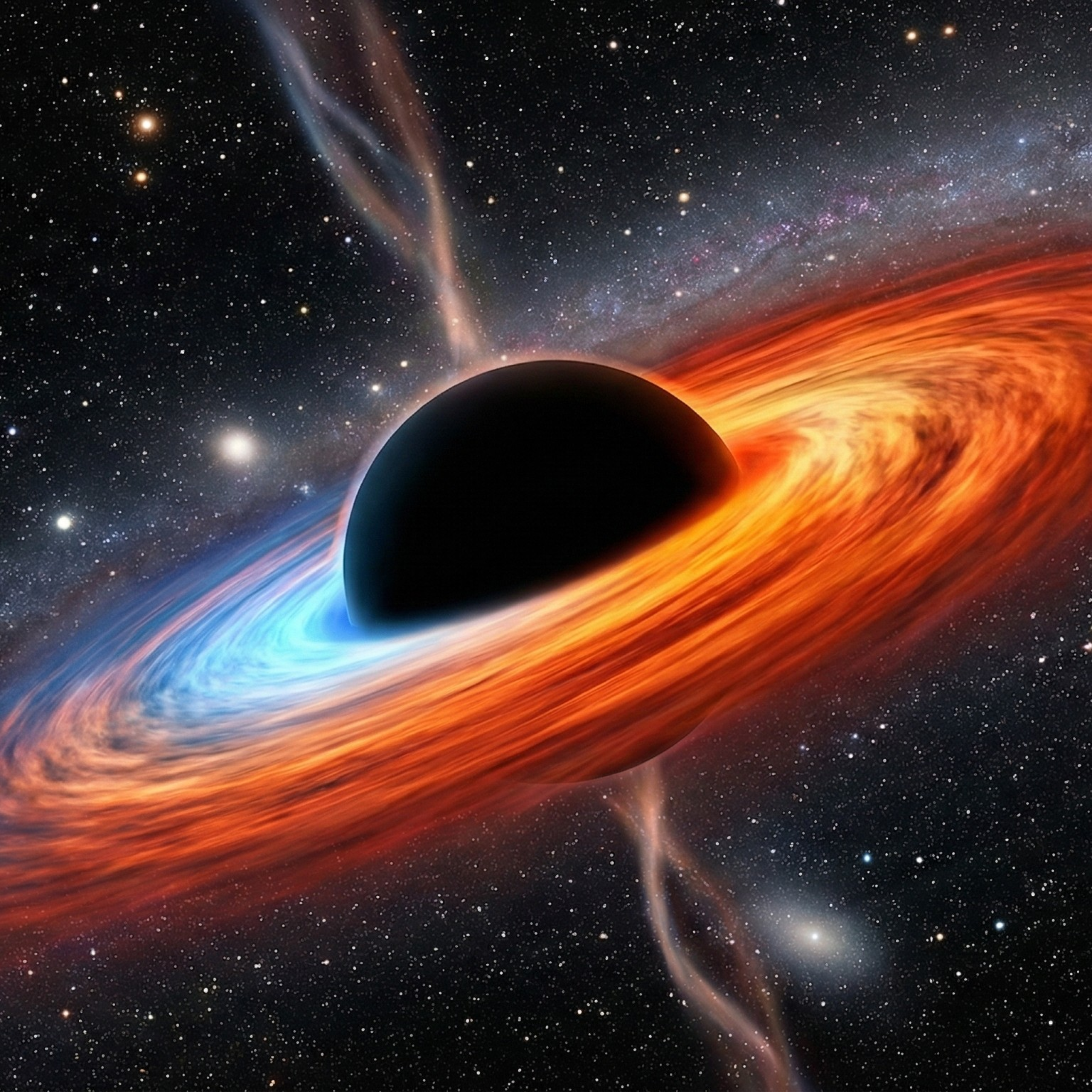
This is called frame-dragging (the Lense-Thirring effect).
Frame-dragging means that a rotating mass literally drags space and time around it.
If you are near a rapidly spinning black hole, space-time is being pulled around in the direction of its rotation.
You can imagine space-time like a viscous fluid, and the spinning black hole is like a spoon stirring it.
This effect isn’t noticeable for an object like Earth’s rotation. It has been measured experimentally.
NASA’s Gravity Probe B mission, for example, confirmed that Earth does drag space-time by a tiny amount[9].
Around a rotating black hole, you not only have gravitational time dilation but also another twist.
Time and space get mixed together in complicated ways due to the rotation.
In the most extreme case, close to a rotating black hole, spacetime is dragged around so powerfully that nothing can resist being pulled into motion.
Everything would be forced to move around the black hole in the same direction that it rotates.
There are even theoretical regions outside the event horizon of a spinning black hole called ergospheres.
In an ergosphere, frame-dragging is so strong that nothing can remain stationary relative to the distant universe. Space-time is being carried along by the rotation, like a giant whirlpool.
For someone near a rapidly rotating black hole, the rotation changes how they experience space and time.
One outcome is that the path of any object around the black hole can be significantly twisted by the rotation.
Frame-dragging doesn’t necessarily slow time more.
Instead, it causes the directions of space and time to start mixing or swirling together.
It’s another reminder that time around black holes doesn’t behave in an intuitive way.
Near these objects, time (and space) behave very differently from our everyday experience.
Evidence of Time Bending Near Black Holes
All this talk about bending time might sound abstract. What evidence do we actually have that time really behaves this way near black holes?
While we can’t travel to a black hole ourselves yet, we have strong indirect evidence.
One piece of evidence is gravitational redshift.
This is the stretching of light to lower energy as it escapes massive objects.
For example, light escaping from the surface of a neutron star is measurably redshifted.
This means it loses energy, which is consistent with time running slower in the strong gravity there.
Near a black hole, any light that escapes from close to the event horizon will be stretched to much longer wavelengths.
In extreme cases, it might be shifted all the way to radio waves or even just heat (infrared).
Astronomers have detected radiation from matter very close to black holes, such as X-rays from the accretion disk.
These signals carry imprints of the gravity effects.
Another line of evidence comes from observations of stars orbiting the supermassive black hole at our galaxy’s center (Sagittarius A*).
As these stars swing close by the black hole, their light spectrum shows slight shifts that match general relativity’s predictions.
This includes evidence of gravitational time dilation.
In 2018, scientists observed a star called S2 passing near our galaxy’s central black hole.
They noted that its light was redshifted by gravity, just as Einstein’s theory predicted.
On a more human scale, time dilation has been measured here on Earth. The effects have also been measured within our solar system.
Clocks on GPS satellites run at different rates, as discussed earlier.
Time differences have been measured between clocks on Earth’s surface and those at higher altitudes.
Experiments with rockets and airplanes have all confirmed the predictions of gravitational time dilation.
Finally, it’s worth noting that the Event Horizon Telescope project captured the first direct image of a black hole’s shadow in 2019.
This historic image was of the supermassive black hole in the galaxy M87[10][11].
That image, a ring of light around darkness, is actually a portrait of space and time warped to the extreme.
It’s not a direct picture of time dilation. But it visually confirms that we are dealing with gravity so strong that even light is heavily affected.
Time bending is an inseparable part of that scenario.
Can Black Holes Be Used as Time Machines?
Whenever the topic of black holes and time comes up, a popular question is whether black holes could allow time travel.
The idea of “time machines” using black holes has appeared in science fiction and even in theoretical physics papers. So is there any truth to it?
The short answer is not in any practical sense.
It’s true that black holes can send something (or someone) to the far future relative to someone who stayed outside.
For instance, if our astronaut could hover near the edge of a black hole for a while and then escape, they might find that far more time had passed in the outside universe.
In effect, they would have traveled to the future by experiencing time more slowly.
This is essentially a form of time travel. Specifically, time dilation allows travel into the future by slowing one’s own clock.
However, going to the past is another matter entirely.
General relativity in theory allows some weird structures like wormholes or rotating black holes with something called a “ring singularity” that might permit backward time travel[9].
But these are highly speculative, and most physicists suspect that the universe forbids actual time paradoxes.
In any case, entering a black hole to try to use its time-bending abilities is not feasible.
You could never come back out to tell the tale. And you would be crushed by the extreme tidal forces long before anything else.
So while black holes make great science fiction plot devices, in reality they are one-way trips.
They are definitely not convenient time portals.
However, they do teach us how flexible time can be. That is arguably more interesting than any sci-fi time machine.
Understanding Time Through the Lens of Black Holes
Black holes show us that time is not absolute or universal. It can stretch and slow under the influence of gravity.
The phrase “time is relative” becomes viscerally true near a black hole. A few hours near a black hole could mean years have gone by elsewhere.
This isn’t just fantasy. It’s backed by Einstein’s well-tested theories and observations in less extreme conditions.
By studying black holes, scientists gain insight into the nature of space-time and gravity.
They push the limits of physics. There is still much we don’t know, especially about what happens inside a black hole.
But what we do know is that these cosmic objects push our understanding of time to its breaking point.
They confirm that the universe has a wildly flexible fabric. Here, space and time can be contorted in ways that defy our everyday intuition.
For us on Earth, the idea that time can bend is a powerful one. It shows how extraordinary the cosmos is.
Black holes, once purely hypothetical, are now known to exist in abundance across the universe. Each one is a natural time-bending machine.
While we wouldn’t want to visit one up close, studying them from afar has taught us a lot. It has helped us uncover one of the universe’s most fascinating truths. Gravity can bend time itself[1][5].
References
[1] [2] [3] [4] [6] What Happens When Something Gets ‘Too Close’ to a Black Hole? – NASA Science
[5] How Do Black Holes Really Work? | Britannica
[7] [8] Black hole – Wikipedia
[9] Evidence found that spinning black holes drag spacetime | MIT News[10][11] NASA Visualization Shows a Black Hole’s Warped World – NASA