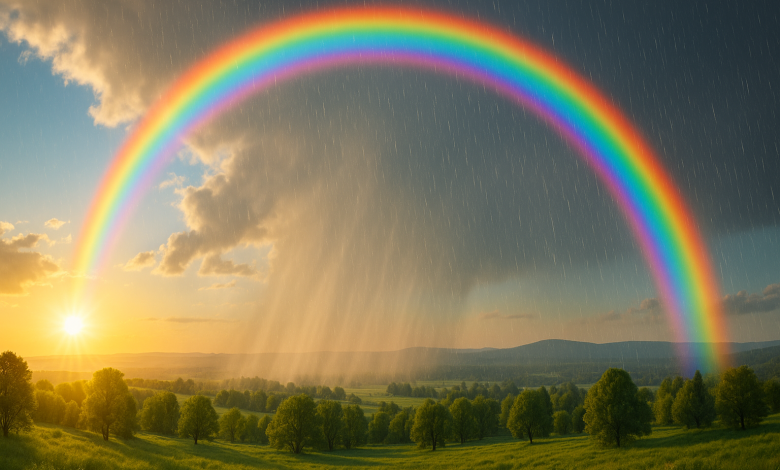
A rainbow arrives unannounced: look up at a rain-showered sky, and there it is, a luminous arc of colours, a fleeting bridge of light that seems magically painted across the heavens.
That beautiful arch is called a rainbow, but far from being simply a pretty gift from the skies, it is a rich interplay of physics, geometry, and optics.
In this article, we will delve deeper into this phenomenon, exploring how nature transforms ordinary sunlight and raindrops into a vibrant palette of colours. What shapes, angles, and optics are involved? And what surprising variations and cultural stories swirl around this marvel?
Rainbow? What is it?
A rainbow is an optical and meteorological phenomenon where sunlight interacts with water droplets suspended in the air, rain, mist, or spray that splits the light into a spectrum of colours and reflects it toward an observer.
The key ingredients are sunlight, a medium of water droplets, and the right viewing geometry. The observer must have the sun behind them and the rain or mist in front of them.
The Physics of Light: Refraction, Reflection, and Dispersion
When sunlight enters a water droplet, it slows down and bends due to refraction. Inside the droplet, the light reflects off the inner surface and exits after bending again.
Different wavelengths of light bend by different amounts, a process known as dispersion. This separation of colours creates the familiar spectrum of a rainbow.
Rainbow and its Anatomy
The primary rainbow forms from one internal reflection, with red on the outside and violet on the inside.
The secondary rainbow forms from two internal reflections, appearing fainter with reversed colours. The darker region between them is called Alexander’s Band.
Under ideal conditions, you may also see faint supernumerary rainbows, formed by interference of light waves.
Rainbow Spotting: When and Where You Can See them
Rainbows appear when sunlight shines on water droplets at a specific angle, typically about 42 degrees from the direction opposite the sun.
They are most visible in the early morning or late afternoon when the sun is lower in the sky.
The best viewing conditions occur when you have the sun behind you and rain or mist ahead, ideally with a dark background for contrast.
Deeper Physics Behind Rainbows
Mathematically, the angle of deviation for light in a raindrop depends on the refractive index of water and the incident angle.
The bright arc of the rainbow corresponds to the minimum deviation angle, where many light rays overlap.
Blue and violet light refract more than red light, explaining why red is always on the outer edge of the primary rainbow.
Rainbow: Cultural and Historical Perspectives
The rainbow has fascinated thinkers for centuries. Aristotle discussed it in his work Meteorology.
In Hinduism, the rainbow holds deep symbolic meaning and appears in several documented pieces of history, Puranas, and scriptural and poetic contexts, often tied to divine power, cosmic harmony, and nature’s connection with the gods.
Some of the references to the Hindu perspectives on the rainbow are as follows:
Indra’s Bow (Indradhanush)
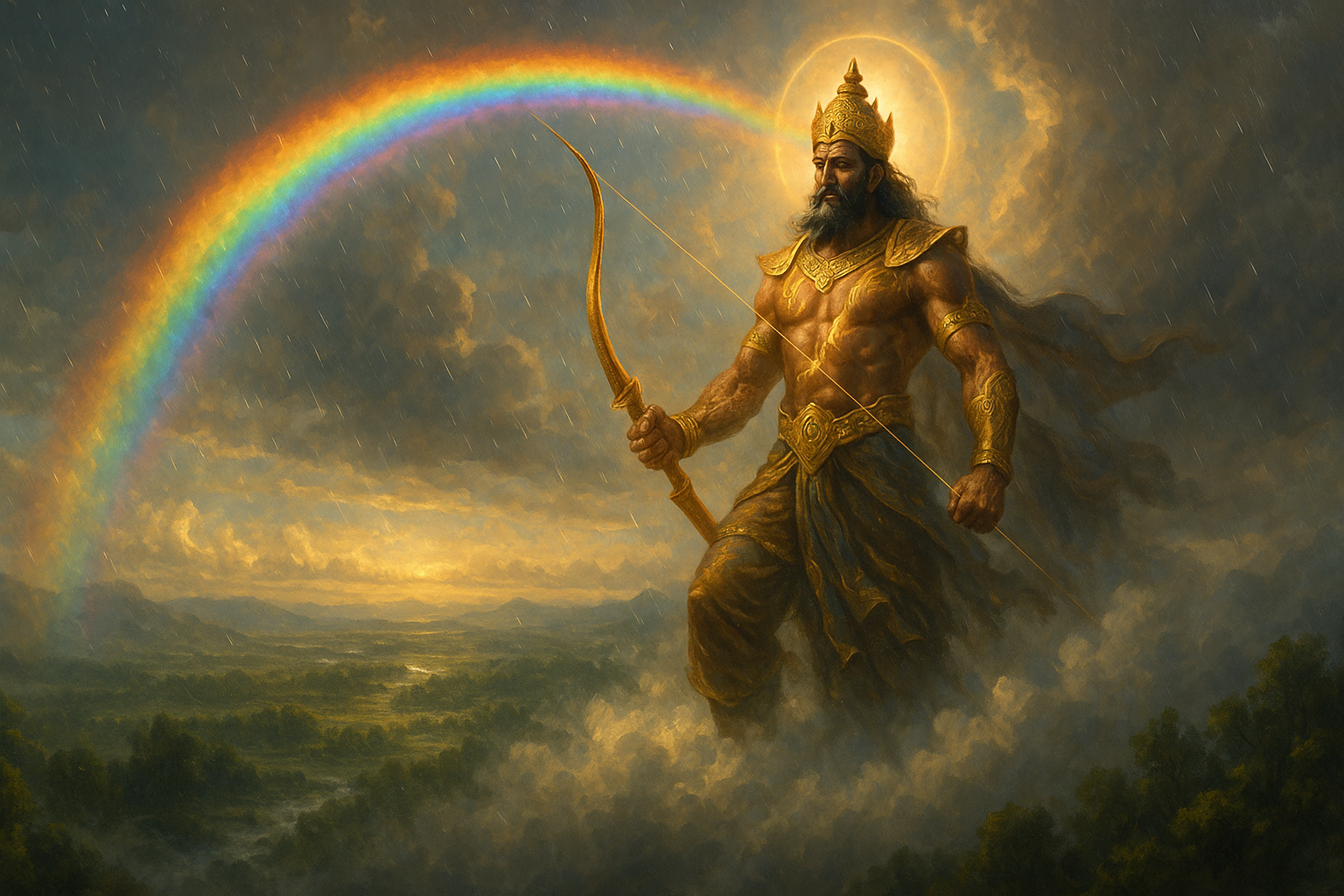
In Sanskrit, the rainbow is called Indradhanush, which literally translates to “the bow of Indra.”
Indra, the Vedic god of rain, thunder, and lightning, is said to wield the Vajra, his thunderbolt weapon. The rainbow is considered his celestial bow, used to shoot arrows of lightning and rain across the sky after a storm.
In the Rig Veda, Indra is praised as the bringer of rain and the slayer of drought-causing demons (like Vritra, the serpent who blocked the waters). After his victory, the rainbow is described as his bow of triumph, a sign that balance and fertility have returned to the world.
Symbolic meaning:
- A divine bridge between heaven and earth
- A sign of restored harmony after chaos (the storm)
- A promise of abundance and rain
Arjuna’s Bow (Gandiva) and Celestial Parallels
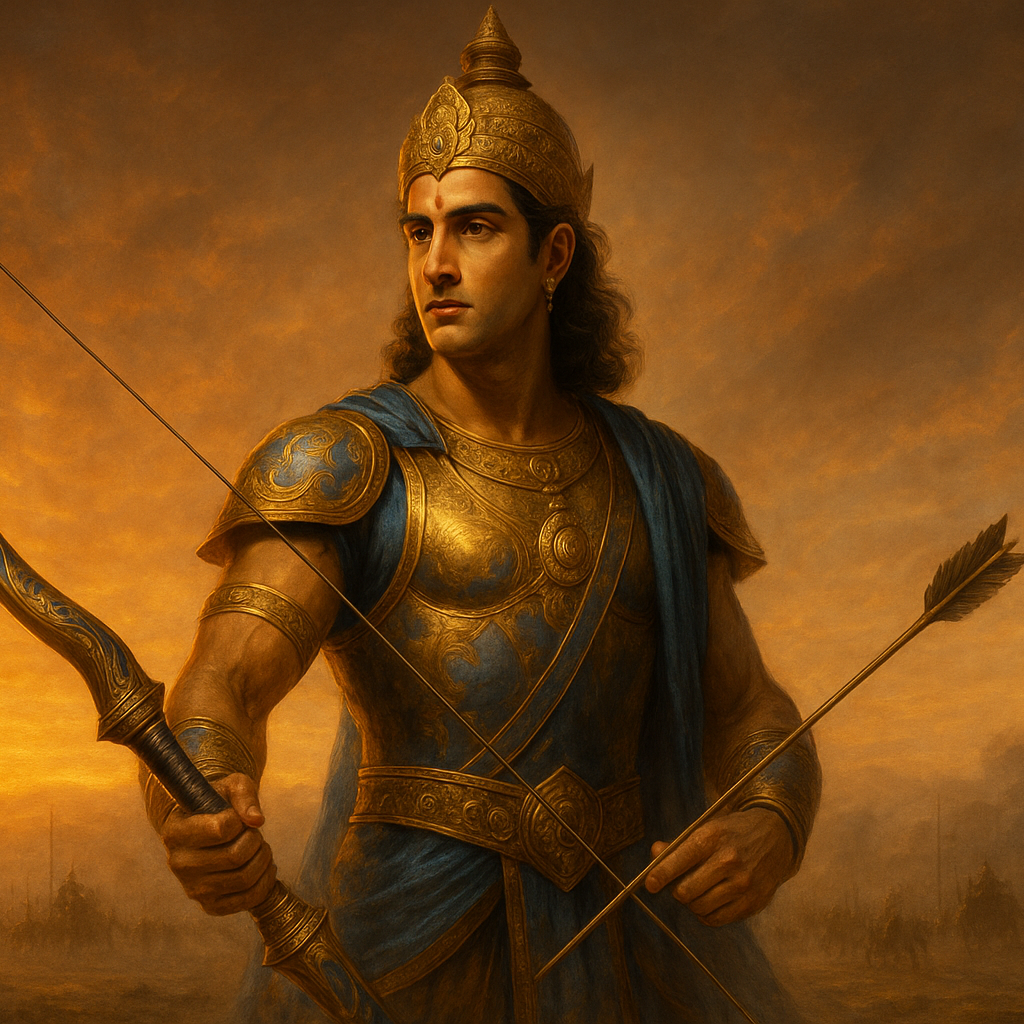
In the Mahabharata, the warrior Arjuna’s legendary bow Gandiva is described as radiant and dazzling with hues of light.
Later Hindu commentators and poets compared its gleaming arc to a rainbow, symbolising divine blessing and cosmic balance.
Thus, the rainbow also came to signify divine strength guided by dharma (righteousness) and power in harmony with natural order.
Rainbow and Vishnu’s Presence
Some later Puranic texts interpret the rainbow as a sign of Vishnu’s energy pervading the atmosphere after rain.
Vishnu, the preserver and sustainer, maintains cosmic order (Rta).
The seven colours of the rainbow are sometimes linked to the seven rays or aspects of cosmic creation, each representing an aspect of divine manifestation.
Rainbow Symbolism in Hindu Philosophy
Hindu thinkers saw the rainbow’s colours as a metaphor for the unity of diversity, many colours emerging from one light, much like the multiplicity of life arising from one Brahma (universal consciousness).
- White sunlight → Brahma (ultimate reality)
- Seven colors → the diversity of creation
Thus, the rainbow embodies Maya (the world of appearances) and the unity hidden behind it.
5. In Folk and Regional Beliefs
Across India, local traditions often see the rainbow as:
- A sign of divine blessings after a storm.
- A bow of the gods protecting villages from demons or drought.
- In some parts of South India, farmers take a rainbow after rain as a good omen for crop fertility.
Children are told stories of Indra painting the sky with his divine brush to remind humanity that peace follows every storm. A moral echoing the larger dharmic philosophy of cyclical renewal.
6. Symbolic Summary
In Hindu cosmology, the rainbow (Indradhanush) is:
- A weapon of divine order (Indra’s bow)
- A bridge between heaven and earth
- A symbol of unity in diversity (seven colors, one light)
- A sign of protection and fertility after rain
- A reminder of cosmic harmony between natural forces
Rainbows and Their Unusual Types
Beyond the familiar arc, there are other fascinating variations like
- A full-circle rainbow can sometimes be seen from aeroplanes.
- Lunar rainbows, or moonbows, appear at night, created by moonlight rather than sunlight.
- Twinned rainbows arise when raindrops of different sizes coexist.
- Fogbows form in mist, often pale and ghostly due to tiny droplet sizes.
The Importance of Understanding Rainbows
Rainbows beautifully combine art and science.
They illustrate fundamental principles of optics and remind us of the power of observation.
Understanding them has historical significance in the development of physics and continues to inspire education, art, and photography today.
Rainbows: Observing and Photography
To capture a rainbow, keep the sun behind you and look toward rain or mist ahead. The lower the sun, the higher the rainbow arc appears. Photographers can use wide-angle lenses and dark backgrounds to enhance visibility.
Rainbows are perfect subjects for learning about light, reflection, and colour composition.
Rainbows – The Common Myths
Despite their beauty, rainbows are often misunderstood. Each person sees their own rainbow, as it depends on the specific geometry between the observer, the sun, and the raindrops.
You cannot reach the ‘end’ of a rainbow, as it moves as you move. Rainbows are not fixed to seven colours; the spectrum is continuous, and what you perceive depends on conditions and eyesight.
Frequently Asked Questions
Q: Why is red on the outside of a rainbow?
A: Red light bends the least when passing through water droplets, exiting at a wider angle, which makes it appear on the outer edge.
Q: Can you always see a rainbow after rain?
A: No. The sun must be shining, low in the sky, and the rain must be in the opposite direction.
Q: What is a double rainbow?
A: It occurs when light reflects twice inside water droplets, forming a fainter secondary arc with reversed colours.
Q: Do other planets have rainbows?
A: Possibly, if there are suitable droplets and sunlight. On Saturn’s moon Titan, methane rain could create similar optical effects.
Q: Can you make a rainbow yourself?
A: Yes. Spray fine water droplets into sunlight using a garden hose—you’ll see a miniature rainbow if the sun is behind you.
References
https://en.wikipedia.org/wiki/Rainbow