
Time is the most familiar mystery we live with. It moves forward relentlessly, never backward, carrying us from past to future with no apparent pause button.
This one-way motion is often called the arrow of time, a concept that sits at the intersection of physics, philosophy, and human experience.
But why does time have a direction at all? And more provocatively, could time ever reverse its flow?
To answer this, we need to look beyond clocks and calendars and into the laws of nature themselves.
The arrow of time is not just a poetic idea. It is deeply tied to entropy, probability, and the structure of the universe.
Understanding why time moves forward also reveals why time reversal, while mathematically possible in some equations, remains physically elusive.
The Arrow of Time and Our Everyday Experience
The arrow of time is the observation that time appears to move in one direction: eggs break but do not unbreak, people age but do not grow younger, and memories point toward the past, not the future.
This directionality feels obvious, yet it is surprisingly difficult to explain using basic physics alone.
Many fundamental physical laws are time symmetry laws. This means they work the same whether time moves forward or backward.
If you filmed two billiard balls colliding and played the video in reverse, the motion would still obey Newton’s laws. At this microscopic level, there is no preferred direction of time.
So where does the arrow come from? The answer lies not in individual particles but in large collections of them.
The macroscopic world behaves differently because of statistics and probability. When systems contain billions of particles, certain outcomes become overwhelmingly more likely than others.
This statistical bias creates the sense of time’s flow we experience.
Human perception reinforces this direction. Memory formation, biological aging, and cause-and-effect relationships all align with the arrow of time.
We remember yesterday, not tomorrow. Causes precede effects. These patterns are not imposed by consciousness alone; they emerge from deeper physical processes that govern matter and energy.
Entropy and the Thermodynamic Arrow of Time
The most important explanation for the arrow of time comes from thermodynamics, specifically the Second Law of Thermodynamics.
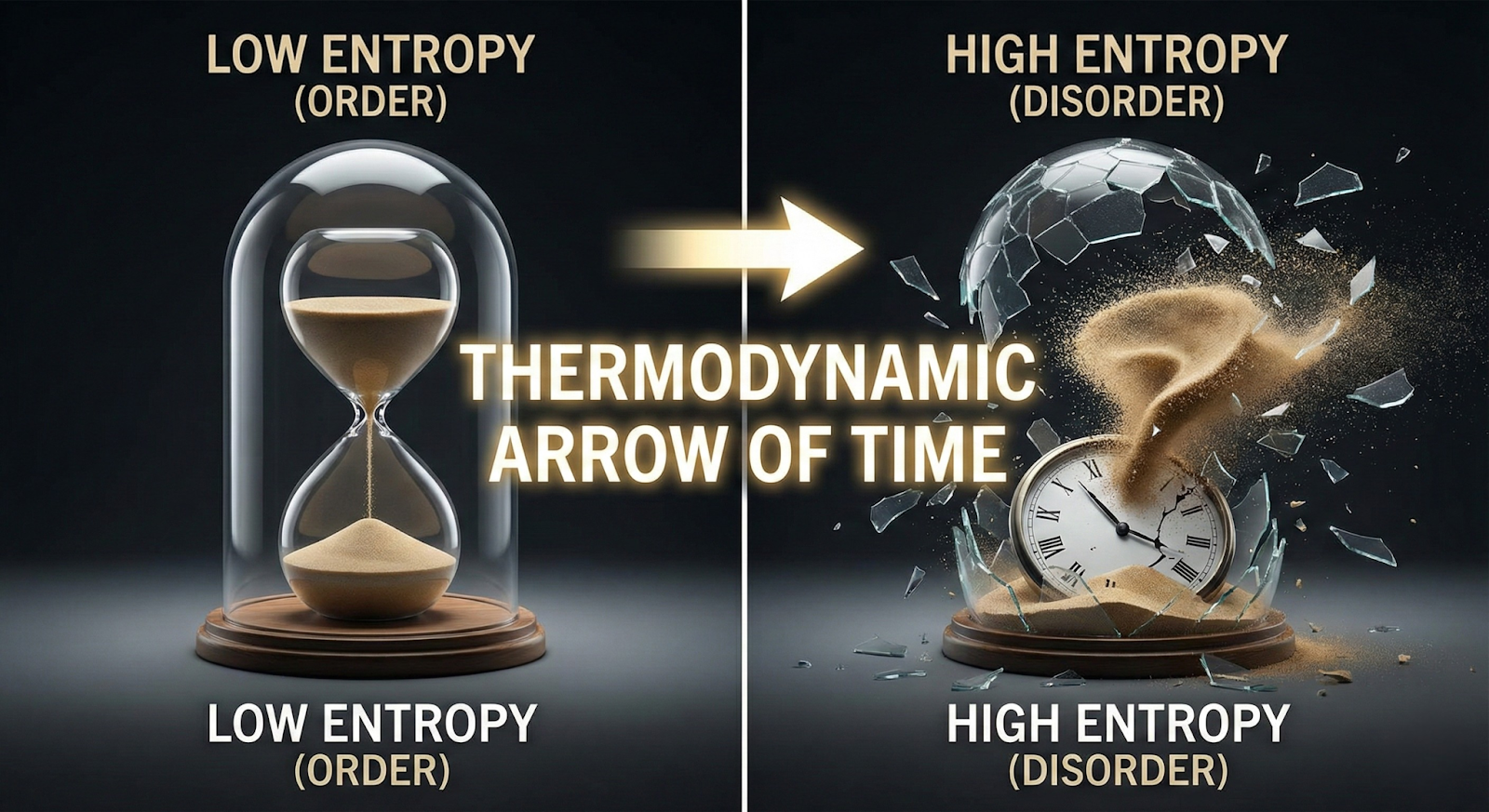
This law states that in an isolated system, entropy tends to increase over time.
Entropy is often described as disorder, but a better definition is the number of possible microscopic arrangements that correspond to a system’s overall state.
A tidy room has low entropy because there are few ways to arrange everything neatly. A messy room has high entropy because there are countless ways for objects to be scattered.
The arrow of time follows this gradient of entropy. Time moves forward because the universe is constantly transitioning from a state of low probability (order) to high probability (disorder).
The formula for the change in entropy is expressed as:

Where represents the change in entropy.
Because this value must always be positive or neutral in an isolated system, the arrow of time is fundamentally driven by the universe’s relentless march toward disorder.
As time moves forward, systems naturally evolve toward states with higher entropy because those states are statistically more probable.
This is why heat flows from hot objects to cold ones and not the other way around. It is not forbidden for heat to move from cold to hot, but it is astronomically unlikely.
This entropy increase defines the arrow of time we observe in daily life. Broken objects do not spontaneously reassemble.
Smoke disperses into the air instead of gathering back into a cigarette.
These processes are technically reversible under time reversal equations, yet entropy makes reversal effectively impossible in practice.
Time Symmetry in Fundamental Physics
At the level of fundamental interactions, nature appears largely indifferent to the direction of time.
Many equations governing electromagnetism, gravity, and quantum mechanics exhibit time symmetry.
If the direction of time is reversed in these equations, they still hold true.
This raises a paradox. If the laws of physics do not prefer a direction, why does time’s flow appear so strongly directional in the real world?
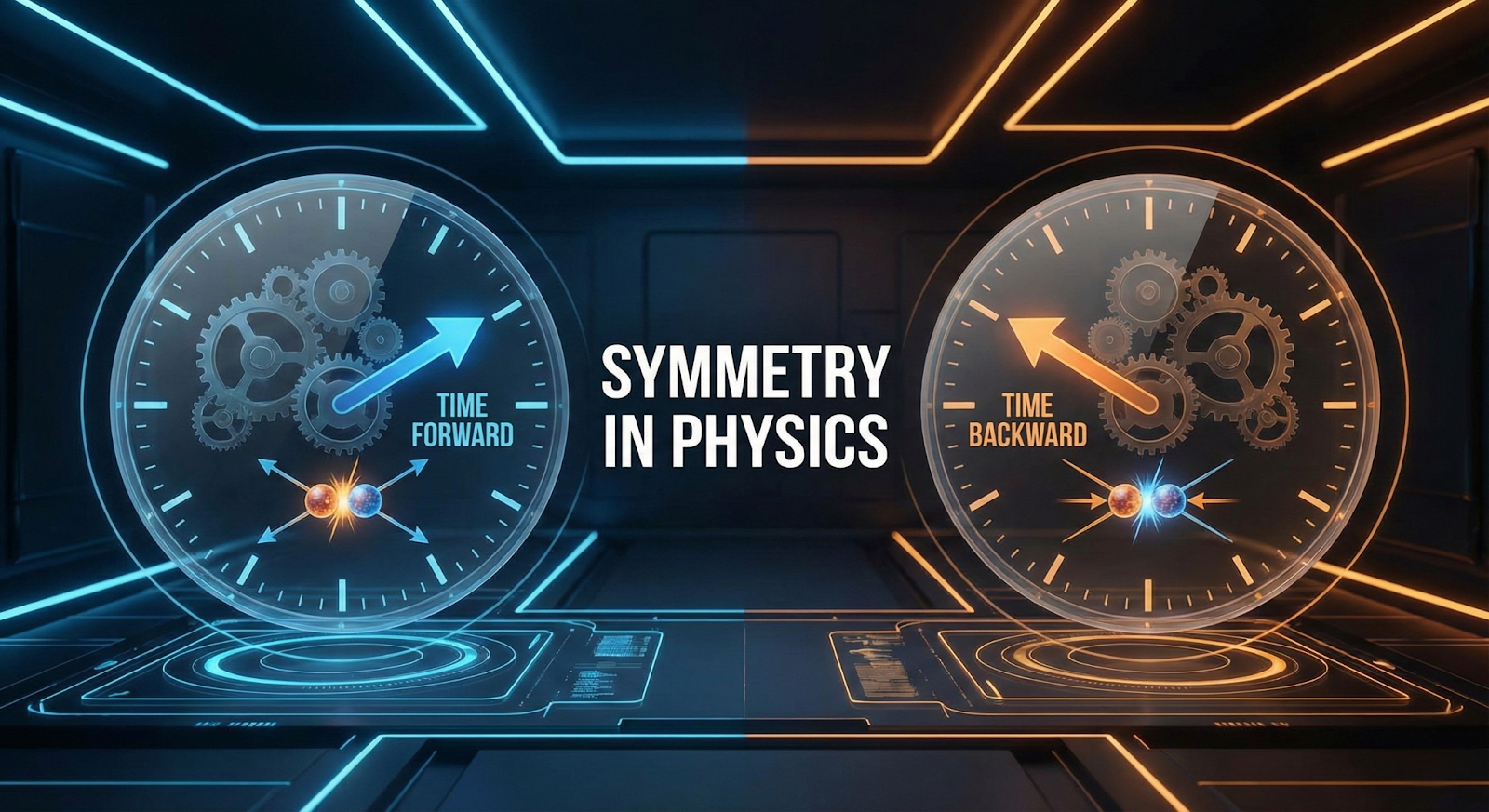
The resolution lies in initial conditions. The universe began in a remarkably low-entropy state. From that starting point, entropy has been increasing ever since.
The laws allow time reversal, but the universe’s starting configuration biases evolution in one direction.
Some subtle violations of time symmetry do exist, particularly in particle physics.
Certain weak nuclear interactions behave slightly differently under time reversal, but these effects are too small to explain the everyday arrow of time. They add asymmetry, but they do not define the overall flow.
In short, time symmetry exists at the microscopic level, while the arrow of time emerges at the macroscopic level.
This distinction is crucial for understanding why time feels irreversible even when the underlying equations are not.
Could Time Ever Run Backward?
The idea of time reversal fascinates physicists and science fiction writers alike. In theory, nothing in many physical equations forbids time from running backward.
In practice, reversing time would require reversing entropy across an entire system.
To make time run backward, every particle would need to retrace its exact previous path, with absolute precision.
The probability of this happening naturally is effectively zero. Even the smallest disturbance would prevent perfect reversal.
Some speculative theories explore scenarios where time’s arrow could behave differently. For example, near certain cosmological conditions or hypothetical states of the universe, entropy gradients might behave unusually.
However, these ideas remain theoretical and lack experimental support.
Black holes and quantum gravity also raise deep questions about time’s flow. In extreme environments, our current understanding of time may break down.
Yet even in these cases, no evidence suggests that time reversal is possible in a practical or observable sense.
Time’s Flow, Causality, and the Future
The arrow of time is closely linked to causality. Causes come before effects because entropy increases in that direction.
If time ran backward, cause and effect would blur, undermining the logical structure of physical reality.
This connection explains why prediction works differently from memory. We remember the past because information about it is encoded in high-entropy states like brain patterns and written records. The future lacks such records because it has not yet occurred.
The flow of time is therefore not an illusion, but an emergent feature of the universe. It arises from the interplay between microscopic laws, macroscopic statistics, and the universe’s low-entropy origin.
While time reversal remains a mathematical curiosity, time’s forward march remains a physical certainty.
Conclusion: Why the Arrow of Time Matters
The arrow of time is not imposed by clocks or human perception alone. It emerges from entropy, probability, and the universe’s initial conditions.
While time symmetry exists in many fundamental laws, the macroscopic world is governed by irreversible processes that define time’s flow.
Could time ever run backward? In theory, equations allow it. In reality, entropy makes it unimaginably unlikely.
The arrow of time is one of the clearest examples of how simple laws give rise to complex, irreversible behavior.
If you want to explore more about time, physics, and the deep rules shaping reality, dive into the science features at read.thescientificindian.com and continue following the trail of time forward.