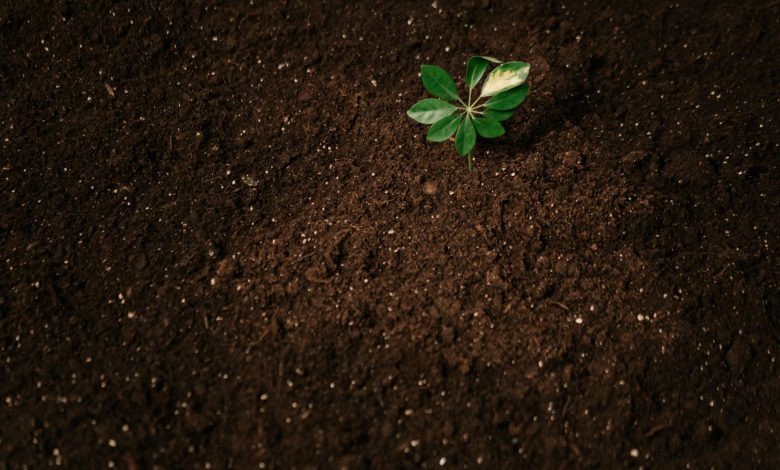
You know that smell of wet soil? The first heavy rain of the monsoon hits the parched earth, and something rises from the soil.
It fills your lungs before you even notice you’re breathing deeper. Most people call it the smell of rain, or maybe just “wet earth.” It feels ancient, somehow.
Familiar in a way you can’t quite explain. That smell has a name: petrichor. And it has a source that might surprise you.
The scent comes from a chemical called geosmin, and it’s produced by soil bacteria called actinomycetes.
These microscopic organisms live in soil everywhere, quietly doing their work for most of the year.
When they die, or when rain disturbs the soil, geosmin gets released into the air. Here’s the remarkable part: the human nose can detect geosmin at concentrations as low as five parts per trillion. We are extraordinarily sensitive to this one molecule.
Why would evolution give us such a finely tuned detector for a bacterial byproduct?
The leading theory is that our ancestors who could smell rain coming had a survival advantage.
Finding water meant staying alive. The smell of petrichor was a signal worth noticing.
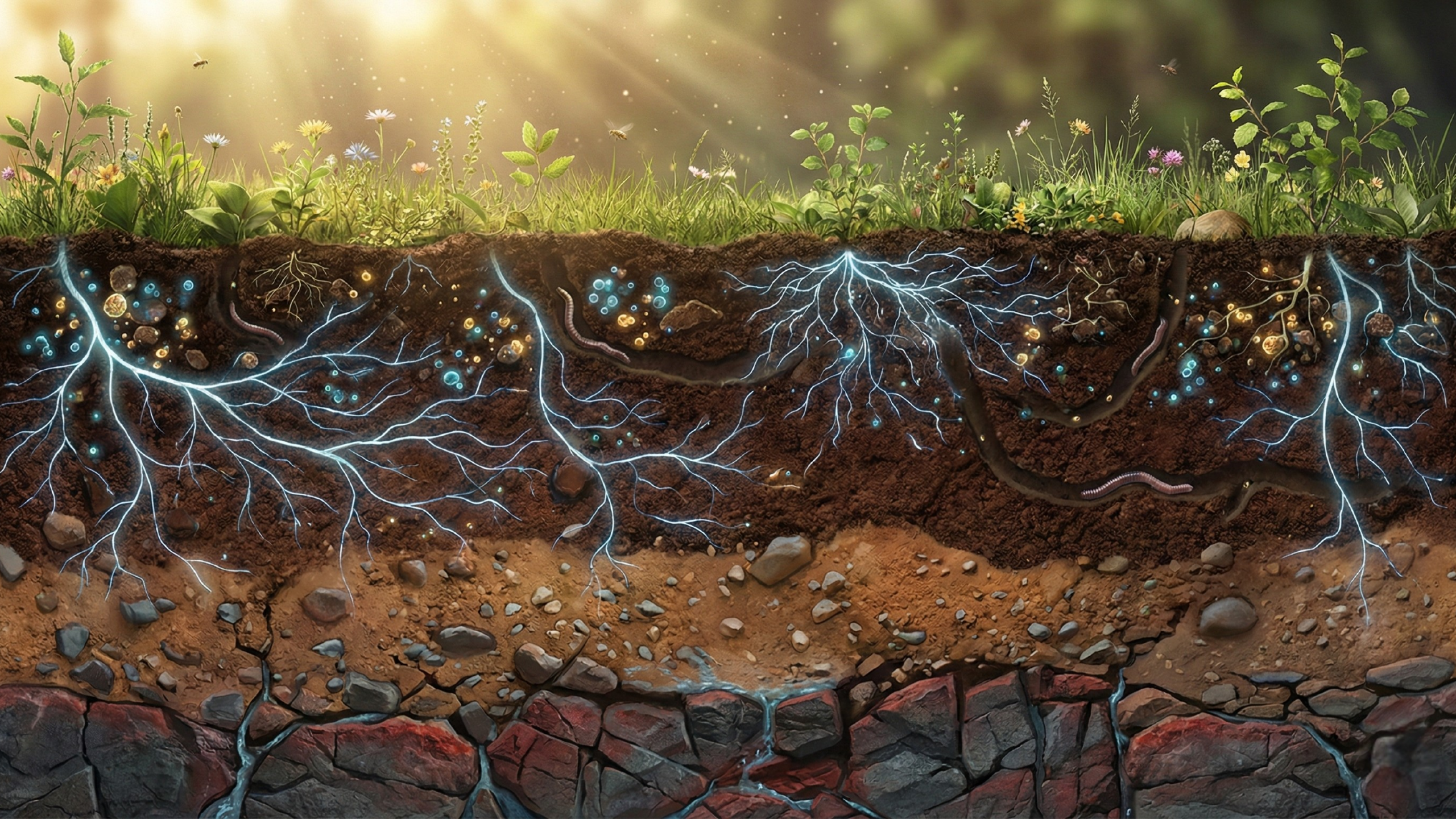
But this single fact reveals something much bigger. Soil isn’t just crushed rock mixed with dead leaves. It’s a living system.
One handful of healthy soil contains more microorganisms than there are humans on Earth.
By the time you finish this article, you’ll understand soil not as a substance, but as a process. A system. A living factory that makes all land-based life possible.
Soil: How Is it Born?
Mechanical grinding. Three different processes work together, often over thousands of years.
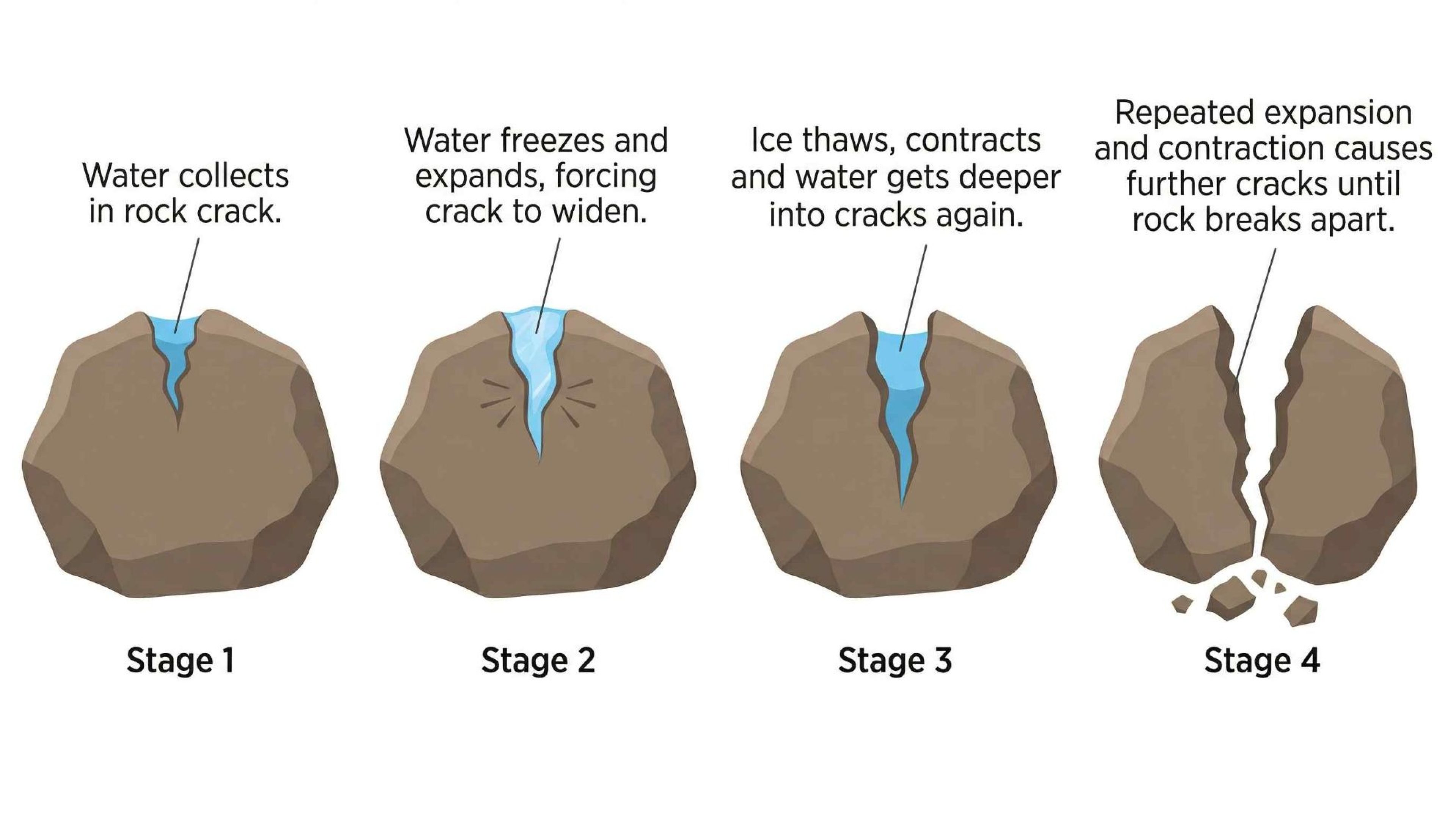
Physical weathering is the most intuitive. Temperature changes crack rocks. Water seeps into tiny fractures, freezes, expands, and splits the rock further. In the Himalayas, this freeze-thaw cycle is relentless. In Rajasthan, extreme temperature swings between day and night do similar work. Slowly, boulders become pebbles, pebbles become sand.
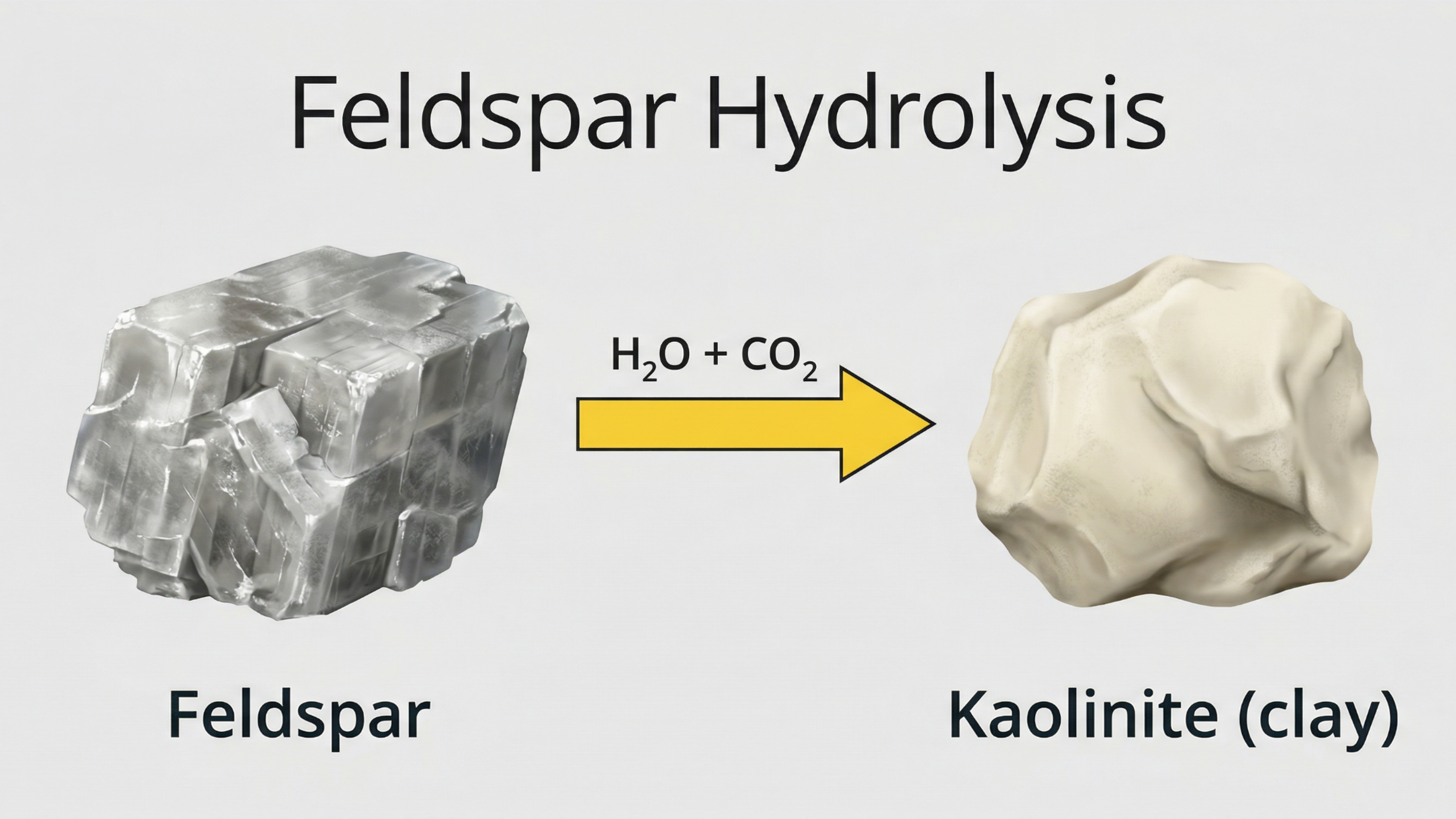
Chemical weathering is subtler but just as important. Rainwater is naturally slightly acidic because it dissolves carbon dioxide from the air. When this weak acid contacts minerals in rock, it triggers chemical reactions. Some minerals dissolve outright. Others transform into new substances. Feldspar, one of the most common minerals in granite, slowly converts into clay through chemical weathering. This is why the Deccan Plateau, built on basalt rock, has such distinctive black clay soil. The parent rock’s chemistry determines what kind of soil eventually forms.
Biological weathering is where life enters the picture. Lichens, those crusty patches you see on old rocks, are partnerships between fungi and algae. They’re among the first colonizers of bare rock. Lichens secrete acids that dissolve minerals, extracting nutrients directly from stone. When they die, their bodies add the first traces of organic matter. Plant roots grow into cracks and widen them. Each generation of life makes it slightly easier for the next.
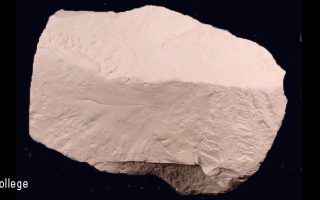
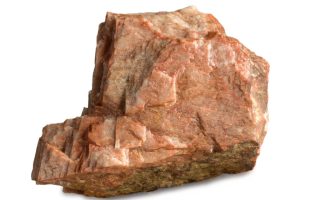
This is the critical insight your textbook misses: soil isn’t just broken rock. It’s broken rock plus time plus life.
Without organisms, you’d have sterile mineral dust, not soil. The living component isn’t optional. It’s essential.
Consider the alluvial soils of the Indo-Gangetic plain. These didn’t form where they now lie.
Rivers carried weathered material down from the Himalayas and deposited it across the plains over millions of years.
This soil is pre-processed, pre-mixed, delivered by water. It’s also why these soils are so deep and fertile. They’ve been accumulating life and nutrients for geological ages.
One more thing worth knowing: soil formation is slow.
Under natural conditions, it takes 500 to 1,000 years to form just two or three centimeters of soil from rock.
Every handful you hold took longer to make than recorded human history.
Soil and its Layers
If you’ve ever looked at the side of a road cut through a hill, or the walls of a freshly dug well, you’ve seen a soil profile.
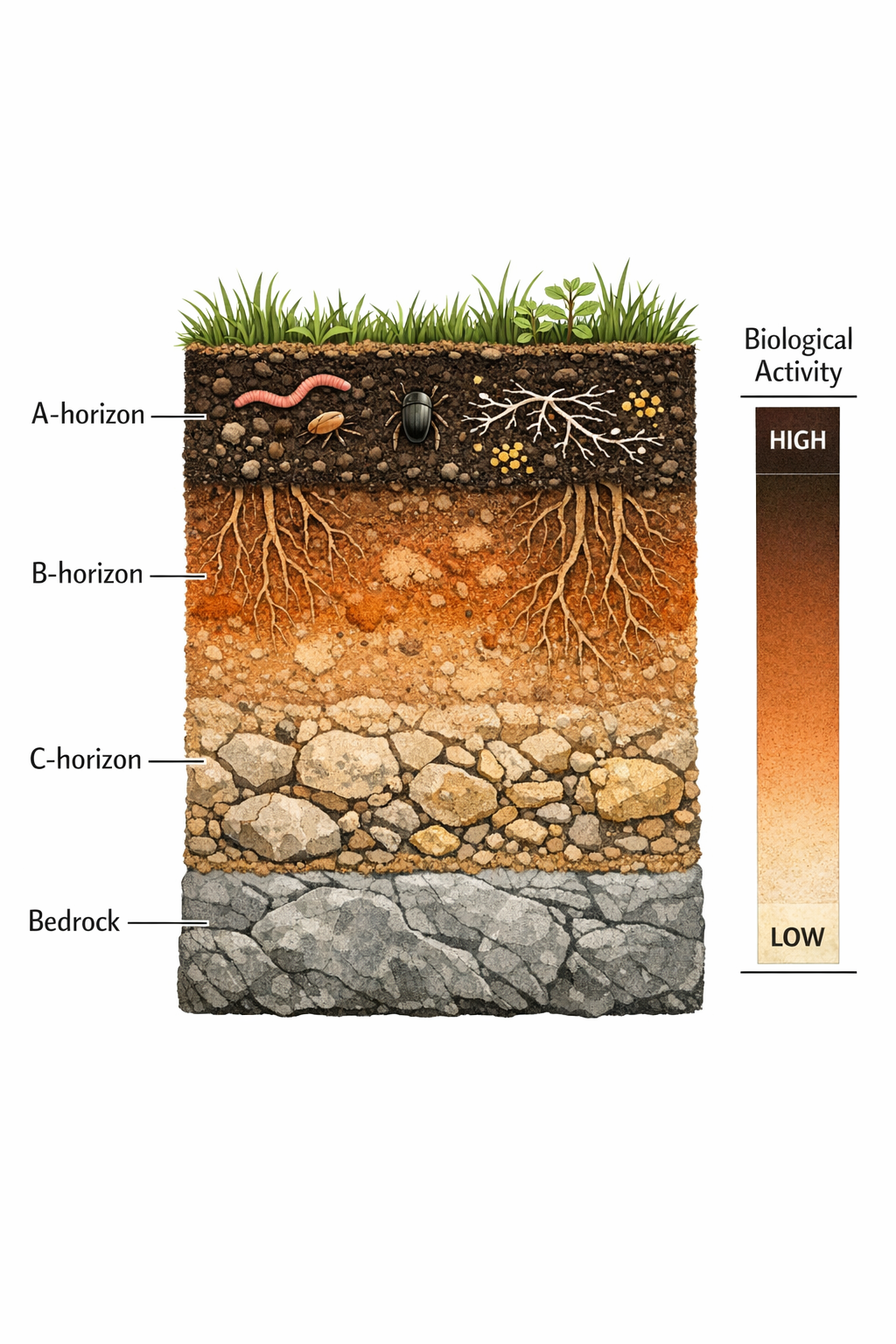
The textbook describes these layers, called horizons, but doesn’t explain what makes each one different or why it matters. Let’s talk about it.
The A-Horizon (Topsoil): The Living Zone
The topmost layer is usually darker than what lies beneath. That darkness comes from humus, the stable organic matter left after decomposition.
This is where 80 to 90 percent of soil life concentrates. Most plant roots stay here because this is where the nutrients are.
Earthworms tunnel through it. Fungi spread their networks. Bacteria number in the billions per gram.
Thickness varies enormously. Degraded farmland might have only five centimeters of topsoil. An undisturbed forest can have thirty centimeters or more.
When topsoil erodes, it takes centuries of accumulated biological wealth with it.
The B-Horizon (Subsoil): The Storage Zone
Below the topsoil, the color lightens and life becomes sparse. This layer contains fewer organisms and less organic matter, but it serves an important function.
Minerals leached from above accumulate here. Iron oxides, clay particles, and calcium compounds wash down from the topsoil and collect in the subsoil.
This often gives it a reddish or yellowish tint.
Tree roots reach down into the B-horizon during dry seasons, accessing water that has percolated below the surface.
It’s a reserve, both of water and of nutrients that slowly release upward.
The C-Horizon: The Transition Zone
Deeper still, you find partly weathered rock. Large fragments sit surrounded by finer material.
This layer is still being transformed into soil, but the process is extremely slow at this depth. Less water penetrates here. Fewer organisms can survive.
Bedrock: The Foundation
Eventually, you hit solid, unweathered rock. This is the ultimate source of everything above.
Granite bedrock produces sandy, acidic soil. Limestone creates calcium-rich, alkaline conditions.
Basalt yields the heavy black clays of central India. The bedrock sets limits on what the soil above can become.
Reading the story: A soil profile is a record of time and process. The darker the topsoil, the more biological activity has accumulated there.
When you see pale, thin topsoil, you’re looking at degraded or young soil. Deep, dark topsoil indicates centuries of life and death, each generation contributing to the next.
Next time you see a roadside cut or construction excavation, take a moment to notice the color gradient.
The boundary between dark and light marks where life’s influence fades. It’s a visual history lesson written in dirt.
Soil types: Sandy, Clayey, Loamy Soils, The Physics of Particles
Sandy soils have large particles, clayey soils have tiny ones, and loamy soils have a mix.
Sand particles range from 0.05 to 2 millimeters in diameter. You can see individual grains with the naked eye.
They’re large enough that they can’t pack tightly together. Between the grains are gaps, called pores, that are relatively big.
Water flows through these pores easily. Gravity pulls it down before roots can absorb much. Air fills the spaces between particles, making sandy soil well-aerated but dry.
Clay particles are microscopic, less than 0.002 millimeters across. They’re so small that they pack together with almost no gaps between them.
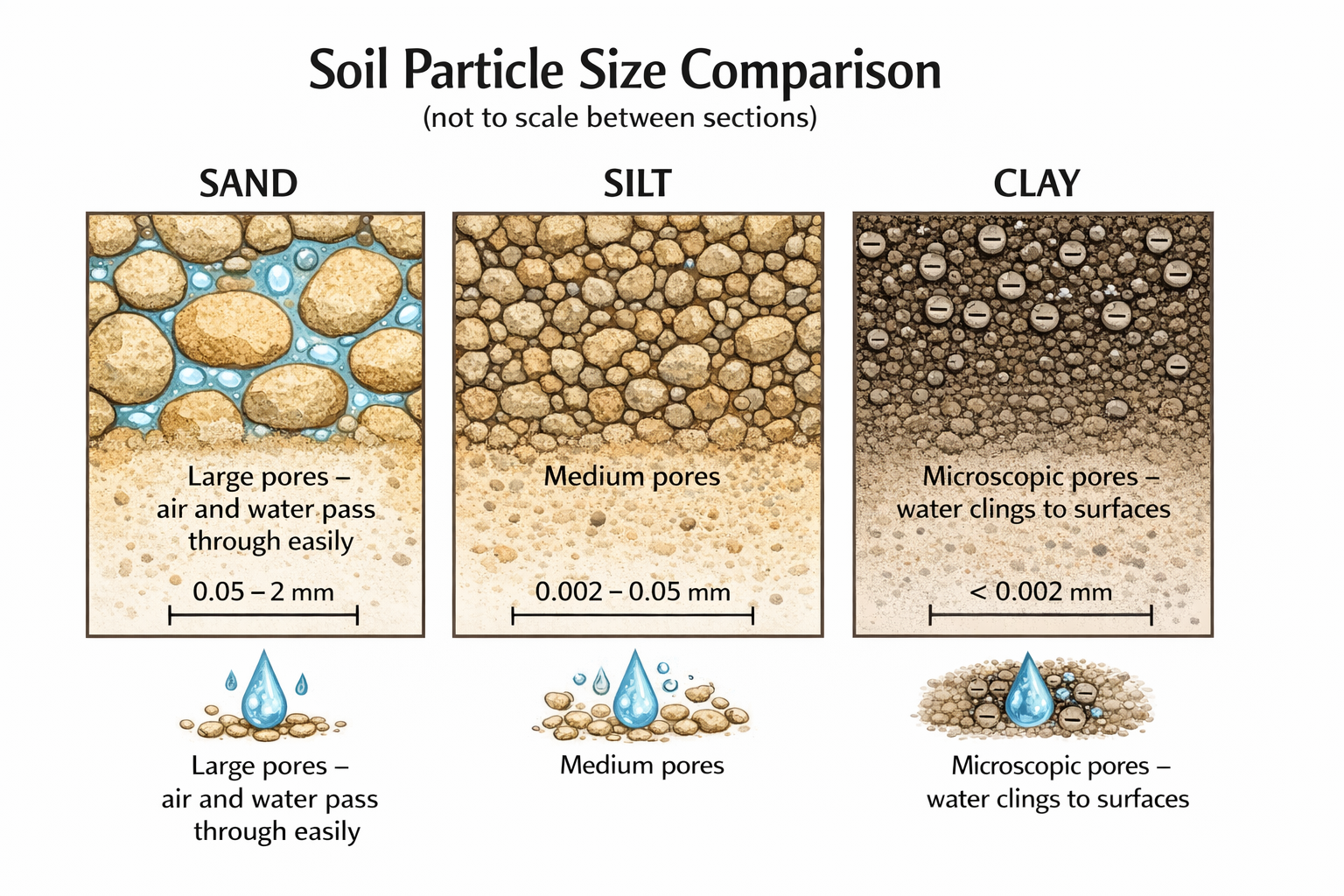
Water molecules cling to the enormous surface area of clay particles and can’t drain easily.
This means clay soil holds water well, but it also means poor aeration. When clay soil is saturated, roots can actually suffocate.
Loam contains a mixture of particle sizes. Some large pores drain excess water, preventing waterlogging.
Some small pores hold water for roots to access later. Air can circulate. It’s this balance that makes loam ideal for most plants.
But there’s something else the textbook doesn’t mention. Clay particles aren’t just small.
They carry negative electrical charges on their surfaces. This matters because many plant nutrients, including potassium, calcium, magnesium, and ammonium, are positively charged ions.
They stick to clay particles like magnets. Sandy soil can’t hold these nutrients.
They wash away with the first rain. This is why clay content correlates with fertility, up to a point.
Soil Comparison by it’s Types
| Property | Sandy Soil | Clayey Soil | Loamy Soil |
| Particle size | 0.05-2 mm | Less than 0.002 mm | Mixed |
| Drainage | Fast | Slow | Moderate |
| Water retention | Low | High | Balanced |
| Aeration | Good | Poor when wet | Good |
| Nutrient holding | Poor | Good | Good |
An Indian example: The black cotton soil of Maharashtra and Gujarat is 40 to 60 percent clay.
It swells dramatically when wet and shrinks when dry, creating those deep cracks you see in summer.
This makes it terrible for building foundations. But cotton tolerates waterlogged soil better than most crops, and the high clay content holds nutrients beautifully. The soil and the crop evolved together, in a sense.
One common misconception: sandy soil is bad and clayey soil is good. Neither is inherently better.
Each suits different purposes. Date palms thrive in sandy desert soil. Rice needs the waterlogging that only clay can provide. Matching soil type to crop is the real skill.
Soil workers: The Invisible Workforce
The class 7 textbook says bacteria, plant roots, and earthworms are “important parts of soil.” It describes humus as “rotting dead matter.”
Both statements are true the way saying “the engine is an important part of a car” is true. Technically correct, but missing deeper context.
Let’s talk about what’s actually happening down there.
The numbers are staggering. One teaspoon of healthy soil contains roughly one billion bacteria, several kilometers of fungal threads, thousands of single-celled predators called protozoa, and dozens of tiny worms called nematodes.
A single gram can contain 10,000 different bacterial species. More organisms live in a handful of soil than humans who have ever existed.
These aren’t just sitting there. They’re working.
The decomposition process
When a leaf falls from a tree, it doesn’t simply rot. A carefully sequenced team of specialists breaks it down, each group handling what the previous group couldn’t.
First come fast-acting bacteria. They consume the simple sugars leaking from damaged leaf cells. Easy food, grabbed quickly.
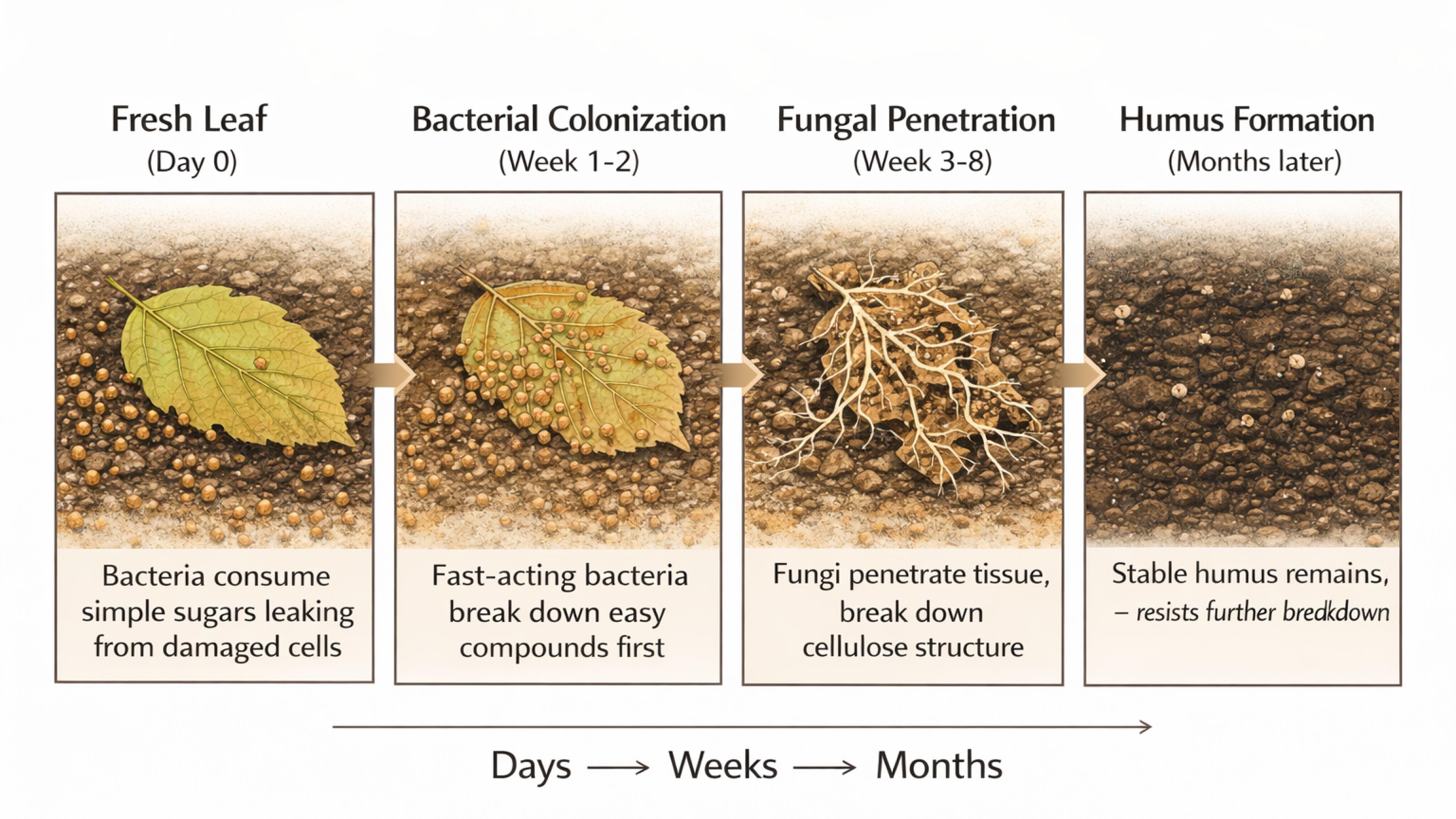
Then fungi arrive. Unlike bacteria, fungi can penetrate solid tissue. Their thread-like structures, called hyphae, grow into the leaf and secrete enzymes that break down cellulose, the tough structural material that gives plants their rigidity. Fungi are the demolition crew.
After that, actinomycetes (those geosmin producers from the opening) tackle even tougher compounds like lignin and chitin. They specialize in materials other microbes can’t handle.
Finally, smaller bacteria consume whatever remains, breaking it into the simplest mineral forms.
This isn’t random decay. It’s a coordinated industrial process. Each group is specialized for specific materials. Each hands off to the next.
What humus actually is
Humus is what remains after decomposition is essentially complete. It’s not actively rotting. It’s the stable end-product.
Here’s what happens: when microbes digest organic matter, they build their own bodies from the carbon and nutrients.
When those microbes die, their bodies become food for other microbes. This cycle repeats many times.
What eventually remains is a dark, carbon-rich substance that resists further breakdown. That’s humus.
Humus does several critical things. It holds water like a sponge. It holds nutrients the way clay does, through surface charges.
It binds soil particles together into clumps called aggregates, improving structure. And it feeds the microbial community continuously, slowly releasing nutrients over time.
The dark color of healthy topsoil comes from humus. Humus is dark because of the complex carbon compounds formed through countless cycles of microbial processing.
When you see black soil, you’re seeing concentrated biological history.
Why this matters: the nutrient release mechanism
Plants can’t eat dead leaves. They can only absorb simple mineral ions dissolved in water.
Nitrate, phosphate, potassium, calcium, magnesium. That’s it. The plant root is essentially a straw that can only drink very simple solutions.
The entire job of soil microbes is to convert complex organic matter into those simple ions.
Without microbes, fallen leaves would pile up forever. Nutrients would stay locked in dead tissue. Plants would starve even surrounded by nutrient-rich debris.
This is the hidden foundation of every land ecosystem on Earth.
Key Microbial Groups in Soil
| Group | What They Do | Why It Matters |
| Decomposers | Break down dead organic matter | Recycles all nutrients |
| Nitrogen fixers | Convert atmospheric nitrogen to ammonia | Only source of new nitrogen for most ecosystems |
| Nitrifiers | Convert ammonia to nitrate | Makes nitrogen usable by most plants |
| Mycorrhizal fungi | Partner with roots, extend nutrient reach | 80-90% of plant species depend on them |
| Phosphate solubilizers | Release phosphorus from minerals | Phosphorus often limits plant growth |
Indian agricultural scientists have long worked with these organisms. Rhizobium bacteria, which fix nitrogen in the root nodules of dal and bean crops, are now produced commercially as biofertilizers. This is soil microbiology applied directly to farming.
Soil: The Circle of Nutrients
While textbook says soil “supplies nutrients.” But where do those nutrients come from?
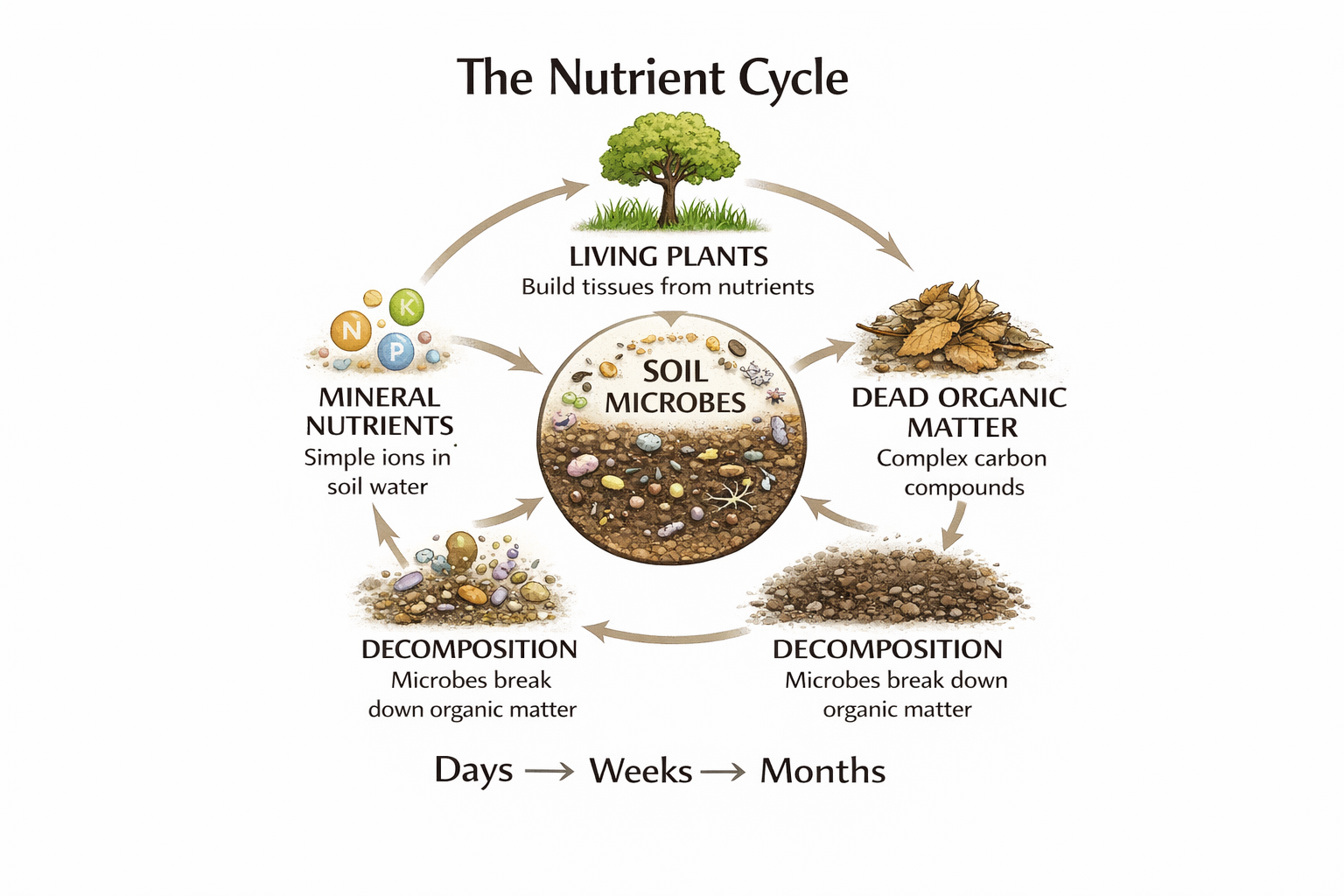
They cycle. Understanding these cycles reveals soil as what it really is: the recycling center of all terrestrial life.
Carbon: the energy cycle
Plants capture carbon dioxide from the air and build it into their tissues through photosynthesis.
When plants die, their carbon-rich bodies fall to the soil. Microbes decompose this material, and in the process, they respire.
They breathe out carbon dioxide, just like you do. Some of that carbon returns to the atmosphere.
But some becomes stable humus, locked away in soil for decades or even centuries.
Here’s a fact that surprises most people: soil holds more carbon than the atmosphere and all plant life combined.
The thin layer of dirt beneath your feet is one of Earth’s largest carbon reservoirs.
Nitrogen: the growth-limiting factor
Air is 78 percent nitrogen gas, but plants can’t use it in that form. Nitrogen gas is extremely stable. Its atoms are triple-bonded together and don’t react with much.
Only certain specialized bacteria can break that bond and convert atmospheric nitrogen into ammonia, a form plants can actually use. These nitrogen-fixing bacteria live either freely in soil or, more commonly, in nodules on the roots of legumes. Think of all the dal crops, beans, groundnuts, and clovers. Those little bumps on their roots contain bacteria doing work no plant can do alone.
Other bacteria then convert ammonia to nitrate, the nitrogen form most plants prefer. This is why rotating crops with legumes has been practiced for thousands of years. The legumes bring free nitrogen into the system. The following crop benefits from what the bacteria left behind.
Phosphorus: the hidden limit
Unlike carbon and nitrogen, phosphorus has no atmospheric form. All of it comes from rocks, released incredibly slowly through weathering.
In many tropical soils, phosphorus is the nutrient that limits growth.
Mycorrhizal fungi are crucial here. These fungi form partnerships with plant roots, extending far beyond where roots can reach.
Their tiny threads explore soil pores too small for root hairs, accessing phosphate that would otherwise be unavailable.
In exchange, the plant provides the fungus with sugars from photosynthesis. Neither could thrive alone.
Together, they solve a problem that’s been shaping ecosystems for 400 million years.
The practical implication
Chemical fertilizers bypass this microbial system. They provide nutrients directly to plants without feeding soil organisms.
This works in the short term. But over time, microbial communities decline. Soil structure degrades.
More fertilizer is needed for the same yield. Understanding the cycle explains why “feeding the soil, not just the plant” makes long-term sense.
Soil and Crop Matching
Rice requires standing water for much of its growth cycle. It needs soil that holds water, which means high clay content.
Remarkably, rice can tolerate the low-oxygen conditions of waterlogged soil that would kill most crops.
This is why rice dominates in Bengal, coastal Andhra Pradesh, and the Tamil Nadu deltas, all regions with heavy clay soils, high rainfall, and flat terrain that holds water.
Wheat needs well-drained soil. Its roots rot in waterlogged conditions. It also prefers cool winters and moderate water.
The loamy alluvial soils of Punjab, Haryana, and Uttar Pradesh hold enough moisture without waterlogging and have distinct cool seasons for wheat to mature.
Cotton develops a deep taproot that needs deep soil to penetrate. It tolerates some waterlogging but ultimately requires drainage.
The black cotton soil of the Deccan is ideal. It’s deep and clay-rich, but the dramatic shrink-swell cycles as it wets and dries actually help root penetration by creating natural channels.
Groundnut produces its pods underground. The pods need to push through soil to develop properly. Loose, sandy-loam soil allows this.
Heavy clay would crush the developing nuts. Gujarat and Andhra Pradesh have the lighter soils groundnut prefers.
Millets are the survivors. They tolerate drought and poor soil better than almost any other grain.
In Rajasthan and semi-arid Karnataka, where other crops fail, millets persist. Sandy soils with low water retention are not a problem for plants that evolved to expect very little.
Traditional agriculture developed these matches over centuries of observation. Farmers didn’t know the physics, but they knew what worked.
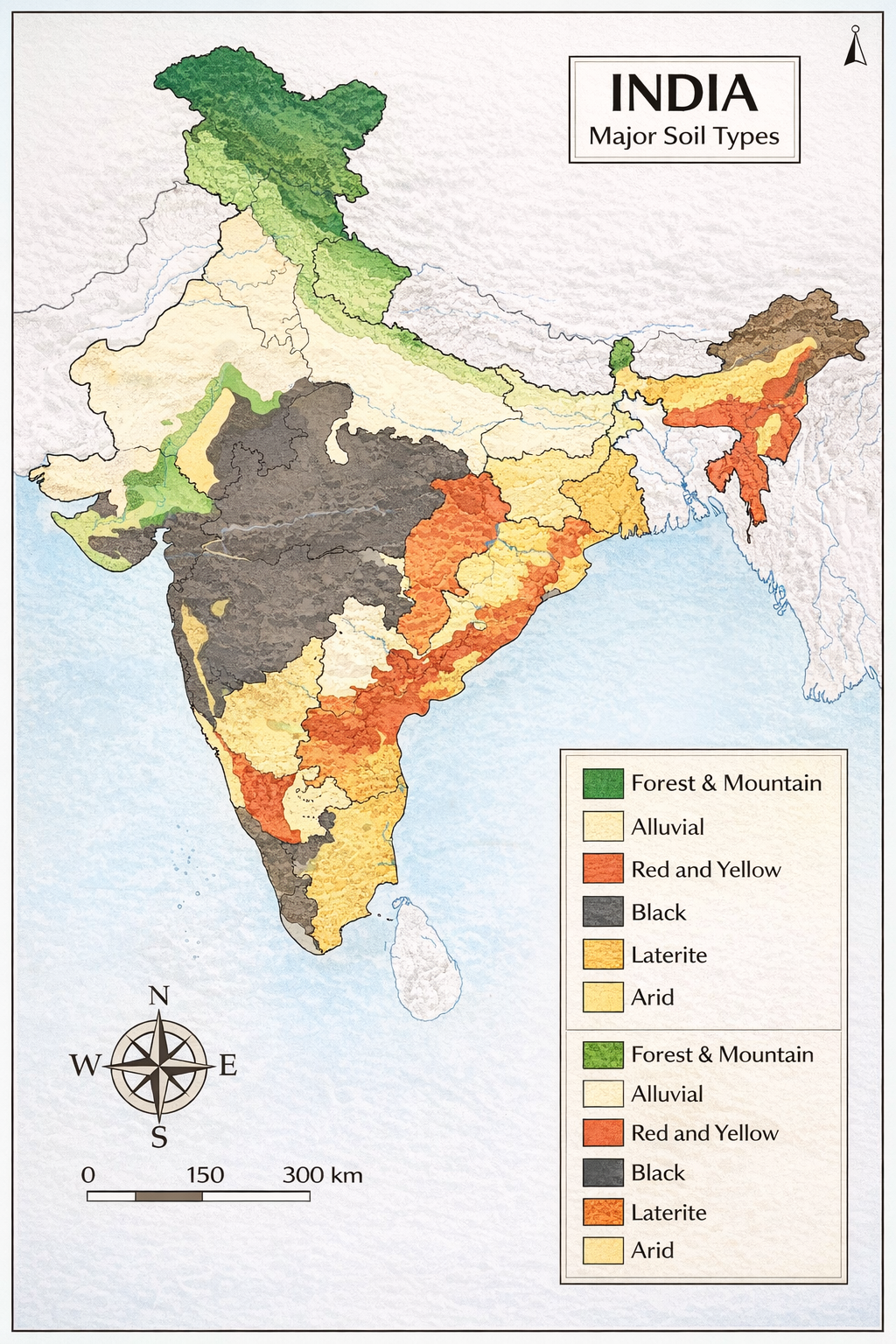
The science explains why. When we ignore these patterns, growing water-intensive crops in water-scarce regions or planting in mismatched soil types, we fight against physics. We usually lose.
When Soil Fails
Your textbook mentions erosion and pollution as threats to soil. It suggests planting trees. That’s good advice, but the full picture is more complex.
Erosion: the visible threat
Topsoil is the living layer. It’s also the layer that erodes first.
Water erosion happens every monsoon when slopes are bare. Rain hits exposed soil, dislodges particles, and carries them downhill. The Chambal ravines in central India are erosion in its extreme form. Centuries of topsoil loss carved deep gullies into the landscape.
Wind erosion affects drier regions. In Rajasthan, when vegetation is removed, topsoil literally blows away. Each dust storm carries the accumulated work of centuries.
The math is brutal: one centimeter of topsoil takes 500 to 1,000 years to form. It can wash away in a single storm. Once gone, it’s not coming back in any human timeframe.
Chemical degradation: the invisible threat
You can see erosion. Chemical damage is harder to spot until it’s severe.
Excessive fertilizers increase soil salinity. You might notice white crusts forming on the surface.
Pesticides kill soil organisms alongside their targets. The decomposition system slows. Organic matter stops cycling properly.
Industrial waste introduces heavy metals that accumulate over time.
Plastic persists for centuries. It blocks water movement, prevents root growth, and physically fragments into smaller pieces that spread through the soil profile.
The hidden crisis: microbial loss
This is the one almost nobody talks about. Intensive agriculture with heavy chemical inputs reduces microbial diversity.
Fewer species means fewer functions and less resilience. The soil becomes dependent on external inputs because its internal nutrient-cycling machinery is damaged.
This doesn’t show immediately. A farmer can maintain yields for years with increasing fertilizer applications. But underneath, the system is degrading.
Eventually, soil structure collapses. Water infiltration fails. The treadmill accelerates.
Punjab’s “green revolution” soils tell this story. Fifty years of intensive cultivation have left many fields with declining organic matter and increasing salinity.
Compare this to traditionally managed soils in parts of the Deccan that have remained productive for centuries.
Recovery is possible but slow
Adding organic matter, whether compost, crop residues, or cover crops, feeds microbial communities back to health.
Reducing tillage protects fungal networks that plowing destroys. Diversifying crops supports diverse soil communities.
But there’s no quick fix. Full recovery of severely degraded soil takes decades. Prevention is vastly easier than cure.
The Ground Beneath Our Feet
Let’s return to where we started: the smell of rain on dry soil.
That smell exists because soil is alive. Billions of organisms are cycling nutrients, building structure, making terrestrial life possible.
Every breath of petrichor is evidence of an invisible world working beneath the surface.
Your Class 7 textbook introduces soil as layers and particles and properties. That’s accurate but incomplete. It’s like describing a forest as “a collection of trees.” True, but missing the point.
Soil is a process. It’s weathering and decomposition and synthesis happening simultaneously, continuously, everywhere.
It’s a food web as complex as any jungle, just microscopic. It’s a carbon bank larger than the atmosphere. It’s a water filter, a nutrient recycler, and the foundation of every meal you’ve ever eaten.
When the textbook says soil “provides nutrients to plants,” it’s describing the end result of all this hidden activity. Now you know what’s behind those three words.
The handful of soil you walk over contains multitudes. Treat it accordingly.
Frequently Asked Questions
What is soil made of?
Soil is a mixture of mineral particles from weathered rock, organic matter from decomposed plant and animal remains, living organisms (bacteria, fungi, insects, worms), water, and air. The proportions vary by soil type and location.
Why is topsoil dark in color?
Topsoil is dark because it contains humus, a stable carbon-rich material formed when microbes decompose organic matter over many cycles. More humus means darker color and usually higher fertility.
What is the difference between sandy and clayey soil?
Sandy soil has large particles (0.05 to 2 mm) with large pore spaces, so water drains quickly and nutrients wash away easily. Clayey soil has microscopic particles (less than 0.002 mm) that pack tightly, holding water and nutrients but draining poorly.
Why do different crops need different soils?
Crops have evolved with different requirements for water, drainage, and nutrients. Rice tolerates waterlogging and needs clay that holds water. Groundnut needs loose soil so its underground pods can develop. Matching crop to soil type works with nature rather than against it.
How long does it take for soil to form?
Under natural conditions, it takes 500 to 1,000 years to form two to three centimeters of soil from rock. The exact time depends on climate, parent rock type, and biological activity. Soil is essentially a non-renewable resource on human timescales.
Can degraded soil recover?
Yes, but slowly. Adding organic matter, reducing tillage, and planting cover crops can rebuild soil health over years to decades. However, severely eroded soil has lost material that took centuries to accumulate. Prevention is far easier than restoration.