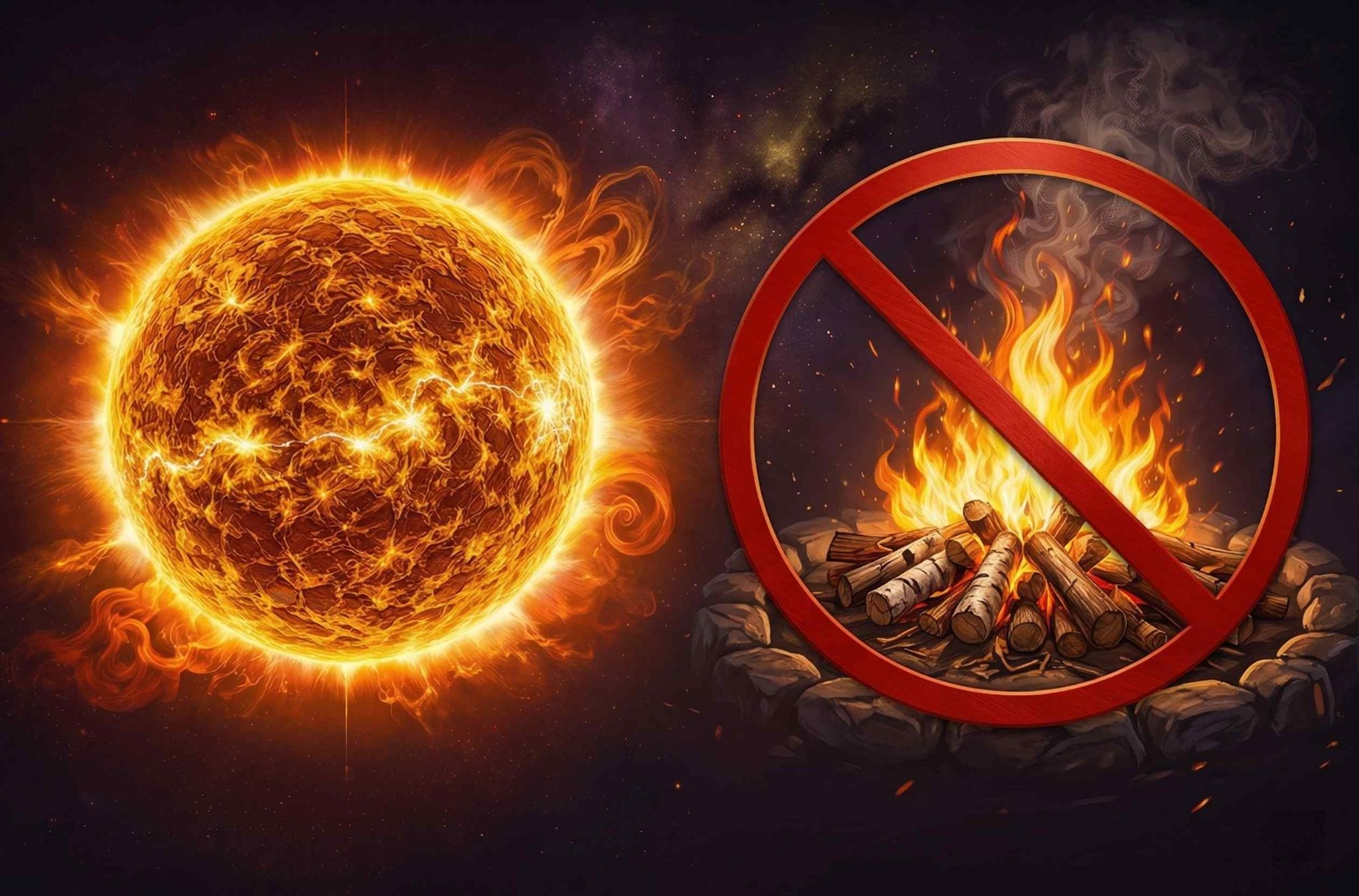
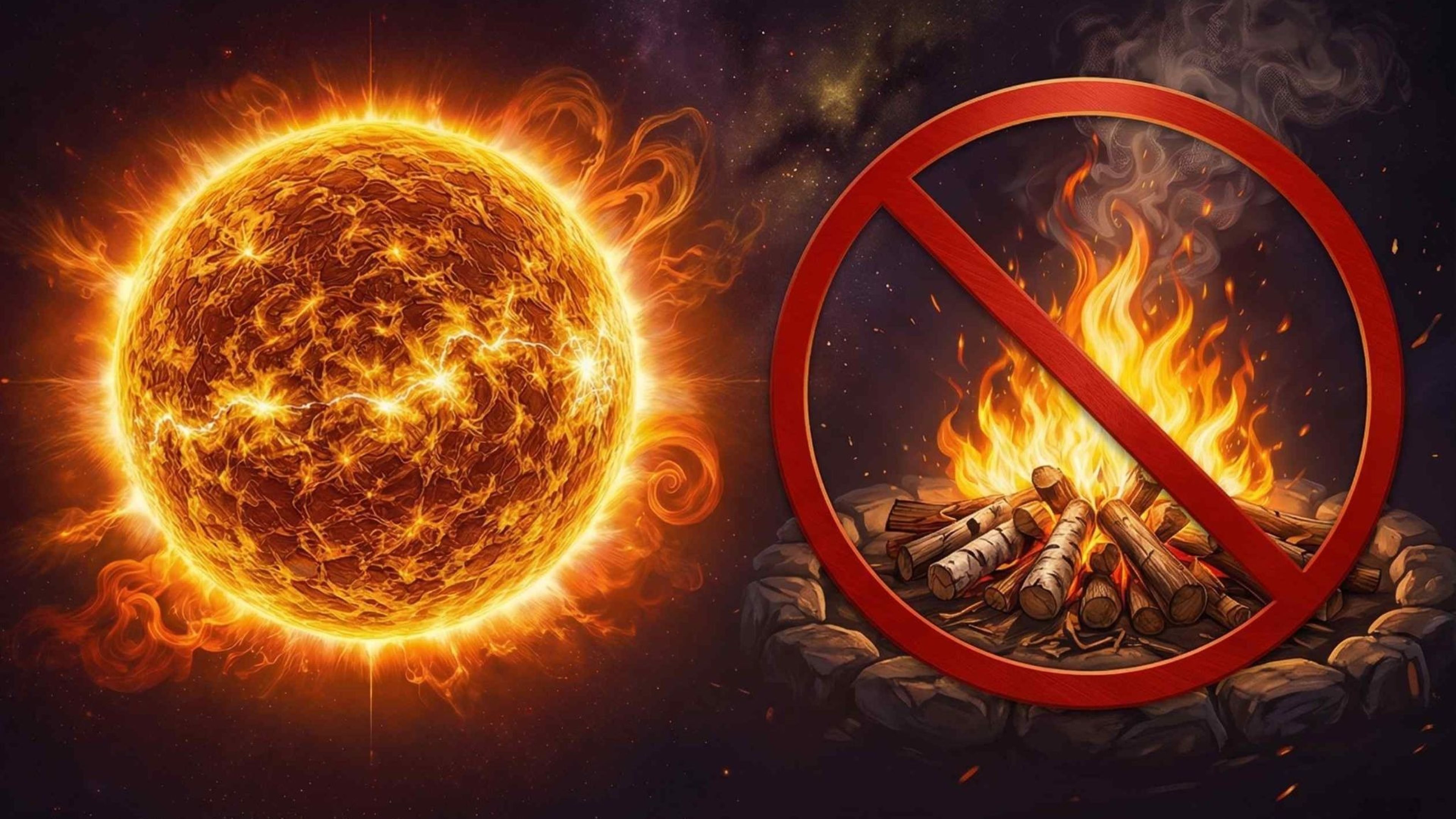
Every campfire you’ve ever watched eventually dies. If you deprive a fire of oxygen, the flames will disappear within seconds.
Yet 150 million kilometers away, the Sun has been blazing for 4.6 billion years in the airless vacuum of space. If fire requires oxygen to burn, how does the Sun burn without it?
The answer transforms everything you thought you knew about fire: the Sun isn’t burning at all.
The Sun doesn’t burn in the same manner as a candle, a forest fire, or your gas stove. Nuclear fusion, which doesn’t need any oxygen at all, is how the Sun makes all of its energy.
Deep in the Sun’s core, hydrogen nuclei smash together under crushing pressure to form helium, converting a tiny fraction of their mass directly into energy. This thermonuclear reaction powers every beam of sunlight that reaches Earth.
In this article, we’ll explore why calling the Sun’s energy production “burning” is technically a misnomer, examine the elegant physics of fusion, and understand why our star can shine for billions of years without a single molecule of oxygen.
The Misconception: Why the Sun Is Not a Giant Campfire
To understand why the Sun doesn’t need oxygen, we first need to understand what actually happens when something burns on Earth. Combustion is a chemical reaction.
When wood catches fire, the carbon and hydrogen atoms react with oxygen molecules in the air.
Chemical bonds break and reform, releasing heat and light as byproducts. The reaction produces carbon dioxide, water vapor, and ash.
This process has an absolute requirement: oxygen. On Earth, fire needs roughly 16% oxygen concentration to sustain itself.
Remove the oxygen, and combustion stops immediately. This is why smothering a fire with a blanket or foam extinguisher works, as you’re cutting off the oxygen supply.
Space presents a fundamental problem for combustion. The vacuum between planets contains virtually no free oxygen.
The few scattered atoms that do exist are so dispersed that chemical burning becomes impossible. If the Sun relied on combustion, it would have flickered out before Earth even formed.
Here’s what the Sun is actually made of: approximately 91% hydrogen and 8.9% helium, by number of atoms.
The remaining fraction of less than 1% consists of heavier elements like oxygen, carbon, nitrogen, and traces of metals.
Yes, the Sun does contain some oxygen atoms, but they play absolutely no role in energy production.
They’re simply passengers in the solar plasma, products of nuclear reactions in stars that existed and died before our Sun was born.
When we refer to the Sun as “burning” hydrogen, we are relying on a metaphor that predates our understanding of stellar physics.
NASA itself clarifies this directly: the Sun does not burn like logs in a fire. People say it burns hydrogen, but hydrogen really doesn’t burn in the Sun; it fuses into helium. No oxygen is required.
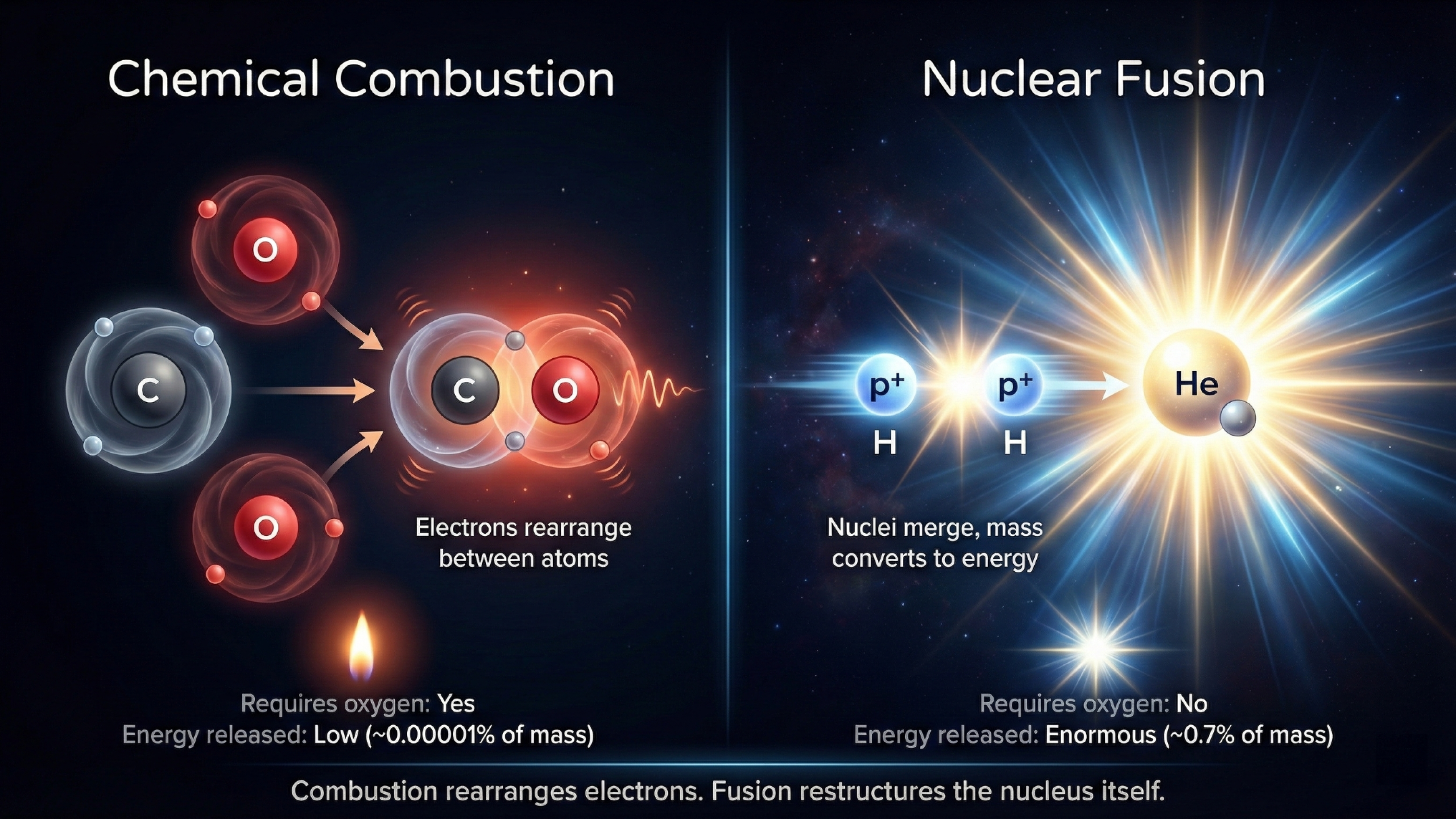
The fundamental distinction:
| Aspect | Combustion (Fire) | Fusion (Sun) |
| Type of reaction | Chemical (electron bonds) | Nuclear (proton/neutron bonds) |
| Requires oxygen | Yes, absolutely | No |
| Fuel consumed | Carbon compounds + O₂ | Hydrogen nuclei only |
| Where it occurs | In molecules at surface temperatures | In atomic nuclei at millions of degrees |
| Energy source | Breaking/forming electron bonds | Converting mass to energy (E=mc²) |
So if the Sun isn’t burning, what exactly is happening inside it? The answer lies in understanding the Sun’s structure and the extreme conditions at its core.
Inside the Sun’s Structure: Where Fusion Actually Happens
The Sun isn’t uniform. Like an onion, it has distinct layers, each with different properties and functions. Understanding this structure reveals why fusion can only occur in one specific region.
The core occupies roughly the innermost 20-25% of the Sun’s radius. This area is the only place where conditions are extreme enough for fusion.
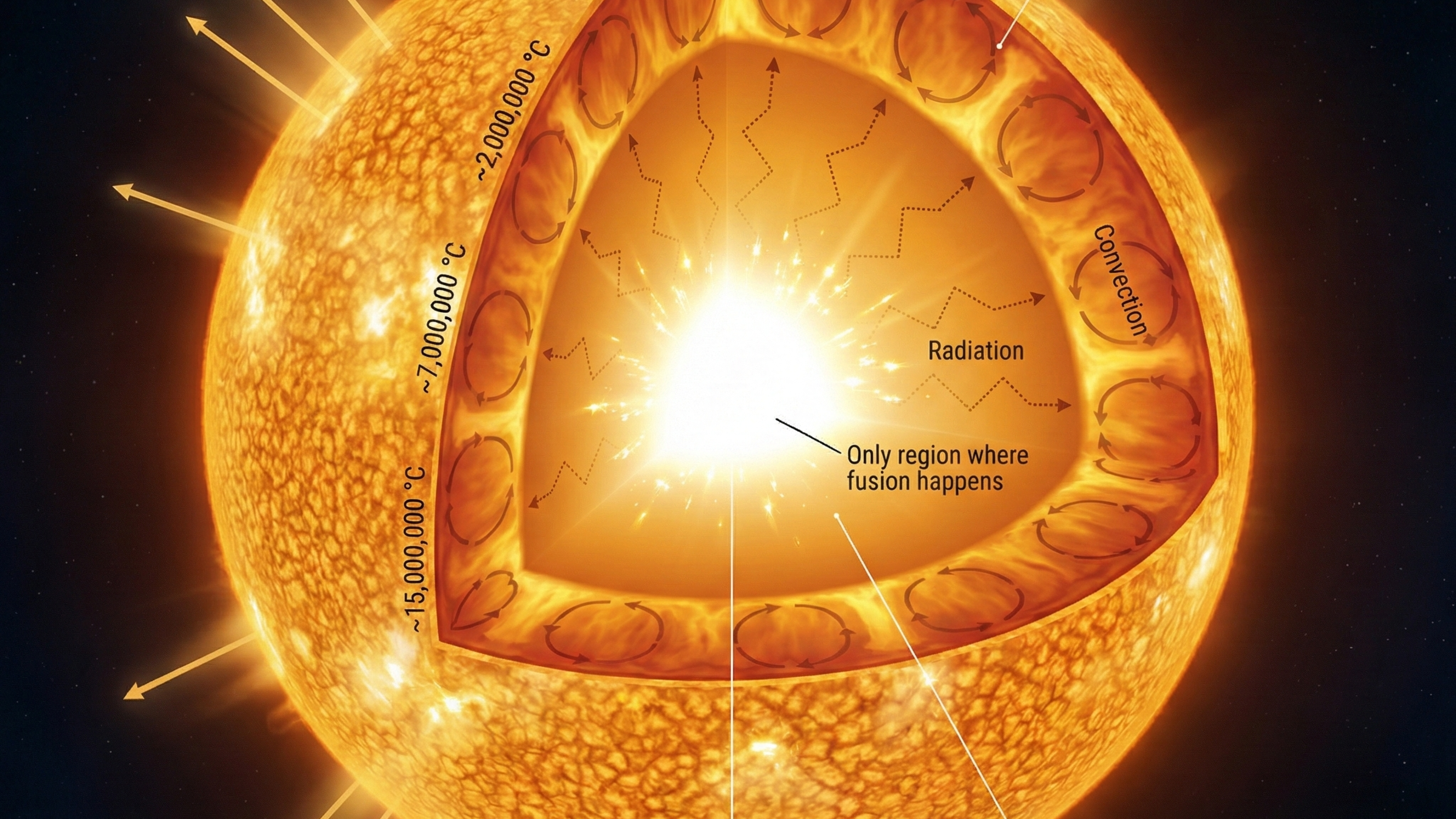
The temperature here reaches approximately 15 million degrees Celsius. The pressure exceeds 250 billion atmospheres; that’s 250 billion times the air pressure at Earth’s surface.
Under these conditions, matter exists as plasma: atoms are completely ionized, with electrons stripped away from nuclei.
Chemistry as we know it doesn’t exist here. There are no molecules, no chemical bonds, no possibility of combustion. Only nuclear physics operates.
Surrounding the core is the radiative zone, extending to about 70% of the Sun’s radius. Energy from core fusion travels through this region primarily as radiation, photons bouncing between particles in a slow random walk outward.
A single photon generated in the core may take 100,000 years to traverse this zone, being absorbed and re-emitted countless times by the dense plasma.
The outer 30% of the Sun’s interior forms the convective zone. Here, energy transport switches to convection: hot plasma rises toward the surface, cools, and sinks back down, like water circulating in a boiling pot. This churning motion carries energy efficiently to the surface.
Finally, the photosphere is what we see as the Sun’s surface, a relatively thin layer at about 5,500°C from which sunlight escapes into space.
The granular appearance of the Sun’s surface reflects those convective cells bubbling up from below.
The critical point: fusion only happens in the core. The rest of the Sun is essentially an elaborate energy-transport system, moving the energy generated by nuclear reactions outward to space.
In the core of the Sun, there is no free oxygen present, and none is required for the fusion process.
Nuclear Fusion: The Sun’s True Engine
Nuclear fusion is the process of combining light atomic nuclei to form heavier ones. When this happens, the resulting nucleus weighs slightly less than the sum of its parts.
That missing mass doesn’t disappear; it converts directly into energy according to Einstein’s famous equation, E=mc². Because the speed of light (c) is enormous, even tiny amounts of mass yield tremendous energy.
The U.S. Department of Energy explains it this way: in a fusion reaction, two light nuclei merge to form a single heavier nucleus. The process releases energy because the total mass of the resulting nucleus is less than the mass of the two original nuclei. The leftover mass becomes energy.
In the Sun, the primary fusion process transforms hydrogen into helium. But this doesn’t happen in a single step.
The dominant reaction sequence in stars like our Sun is called the proton-proton chain, and understanding it reveals the elegant physics that keeps our star shining.
The Proton-Proton Chain: Step by Step
The proton-proton chain converts four hydrogen nuclei (protons) into one helium nucleus through a series of intermediate steps. Each step releases energy, and the overall process powers the Sun’s tremendous output.
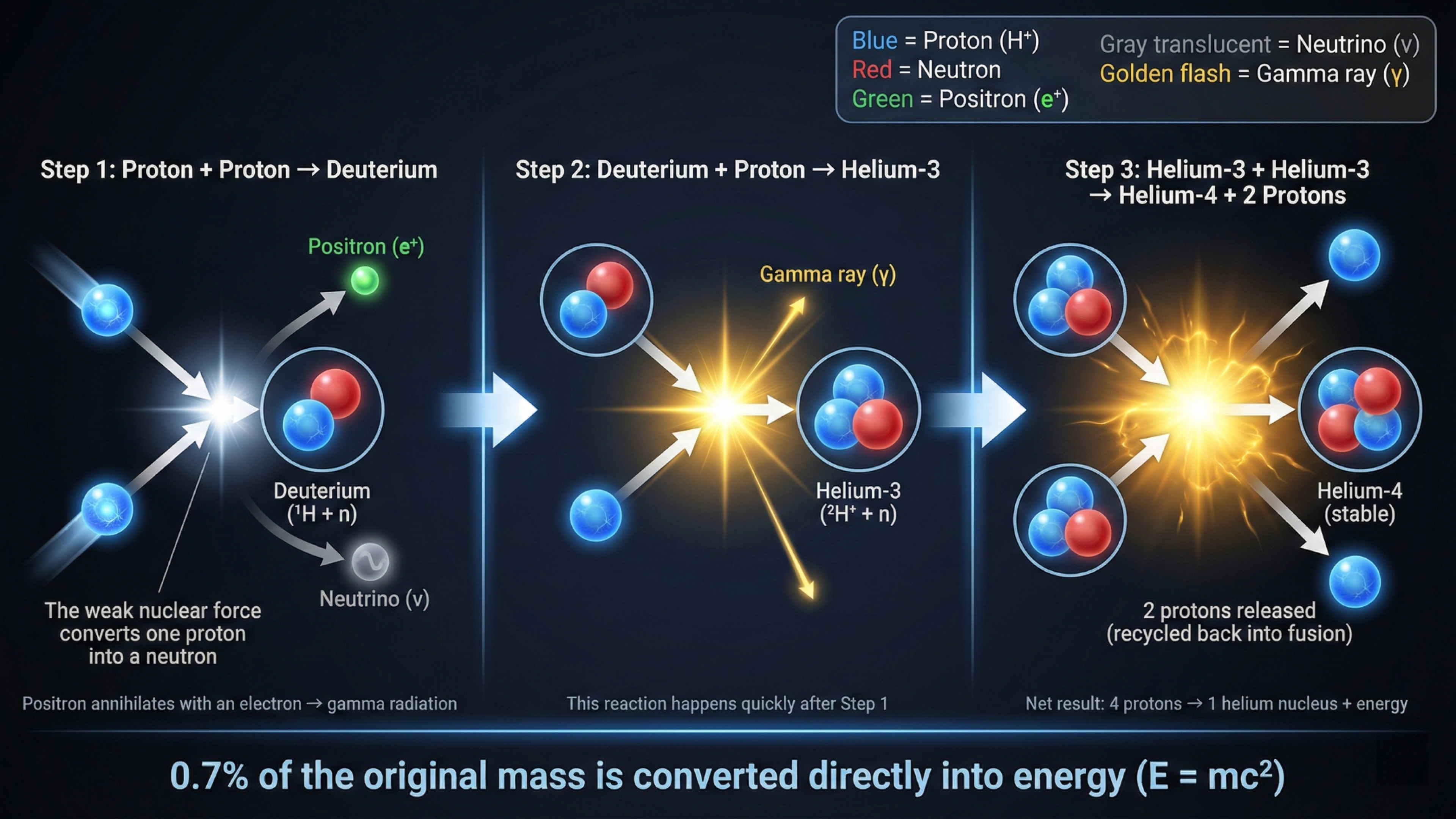
Step 1: Proton + Proton → Deuterium
Two protons collide at extreme speed. Normally, protons repel each other,they’re both positively charged, and like charges push apart. But at 15 million degrees, some protons move fast enough that a phenomenon called quantum tunneling allows them to get close enough for the strong nuclear force to grab hold. When this happens, one proton converts to a neutron (via the weak nuclear force), and the two particles bind together as deuterium (one proton + one neutron). This reaction also releases a positron and a neutrino. The positron immediately annihilates with an electron, producing gamma radiation.
Step 2: Deuterium + Proton → Helium-3
The deuterium nucleus quickly captures another proton, forming helium-3 (two protons + one neutron). This reaction releases a gamma ray photon carrying significant energy.
Step 3: Helium-3 + Helium-3 → Helium-4 + 2 Protons
Finally, two helium-3 nuclei collide and fuse into a stable helium-4 nucleus (two protons + two neutrons). Two excess protons are released back into the plasma, available to start new fusion chains. This step also releases energy.
The net result: four protons become one helium-4 nucleus, plus energy carriers (photons, positrons, neutrinos). About 0.7% of the original mass converts to energy in each complete chain.
The Numbers Are Staggering
Every second, the Sun fuses approximately 600 million tons of hydrogen into 596 million tons of helium. The missing 4 million tons becomes pure energy,roughly 3.8 × 10²⁶ watts of power radiating into space. This has continued for 4.6 billion years and will continue for about 5 billion more.
For perspective: fusing just one kilogram of hydrogen into helium releases energy equivalent to burning approximately 20,000 metric tons of coal. Fusion is millions of times more energy-dense than any chemical reaction. This extraordinary efficiency explains how the Sun can shine for billions of years without exhausting its fuel.
The Quantum Secret: How Tunneling Makes Fusion Possible
Here’s a puzzle that troubled physicists in the early 20th century: the Sun’s core, at 15 million degrees, shouldn’t actually be hot enough for fusion.
Classical physics calculations showed that protons at this temperature don’t have enough kinetic energy to overcome their mutual electrical repulsion.
They should bounce off each other, never getting close enough for the strong nuclear force to bind them.
Yet clearly, the Sun does fuse hydrogen. How?
The answer lies in quantum tunneling, one of the strangest predictions of quantum mechanics. At the subatomic scale, particles don’t behave like tiny billiard balls.
They exhibit wave-like properties, and their positions aren’t precisely defined. This wave nature means there’s a small but non-zero probability that a particle can “tunnel” through an energy barrier it classically couldn’t overcome.
Think of it this way: imagine two protons separated by an energy “hill” of electromagnetic repulsion.
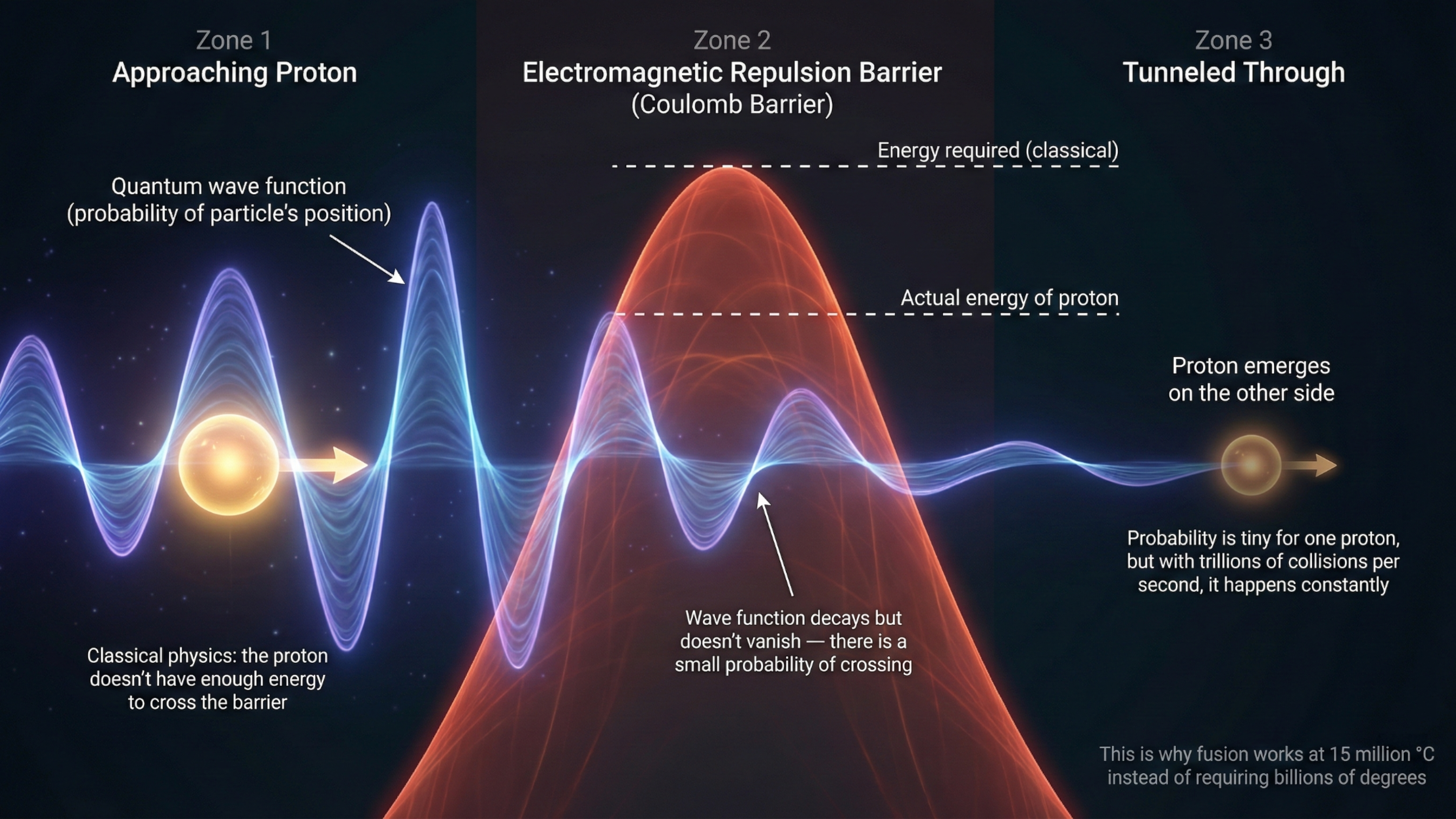
Classical physics says they need enough speed to climb over that hill.
Quantum mechanics says there’s a chance,small, but real,that they can simply appear on the other side without ever having the energy to cross the peak.
This probability is tiny for any individual proton pair. But the Sun’s core contains an astronomical number of protons, all colliding constantly at tremendous speeds.
Enough tunneling events occur every second to sustain the Sun’s fusion output.
Quantum tunneling also explains something important about stellar stability. Because tunneling is rare, fusion proceeds relatively slowly.
A given proton in the Sun’s core might wait billions of years before successfully fusing. This sounds like a problem, but it’s actually a feature.
If fusion happened too easily, stars would burn through their fuel rapidly and explode. The low tunneling probability ensures that fusion is gradual and controlled, allowing the Sun to shine steadily for billions of years rather than consuming itself in a thermonuclear flash.
This balance is exquisite: gravity compresses and heats the core just enough for tunneling to enable fusion, but not so much that reactions run away.
The result is the steady, reliable energy source that has illuminated Earth for eons.
Fusion vs. Combustion: A Complete Comparison
To fully appreciate why the Sun needs no oxygen, let’s compare fusion and combustion across every relevant dimension:
| Aspect | Combustion | Fusion |
| Fuel | Carbon compounds + oxygen | Hydrogen nuclei only |
| Requires oxygen | Yes,absolutely essential | No,operates in vacuum |
| Reaction type | Chemical (electron rearrangement) | Nuclear (nucleon rearrangement) |
| Temperature required | Hundreds of degrees Celsius | Millions of degrees Celsius |
| Pressure required | Normal atmospheric | Billions of atmospheres |
| Energy per kg of fuel | ~30 million joules (coal) | ~600 trillion joules (hydrogen) |
| Efficiency | ~0.00001% mass-to-energy | ~0.7% mass-to-energy |
| Byproducts | CO₂, H₂O, ash, pollution | Helium, neutrinos, photons |
| Duration | Minutes to years | Millions to billions of years |
The energy comparison deserves emphasis. One kilogram of hydrogen undergoing fusion releases roughly 20 million times more energy than burning one kilogram of coal.
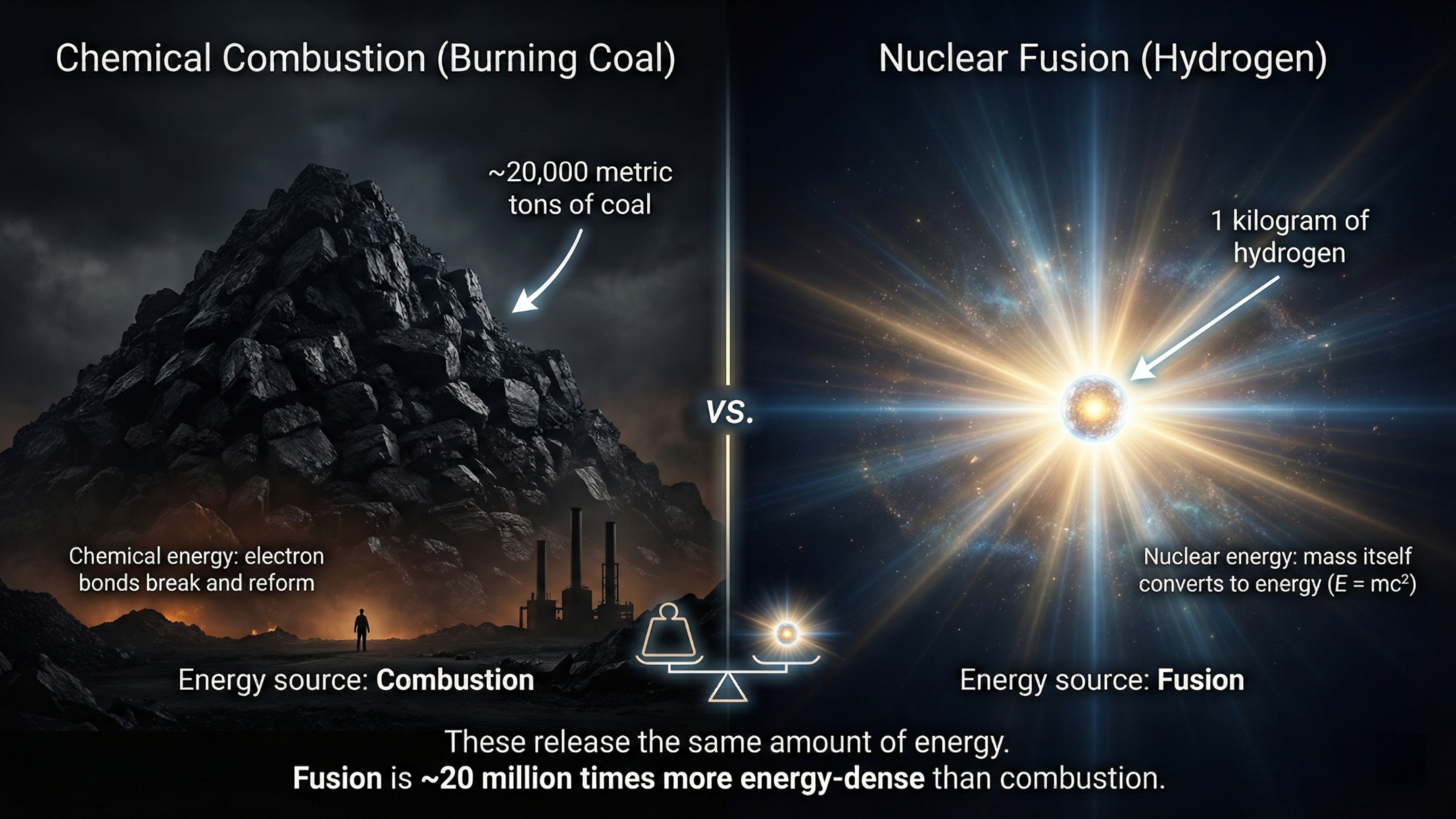
This isn’t a modest difference,it’s the difference between a match and a nuclear weapon. Fusion taps into the binding energy of atomic nuclei, a far deeper energy reservoir than the electron bonds that chemical reactions manipulate.
This energy density explains why the Sun, despite consuming 600 million tons of hydrogen every second, has enough fuel to last billions of years. The Sun’s mass is about 2 × 10³⁰ kilograms. Even burning fuel at this prodigious rate, it has plenty to spare.
The Sun’s Life Cycle: From Birth to White Dwarf
Understanding how the Sun burns without oxygen also means understanding what happens when the hydrogen fuel eventually runs low.
The Sun won’t “run out of oxygen”,there’s none involved,but it will eventually exhaust its core hydrogen supply.
4.6 billion years ago , Birth: The Sun formed from a collapsing cloud of gas and dust. As gravity compressed the cloud, the core heated until hydrogen fusion ignited.
The Sun became a main sequence star, balancing gravitational compression against outward radiation pressure.
Present day , Mid-life stability: The Sun is approximately halfway through its main sequence lifetime.
It steadily converts core hydrogen to helium, growing slightly brighter over time (about 10% more luminous per billion years). Currently, it has consumed roughly half its original core hydrogen.
This phase is remarkably stable,the outward pressure from fusion precisely balances gravity’s inward pull, maintaining the Sun’s size and output for millions of years at a stretch.
Approximately about 5 billion years from now , Red giant phase: When core hydrogen runs low, fusion pressure drops and the core contracts under gravity. This contraction heats the core further, and a shell of hydrogen around the core ignites in fusion.
The increased energy output pushes the Sun’s outer layers outward dramatically. The Sun will swell into a red giant, expanding perhaps to 100 times its current diameter. Mercury and Venus will be engulfed; Earth may be consumed or at minimum baked to sterility.
The core will eventually reach temperatures around 100 million degrees, hot enough to fuse helium into carbon.
About 6-7 billion years from now , Planetary nebula and white dwarf: After exhausting helium fuel, the Sun will shed its outer layers as a glowing shell called a planetary nebula.
The remaining core,now composed of carbon and oxygen (the ash of helium fusion),will collapse into a white dwarf: an Earth-sized stellar remnant of extraordinary density.
With no fusion to sustain it, the white dwarf will simply cool and fade over trillions of years.
Throughout this entire evolution, from birth to white dwarf, the Sun never relies on oxygen for energy. Its “burning” is always nuclear, never chemical. When we say the Sun will “burn out,” we mean it will exhaust its nuclear fuel,first hydrogen, then helium,not that it will run out of oxygen.
Indian Contributions to Solar Science
India’s connection to understanding how stars shine runs deep, both historically and in contemporary research.
Meghnad Saha (1893-1956) stands as one of the most significant contributors to stellar physics. In 1920, Saha derived the ionization equation that bears his name,a mathematical relationship describing how atoms in a gas become ionized at different temperatures and pressures.
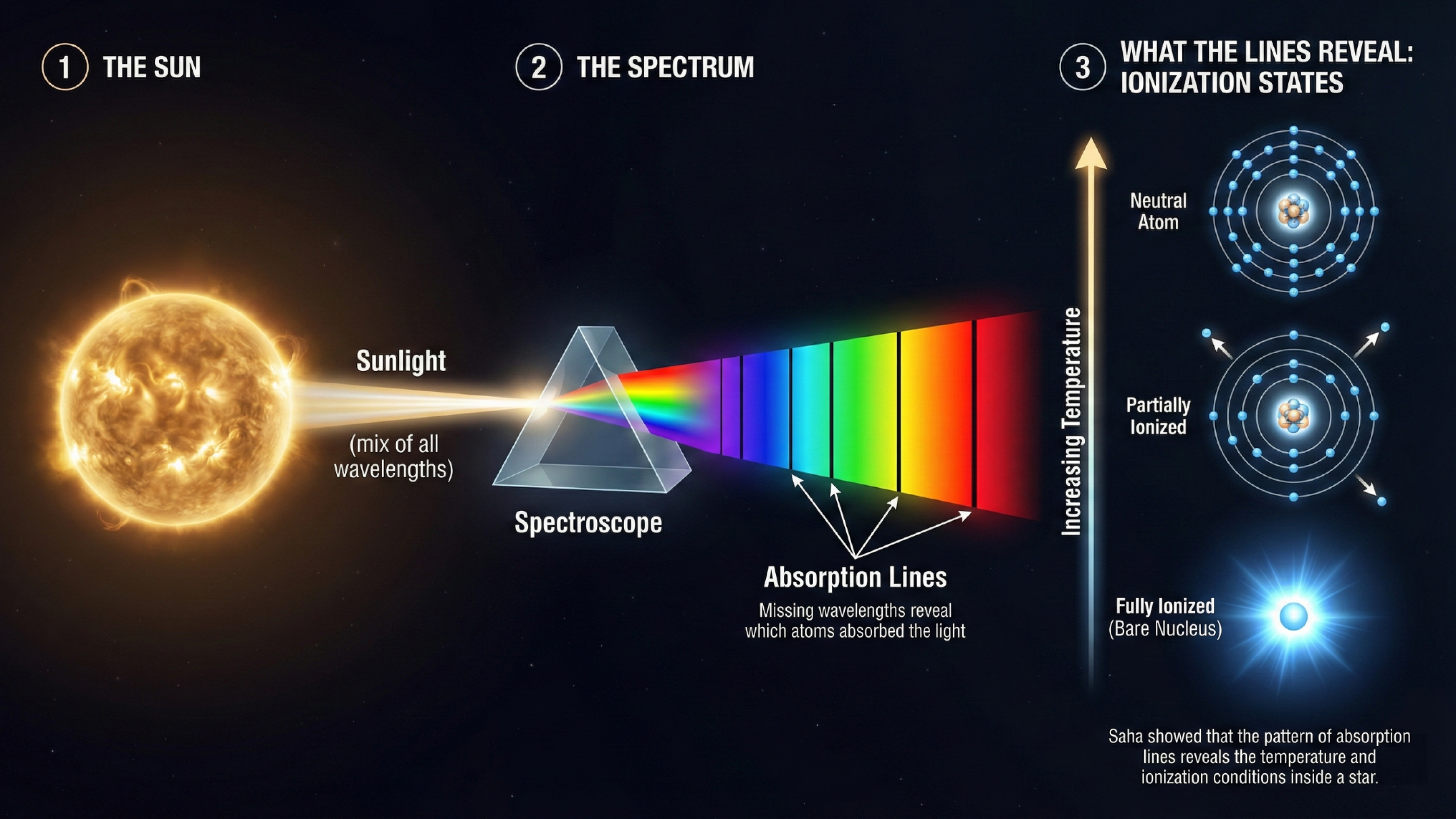
This equation allowed astronomers to determine stellar temperatures by analysing spectral lines.
Saha’s work revealed that the Sun’s surface temperature could be inferred from its spectrum, and that the interior must reach millions of degrees to produce the observed ionization states,laying groundwork for understanding that stellar interiors are hot enough for nuclear reactions.
Subrahmanyan Chandrasekhar, the Indian astrophysicist, contributed the theory of white dwarfs and the Chandrasekhar limit,the maximum mass a white dwarf can have before collapsing further.
This directly connects to what happens after stars like the Sun exhaust their fusion fuel.
Today, India actively studies the Sun through the Aditya-L1 mission, launched by ISRO in 2023. Positioned at the Sun-Earth Lagrange point L1, this spacecraft studies the solar corona, solar wind, and space weather effects,expanding our understanding of how solar activity affects Earth.
On the practical front, India has become a global leader in solar power deployment, with over 50 gigawatts of installed capacity by 2022.
Every solar panel harvests photons that began as gamma rays in the Sun’s fusion core.
Understanding that solar output is stable over human timescales,because it’s powered by fusion, not combustion,provides confidence in solar energy as a reliable long-term resource.
Frequently Asked Questions
Could we put out the Sun by removing oxygen?
No. Since the Sun’s energy comes from nuclear fusion rather than combustion, removing oxygen would have no effect whatsoever. There’s virtually no free oxygen in the Sun’s core anyway, and the oxygen atoms present in the Sun play no role in energy production. You cannot smother a nuclear reaction the way you smother a chemical fire. The only way the Sun’s fusion will stop is when it exhausts its hydrogen fuel,roughly 5 billion years from now.
Will the Sun ever run out of fuel?
Yes, but not for about 5 billion years. The Sun will eventually exhaust the hydrogen in its core. When this happens, it won’t simply go dark,it will expand into a red giant, fuse helium for a time, then shed its outer layers and collapse into a white dwarf. The process is gradual, driven by nuclear physics rather than sudden fuel depletion.
How do rockets burn fuel in space if there’s no oxygen?
Rockets carry their own oxidiser. Unlike the Sun (which doesn’t need oxidiser at all), chemical rockets require oxygen or another oxidising agent to combust their fuel. The Space Shuttle, for instance, carried liquid oxygen alongside liquid hydrogen. This self-contained oxidiser supply enables combustion in the vacuum of space. The Sun operates on entirely different physics,nuclear fusion,and requires no oxidiser.
How do we know the Sun uses fusion and not something else?
Multiple lines of evidence confirm the fusion model. First, we detect neutrinos from the Sun,ghostly particles produced specifically by fusion reactions in the core. The Homestake experiment first detected solar neutrinos in the 1960s, and subsequent experiments have matched predictions from fusion models. Second, helioseismology (studying sound waves that travel through the Sun) reveals internal temperature and density profiles consistent with a fusion-powered core. Third, no other known process could produce the Sun’s enormous energy output sustained over billions of years,gravitational contraction, for instance, would only power the Sun for about 20 million years, far shorter than Earth’s geological age.
What happens when the Sun’s hydrogen runs out?
When core hydrogen is depleted, the core contracts and heats up while hydrogen fusion continues in a shell around it. This causes the Sun to expand into a red giant. Eventually, the core becomes hot enough (~100 million °C) to fuse helium into carbon. After helium exhaustion, the Sun lacks sufficient mass to fuse heavier elements. It will shed its outer layers as a planetary nebula, leaving behind a white dwarf that gradually cools over trillions of years.
Why can’t we see the fusion happening?
We can’t directly observe the Sun’s core because it’s buried beneath hundreds of thousands of kilometres of plasma. Light generated by fusion in the core is absorbed and re-emitted countless times as it travels outward, taking roughly 100,000 years to reach the surface. By the time energy escapes as visible sunlight, it carries no direct visual signature of the fusion process. However, we can detect neutrinos, which pass through the Sun almost unimpeded, providing a direct window into core fusion. We also infer core conditions through helioseismology,essentially using the Sun’s natural vibrations as a diagnostic tool.
Why Understanding This Matters
Knowing that the Sun shines through fusion rather than combustion has practical implications beyond academic curiosity.
Energy reliability: The Sun won’t suddenly fail because it “ran out of air.” Fusion-powered, it will shine steadily for billions of years, making solar energy a dependable resource. Engineers designing solar power systems can count on consistent solar output,variations come from surface activity cycles, not fuel concerns.
Fusion energy research: Understanding stellar fusion inspires efforts to replicate the process on Earth. Projects like ITER aim to achieve controlled fusion, potentially offering a nearly limitless clean energy source. The physics of stellar fusion directly informs these engineering challenges.
Origin of elements: Stellar fusion created the heavier elements that make up our world. The oxygen we breathe, the carbon in our bodies,all were forged in stars through nuclear processes. Understanding stellar fusion is understanding our cosmic origins.
Conclusion
The Sun does not burn. Not in any conventional sense of the word. What we call “burning” is actually nuclear fusion,hydrogen nuclei combining into helium under temperatures and pressures so extreme that chemistry ceases to exist and only nuclear physics remains. No oxygen participates. No chemical combustion occurs.
This distinction transforms a puzzling question into an elegant answer. How does the Sun burn without oxygen in the vacuum of space? It doesn’t burn at all. Instead, deep in its core, mass itself converts into energy according to E=mc², releasing enough power to illuminate an entire solar system for billions of years.
Every sunrise you witness, every plant that photosynthesises, every solar panel that generates electricity,all trace back to thermonuclear reactions 150 million kilometres away, where the answer to how the Sun burns without oxygen turns out to be beautifully simple: it doesn’t need to burn at all. The Sun fuses. And in that fusion lies one of nature’s most elegant solutions to powering a star.