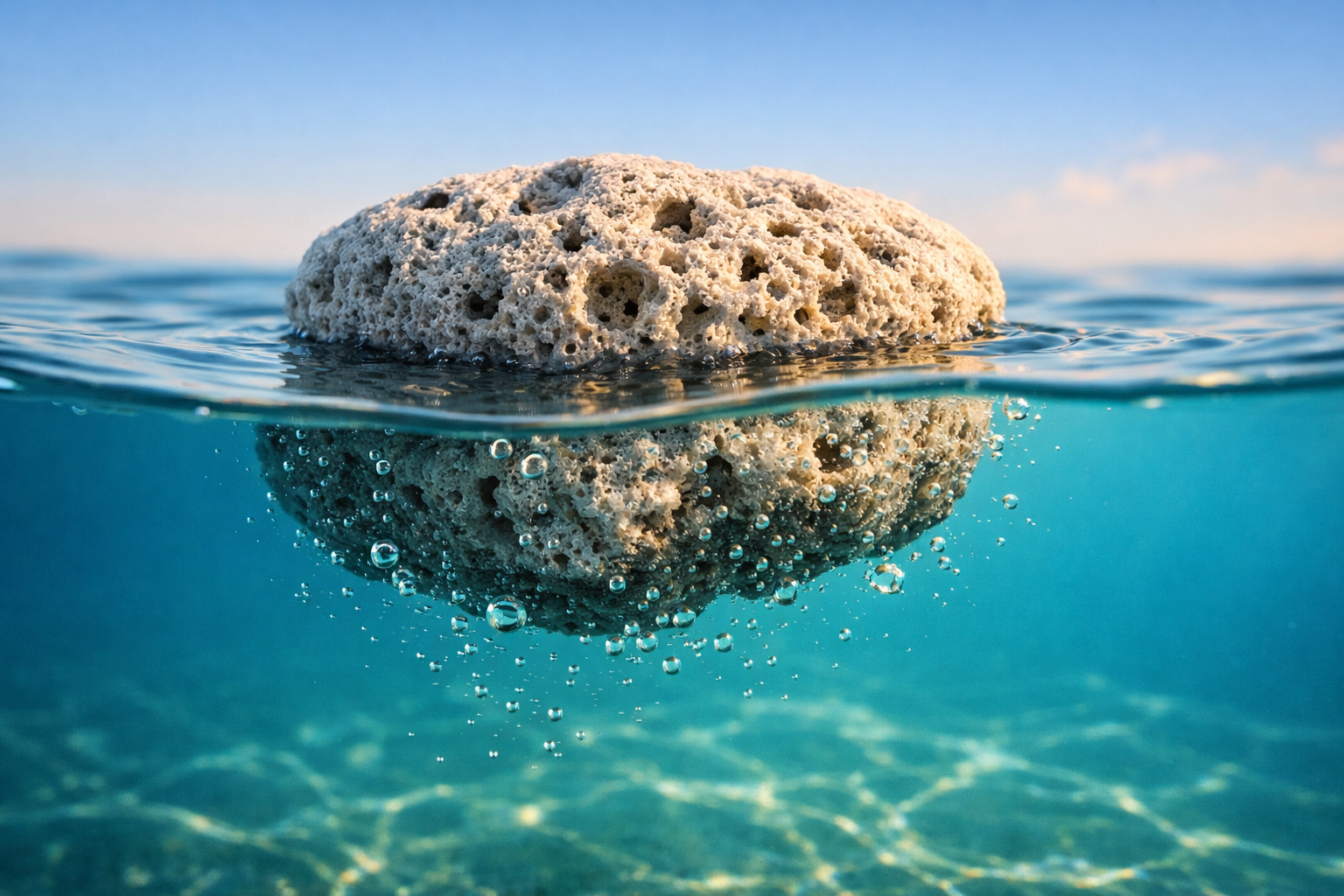
Floating rocks (pumice) sound impossible. We grow up knowing that rocks sink. Throw a pebble into a pond, and down it goes. No exceptions.
Except there are exceptions.
In 2012, an underwater volcano near New Zealand erupted. The eruption sent billions of pumice fragments to the ocean surface. These grey, rough stones didn’t sink. They floated.
Not for minutes. Not for hours. For months.
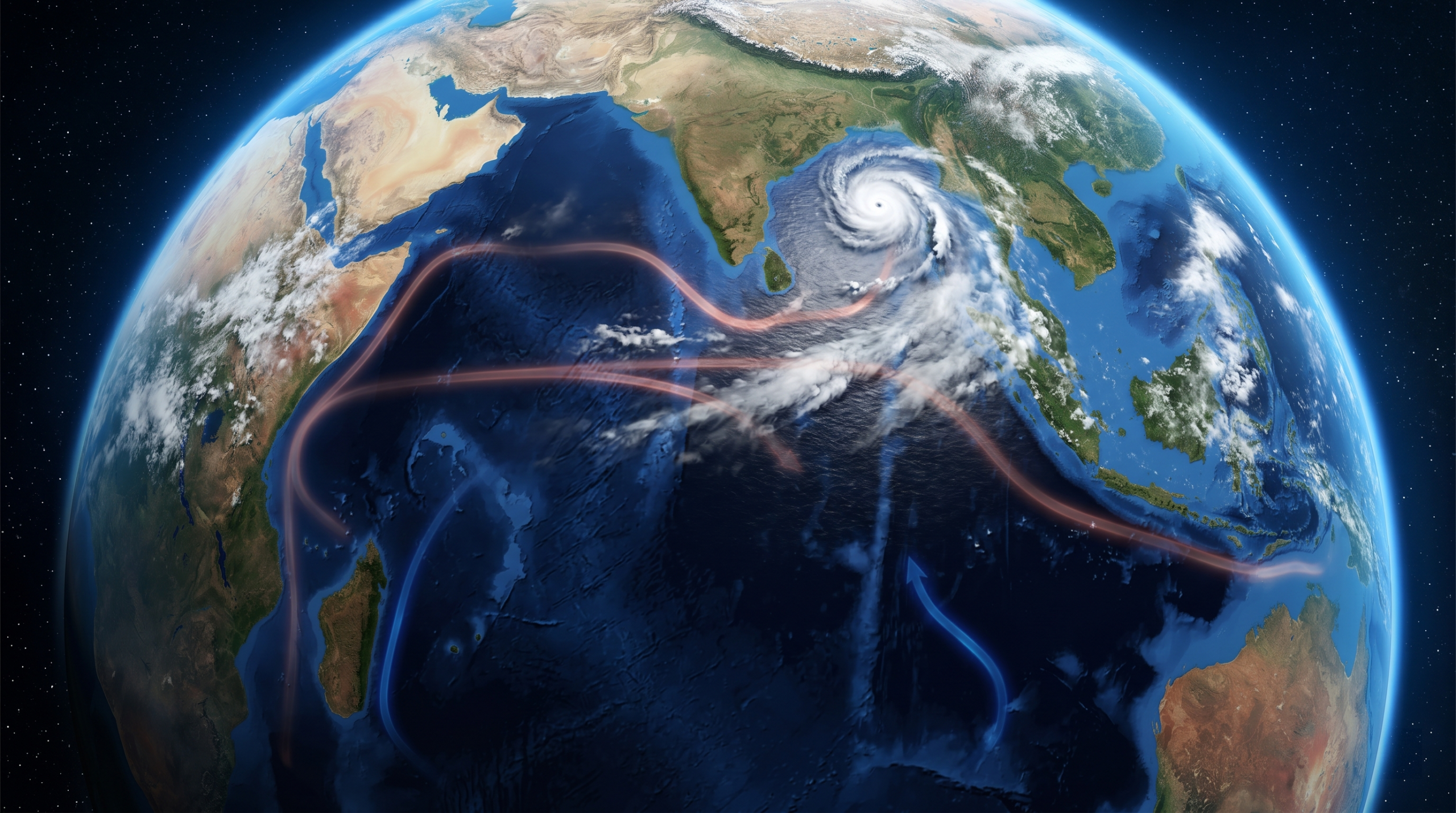
Satellite images show a pumice raft covering 550,000 square kilometres. That’s larger than Spain. Sailors reported navigating through seas of floating stone.
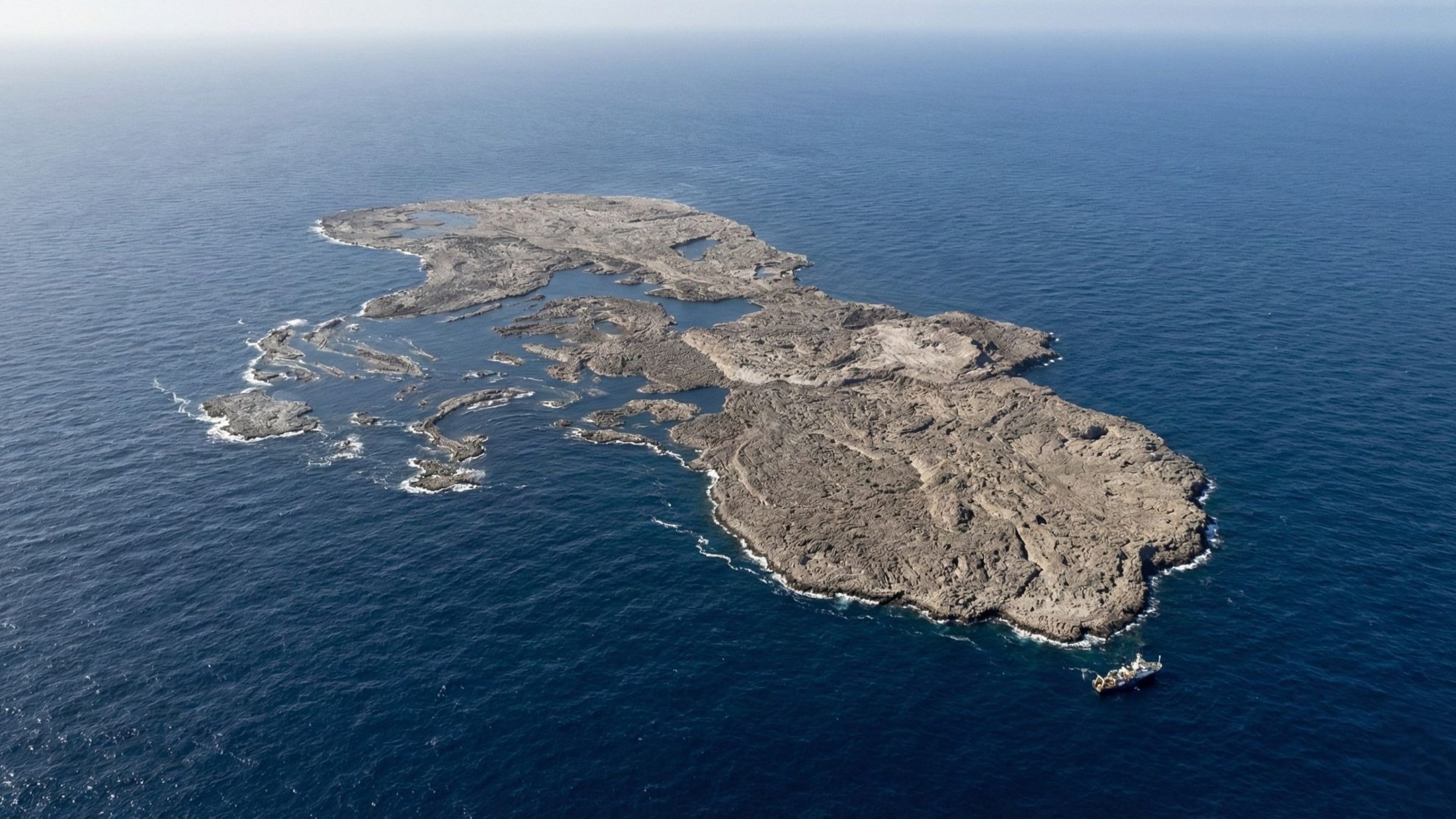
The raft drifted across the Pacific for over a year. The voyage wasn’t a trick. It wasn’t an illusion. It was physics.
But physics requires us to think carefully. We need to understand what “density” really means.
We need to follow water as it enters a labyrinth of tiny air pockets. We need to watch the air slowly dissolve and escape.
By the end of this article, you’ll understand why pumice floats. More importantly, you’ll understand why it keeps floating for so long.
The answer involves volcanoes, surface tension, and molecular diffusion.
Let’s begin with the simplest question: what determines whether something floats or sinks?
Density, Not Weight, Decides Whether Things Float
Here’s a fact that trips people up: weight doesn’t determine floating.
A massive steel cargo ship floats. A tiny steel ball sinks. The ship weighs thousands of tonnes. The ball weighs grams.
Yet the ball sinks and the ship floats. The difference is density.
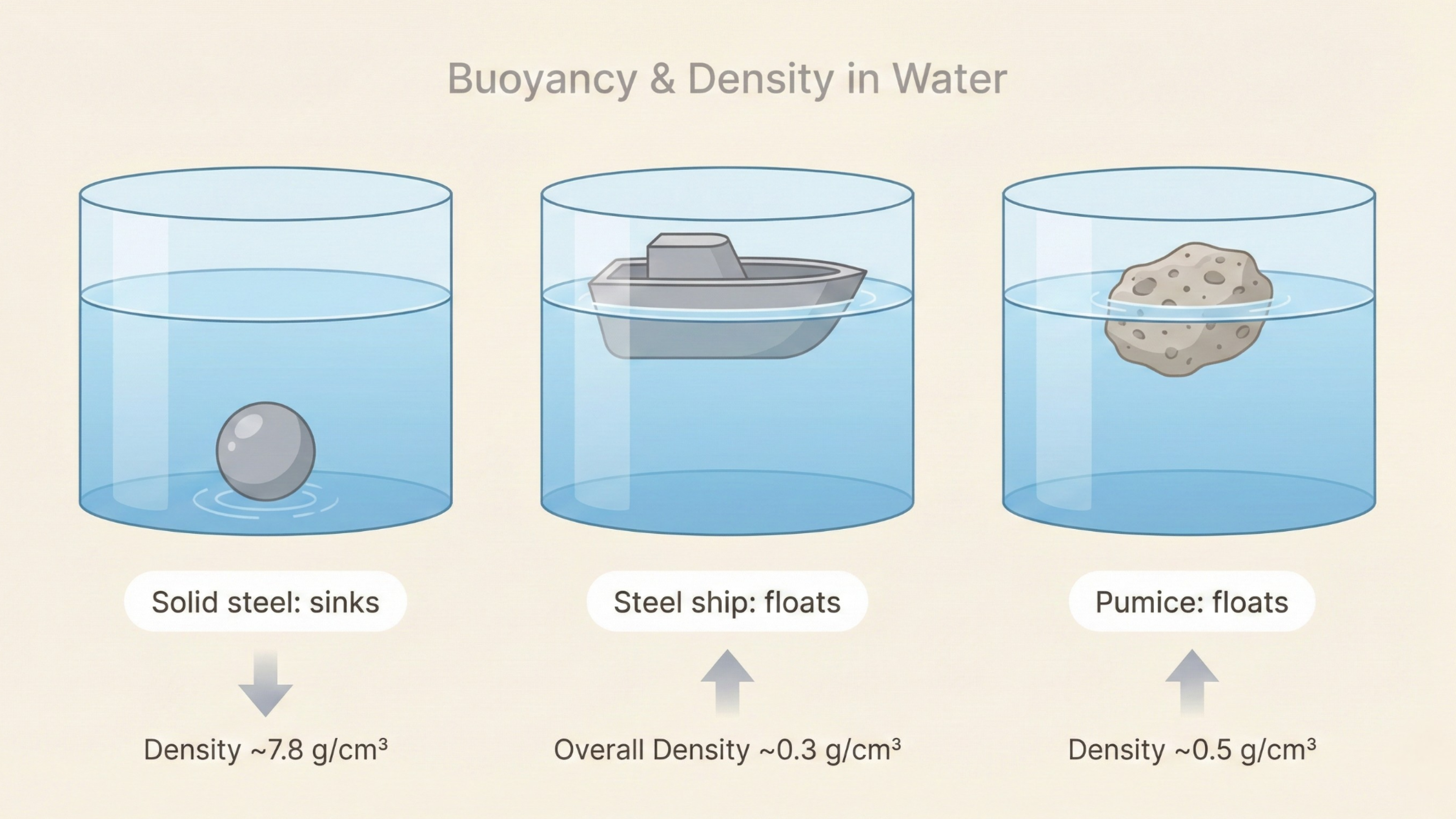
Density measures how much mass is packed into a given volume. Water has a density of 1.0 grams per cubic centimetre. Anything with lower density floats. Anything with higher density sinks.
This is Archimedes’ principle in action. An object immersed in water experiences an upward force. This force equals the weight of water the object displaces. If the object is less dense than water, it displaces more than its own weight. The upward force wins. It floats.
Now consider pumice. The solid material in pumice is volcanic glass.
This glass has a density around 2.4 to 2.5 grams per cubic centimetre. That’s denser than water.
If pumice were solid glass, it would sink immediately. But pumice isn’t solid.
Pumice is riddled with holes. Air pockets fill 50 to 85 percent of its volume. These aren’t just surface pits. They penetrate throughout the rock.
When you measure the bulk density of pumice, you’re measuring rock plus air. Most pumice has a bulk density between 0.3 and 0.8 grams per cubic centimetre. That’s well below water’s 1.0.
Let’s run a quick calculation. Imagine pumice with 75 percent porosity. Only 25 percent of its volume is solid glass. The bulk density works out to roughly 0.625 grams per cubic centimetre.
This pumice floats easily. It displaces more water than it weighs.
The first misconception dies here. Pumice doesn’t float because it’s made of some special lightweight material. The volcanic glass itself is ordinary. What makes pumice light is the air trapped inside its structure.
Think of pumice like bread. Bread dough is dense. Baked bread is light and airy. The flour didn’t change. The structure changed. Pumice is to solid rock what bread is to dough.
How Volcanoes Create Foam Made of Stone
Understanding why pumice floats requires understanding how it forms. The formation process explains everything about its structure.
Pumice begins as magma deep underground. This magma contains dissolved gases. Carbon dioxide, water vapour, and sulphur dioxide are hidden in the molten rock.
They’re dissolved under immense pressure, like carbon dioxide dissolved in a sealed soda bottle.
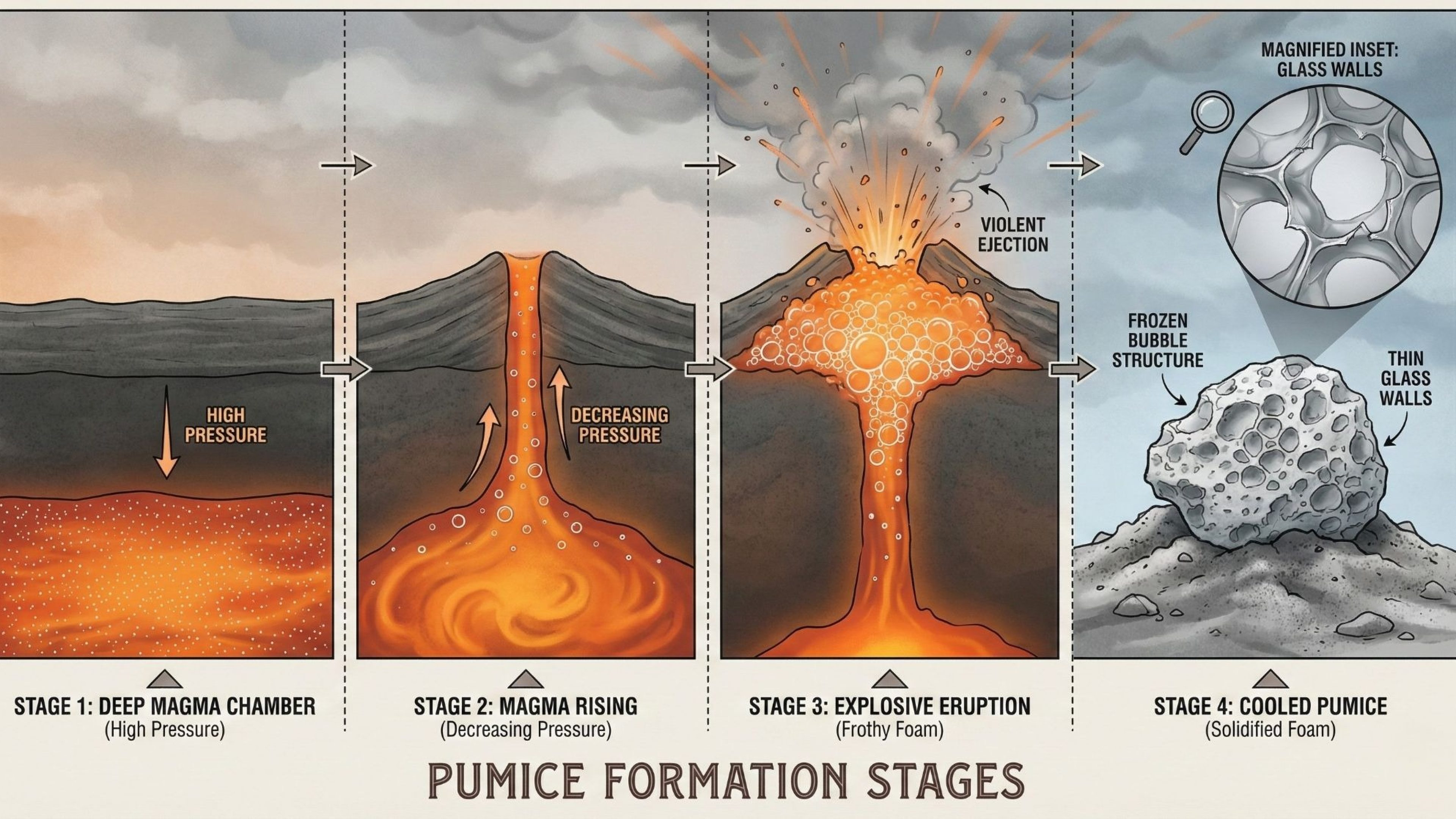
As magma rises toward the surface, pressure drops. The dissolved gases can’t stay in solution anymore. They start coming out of the liquid.
In some eruptions, this process happens gradually. Gases escape slowly. The lava flows calmly. The resulting rock has few bubbles.
But explosive eruptions are different.
In explosive eruptions, magma rises fast. Pressure drops suddenly. Gases come out of solution all at once. The magma froths violently.
Millions of tiny bubbles form simultaneously. The magma becomes foam. Think of shaking a soda bottle and then opening the cap. The liquid erupts as froth.
This frothy magma gets ejected from the volcano. It flies through the air, cooling rapidly. The cooling freezes the bubbles in place.
The result is pumice: solidified volcanic foam.
The bubble walls become thin sheets of volcanic glass. The bubble interiors become air-filled voids. The rock preserves the chaos of the eruption in its structure.
This phenomenon explains why pumice has such extreme porosity. It’s not that something dissolved away.
Organisms did not burrow through it. The pores were born in the moment of eruption. Pumice is a frozen record of violent degassing.
Not all volcanic rocks have this structure. Basaltic lava flows slowly and cools gradually. Gases escape before the rock solidifies. The resulting basalt is dense and heavy.
Pumice forms from silica-rich magmas in explosive eruptions. These magmas are viscous. They trap gases until pressure forces a violent release. The explosion creates foam, and rapid cooling preserves it.
The Real Puzzle: Why Doesn’t Water Just Fill the Holes?
Here’s where the physics gets intriguing.
If pumice is full of interconnected air pockets, water should rush in. The air should escape. The rock should waterlog and sink.
Simple physics predicts that these events will happen quickly. Water naturally rises into narrow spaces through capillary action.
A pumice has millions of channels that are very narrow. Water must penetrate quickly and sink it.
Early researchers calculated that pumice should sink within minutes to hours. Yet pumice floats for days, weeks, or sometimes over a year.
This is the paradox that puzzled scientists for decades. The answer lies in how water actually moves through porous materials.
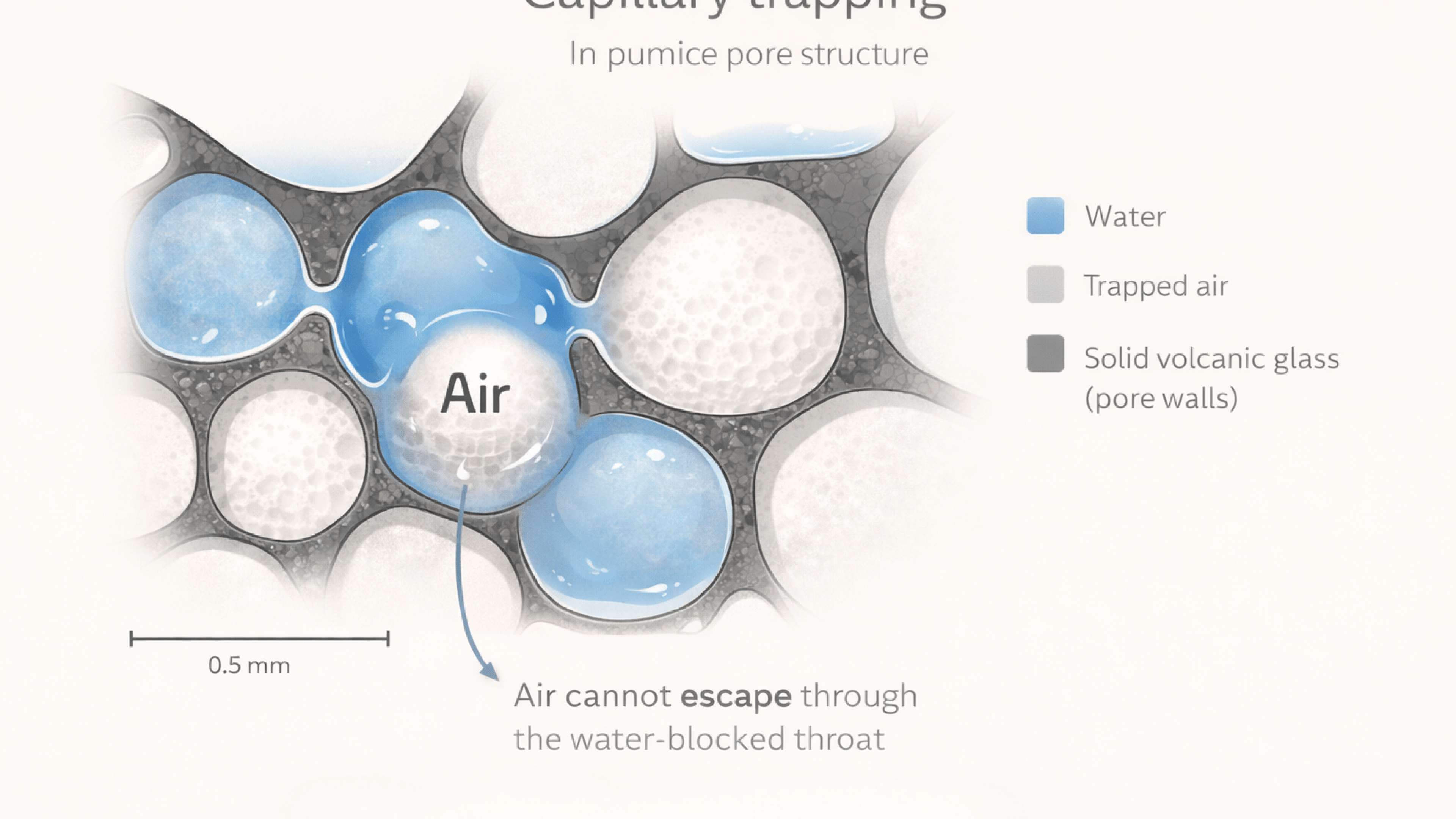
When water enters a porous material, it doesn’t advance as a smooth front. Water preferentially fills larger pores first. These offer less resistance to flow.
As water fills larger channels, it starts surrounding smaller pores. Some pores connect to the outside through narrow throats. Others form dead ends.
Here’s what happens: water surrounds a pocket of air. The air can’t escape because water now blocks the exit. The pocket becomes trapped.
Surface tension makes this trapping effective. At the air-water interface in a narrow pore throat, surface tension creates resistance. The trapped air can’t push through the water barrier. The narrower the throat, the stronger the trapping.
This process is called capillary trapping.
Water doesn’t just displace air. Water can imprison air.
Researchers used micro-CT imaging to look inside floating pumice. They found exactly this pattern. After a day of floating, pumice with 80 percent porosity still had about 20 percent of its pore volume filled with trapped gas.
These weren’t one or two big bubbles. There were thousands of tiny pockets. Each pocket was surrounded by water. Each pocket was separate from its neighbours.
The pumice was partially waterlogged but still buoyant. The trapped air kept it afloat.
The Slow Leak: How Trapped Air Eventually Escapes
Trapped air doesn’t stay trapped forever. Given enough time, pumice will sink. Understanding why requires understanding diffusion.
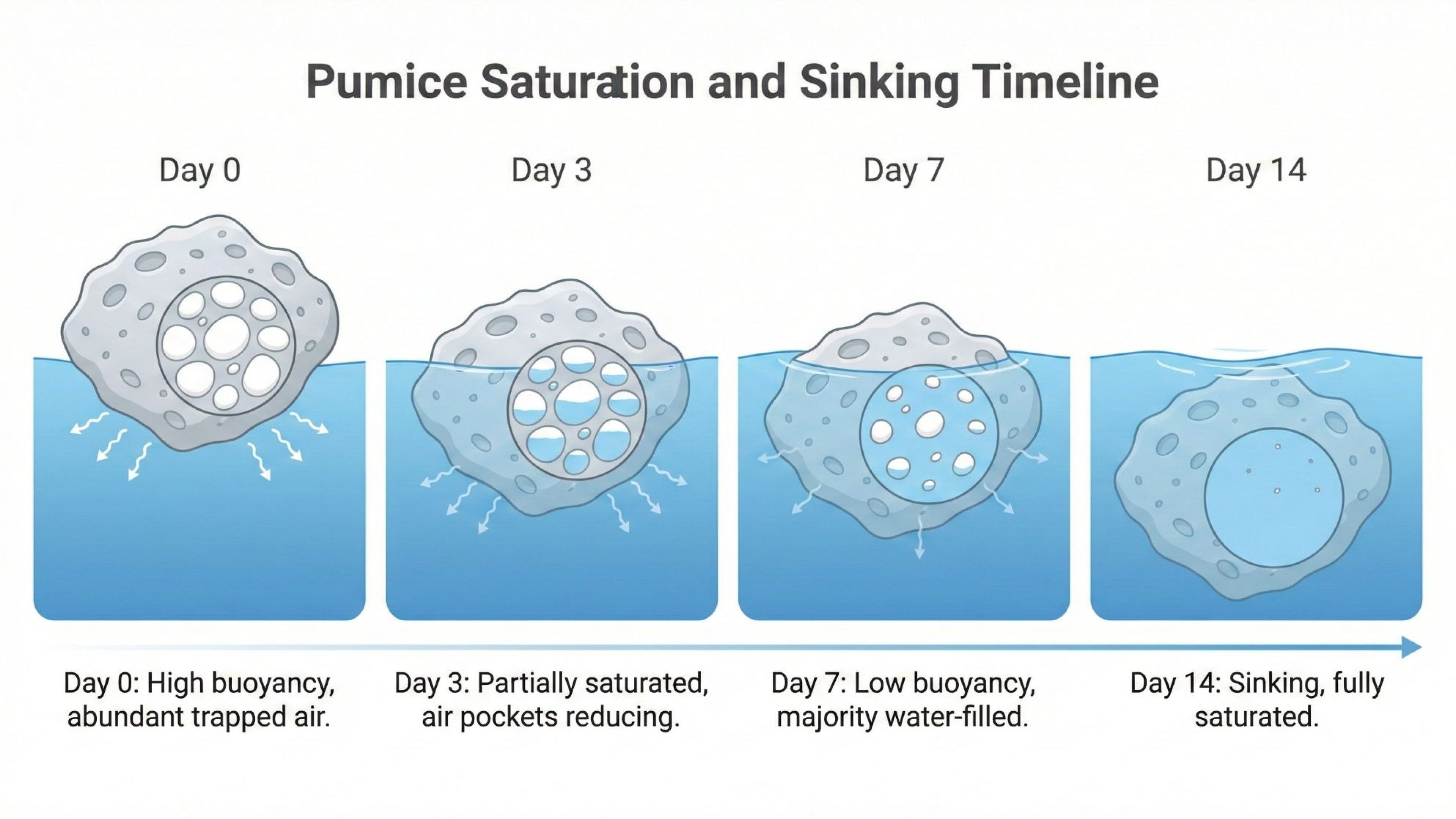
Gas molecules dissolve into water. Air trapped in a pore pocket slowly dissolves into the surrounding pore water. This dissolved gas then spreads through the water by diffusion.
Diffusion is different from flow. In flow, molecules move together in a current. In diffusion, molecules move randomly.
Each molecule bounces around, gradually spreading from areas of high concentration to low concentration.
Diffusion is slow. Very slow.
The dissolved gas diffuses outward through the water-filled pore network. Eventually, it reaches the outer surface of the rock. There, it escapes into the surrounding water.
As gas leaves the trapped pockets, those pockets shrink. Water creeps further into the pore network. More gas dissolves. More gas diffuses away.
This continues until the pumice loses enough air that its bulk density exceeds 1.0 grams per cubic centimetre. At that point, it sinks.
The diffusion-controlled nature of this process explains the timescale. Pumice doesn’t waterlog in minutes. It doesn’t suddenly sink after hours. The process takes days or weeks.
Larger pumice clasts float longer. This seems counterintuitive. Shouldn’t heavier things sink faster?
Not for pumice. Larger clasts have longer diffusion paths. Gas in the centre must travel farther to escape. Float time scales roughly with the square of clast size.
Research confirms this relationship. Pumice with 80 percent or higher porosity floated for over 10 days in experiments. Pumice with about 55 percent porosity sank within an hour.
Porosity alone explained 92 percent of the variance in float times. More porous pumice floats longer because it has more trapped air to lose.
Pore Geometry Matters as Much as Pore Volume
Porosity measures total void space. But two rocks with identical porosity can behave very differently. The arrangement of pores matters too.
Some pores connect to the outside through wide openings. Water enters easily. Air escapes easily. These pores contribute little to long-term floating.
Other pores connect through narrow throats. Water enters but traps air effectively. These pores keep pumice afloat.
Researchers distinguish between connected porosity and dead-end porosity. Connected porosity allows water and air to move freely. Dead-end porosity traps air at constrictions.
The correlation between dead-end porosity and float time is remarkable. In one study, it reached 0.98. This is nearly perfect correlation. Dead-end porosity predicted float time better than total porosity.
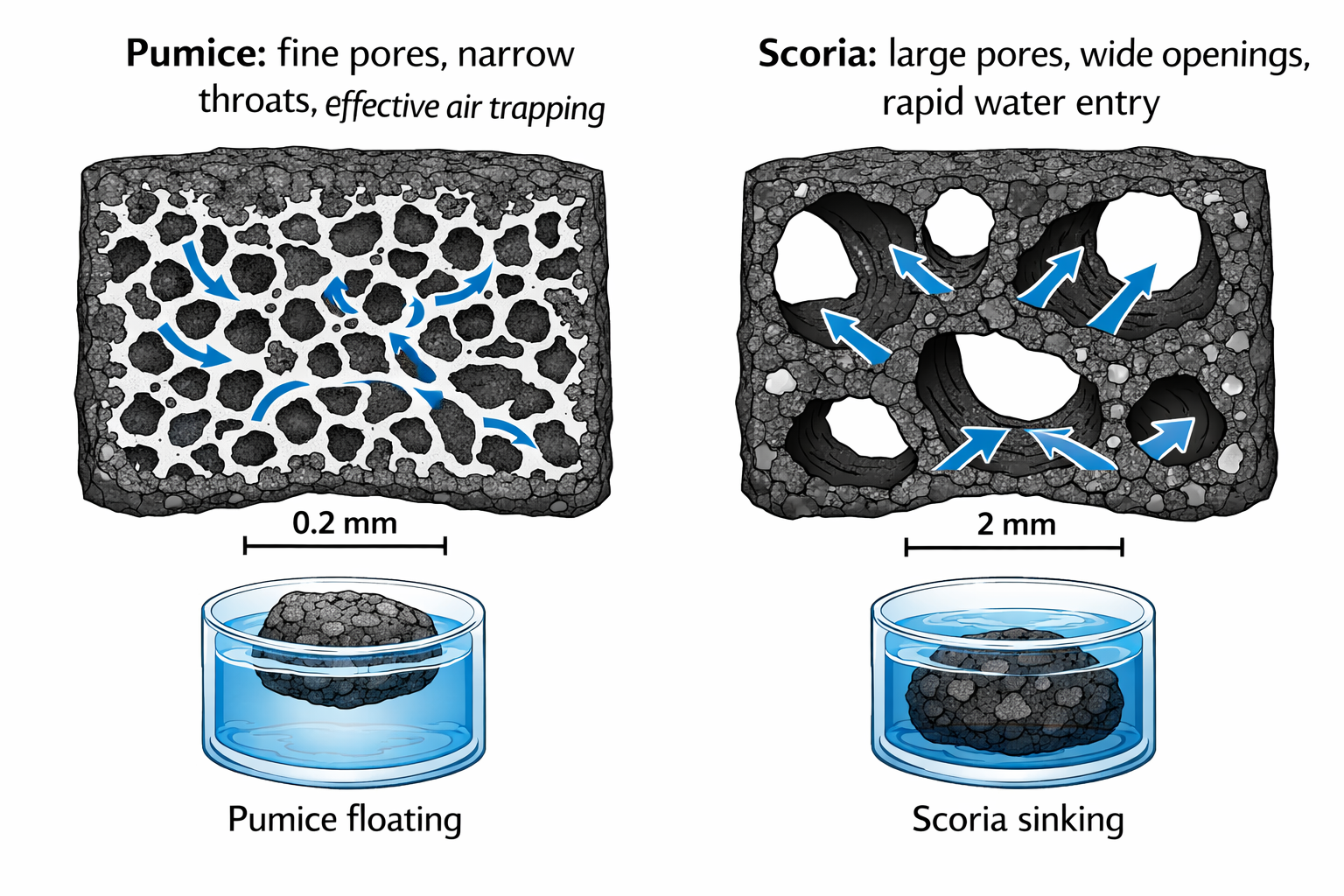
This explains why scoria behaves differently from pumice.
Scoria is another volcanic rock with bubbles. It forms from less viscous magmas. The bubbles in scoria are larger and more open. They connect through wide passages.
Scoria sinks quickly despite its porosity. Water rushes in. Air rushes out. Little trapping occurs.
Pumice has finer, more tortuous pore networks. The structure creates countless dead ends and narrow throats. Air gets trapped throughout the rock.
The volcanic conditions that form pumice create the ideal trapping geometry. Explosive degassing of viscous magma produces small, interconnected bubbles. These bubbles create the labyrinthine structure that keeps air trapped.
Giant Pumice Rafts and Their Surprising Importance
The physics of pumice floating has real consequences. Volcanic eruptions create pumice rafts that drift across oceans.
These rafts matter for ecology, navigation, and hazard assessment.
The 2012 Havre eruption produced one of the largest recorded pumice rafts. Satellites tracked it for months as it crossed the Pacific.
It eventually reached Australia’s coast, more than 3,000 kilometres away.
In 2021, the Fukutoku-Oka-no-Ba volcano erupted near Japan. Pumice from this eruption washed up across the Pacific, including on beaches in Okinawa.
The floating stones travelled thousands of kilometres before reaching shore.
Historical accounts describe similar events. After the 1883 Krakatoa eruption, pumice clogged harbours in the Indian Ocean.
Sailors reported navigating through fields of floating stone that stretched to the horizon.
These rafts carry more than just rock.
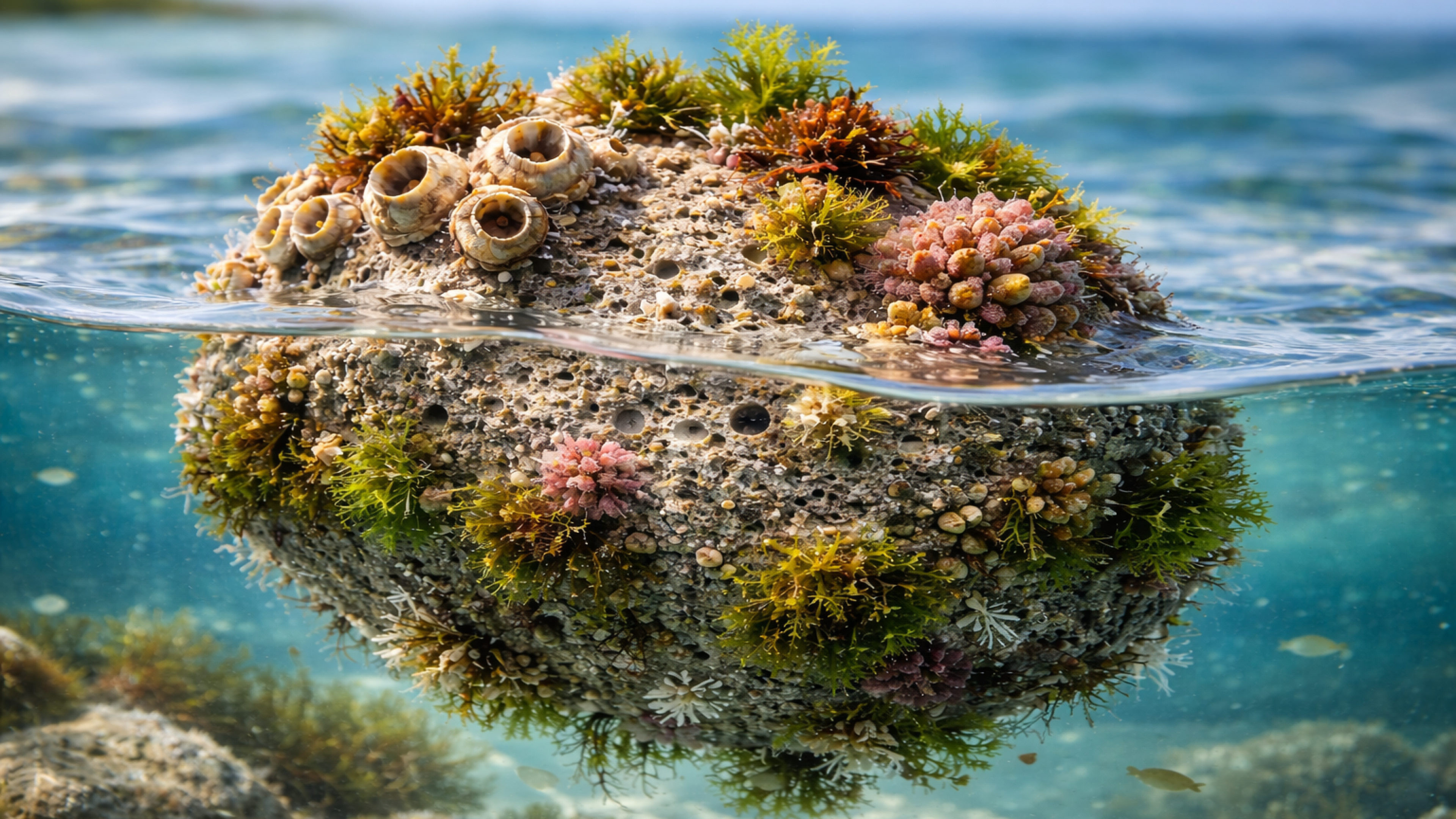
Marine organisms colonise floating pumice. Barnacles, algae, and coral larvae attach to the rough surfaces. The pumice becomes a drifting ecosystem.
Long float times enable remarkable journeys. Organisms can cross ocean basins on pumice rafts. This has implications for species dispersal and reef recovery after disturbances.
Pumice from distant eruptions has seeded new coral colonies on damaged reefs. The rafts act as natural dispersal vehicles, carrying life across barriers that would otherwise be impassable.
Pumice rafts also pose hazards.
Dense rafts can damage ships. Pumice can clog water intake systems and damage propellers. Sailors must navigate carefully through pumice-laden waters.
Understanding float duration helps predict raft behaviour. Highly porous pumice stays afloat for months, crossing entire oceans. Lower porosity material sinks sooner, limiting its travel.
Floating rocks (Pumice) and it’s Indian Connection
India has its own connection to volcanic rocks and pumice.
Barren Island in the Andaman and Nicobar Islands is India’s only confirmed active volcano. Eruptions here have occurred as recently as 2017.
Future eruptions could produce pumice that drifts through the Bay of Bengal and Indian Ocean.
Pumice from distant Pacific eruptions has reached Indian Ocean waters. Ocean currents connect the Pacific to the Indian Ocean through Indonesian passages. Drifting pumice can travel these routes.
Commercially, pumice has significance in India. Deposits exist in Karnataka and Tamil Nadu. These ancient volcanic materials are quarried for construction and horticulture.
The same porosity that makes pumice float makes it useful. Lightweight concrete uses pumice as aggregate. Soil amendments incorporate pumice to improve drainage and aeration.
Pumice deposits in peninsular India tell geological stories. They indicate volcanic activity from millions of years ago.
Understanding pumice behaviour helps interpret these geological records.
The Deccan Traps, one of Earth’s largest volcanic provinces, covered much of western India about 66 million years ago.
While the Deccan eruptions were mostly effusive, understanding volcanic processes connects to this dramatic chapter of Indian geological history.
Frozen Foam: The Complete Picture
Pumice floats because its bulk density is lower than water. The solid volcanic glass is denser than water, but the rock is mostly empty space.
Air-filled pores make up 50 to 85 percent of the volume. This brings the overall density below 1.0 grams per cubic centimetre.
But that only explains why pumice floats initially.
The deeper question is why pumice stays afloat for so long. Water should flood in. Air should rush out. Simple physics predicts rapid sinking.
The answer is capillary trapping.
Water enters pumice but doesn’t displace all the air. As water fills larger pores, it surrounds and isolates smaller pockets of air.
Surface tension at narrow pore throats prevents these pockets from escaping.
The trapped air slowly dissolves into the pore water. Dissolved gas then diffuses outward, molecule by molecule.
This process takes days or weeks. Only when enough gas has escaped does the pumice finally sink.
Pumice is frozen foam. It records the explosive violence of volcanic eruptions in its structure. Each bubble was born in a moment of violent degassing.
Each preserved pore keeps a tiny parcel of ancient volcanic gas trapped inside.
The next time you see pumice, consider what you’re holding. It might be a bathroom scrubbing stone. It might be a garden amendment. It might be a grey pebble on a beach.
Pick it up. Feel how light it is. Think about the volcano that created it. Think about the millions of tiny air pockets hidden inside.
Think about how those pockets could keep this stone afloat for months, drifting across an ocean, slowly surrendering their cargo to the sea.
A rock that floats isn’t magic. It’s physics. But it’s physics that rewards careful thinking about structure, surface tension, and the patient work of diffusing molecules.
Frequently Asked Questions
Why does pumice float on water?
Pumice floats because its average density is lower than water. The solid material is volcanic glass, which is denser than water. But pumice is 50–85 percent empty space filled with air. This makes the overall rock lighter than the water it displaces.
How long can pumice float?
Pumice can float from minutes to over a year. Float time depends mainly on porosity. High-porosity pumice with 80 percent or more void space can stay buoyant for weeks or months. Pumice rafts from volcanic eruptions have been tracked drifting for over a year.
Why doesn’t pumice sink immediately when water enters?
Water enters pumice but doesn’t displace all the air. Capillary forces trap air pockets inside the pore network. Water surrounds these pockets and blocks their escape. The trapped air slowly dissolves and diffuses out, eventually causing the pumice to sink.
Is pumice the only rock that floats?
Pumice is the only common rock type that reliably floats. Some other highly porous materials might float briefly when completely dry. But they typically waterlog quickly. Pumice’s combination of extreme porosity and fine pore geometry makes it uniquely buoyant.
What happens to floating pumice over time?
Floating pumice gradually absorbs water as trapped air dissolves and escapes. The rock rides lower in the water over days or weeks. Eventually, its density exceeds that of water, and it sinks. In the ocean, pumice may also accumulate marine organisms that add weight.
Why do larger pieces of pumice float longer than smaller pieces?
Larger pumice clasts have longer diffusion paths. Gas trapped in the centre must travel farther to reach the outer surface and escape. Since diffusion is a slow process, larger pieces take longer to lose enough air to sink.