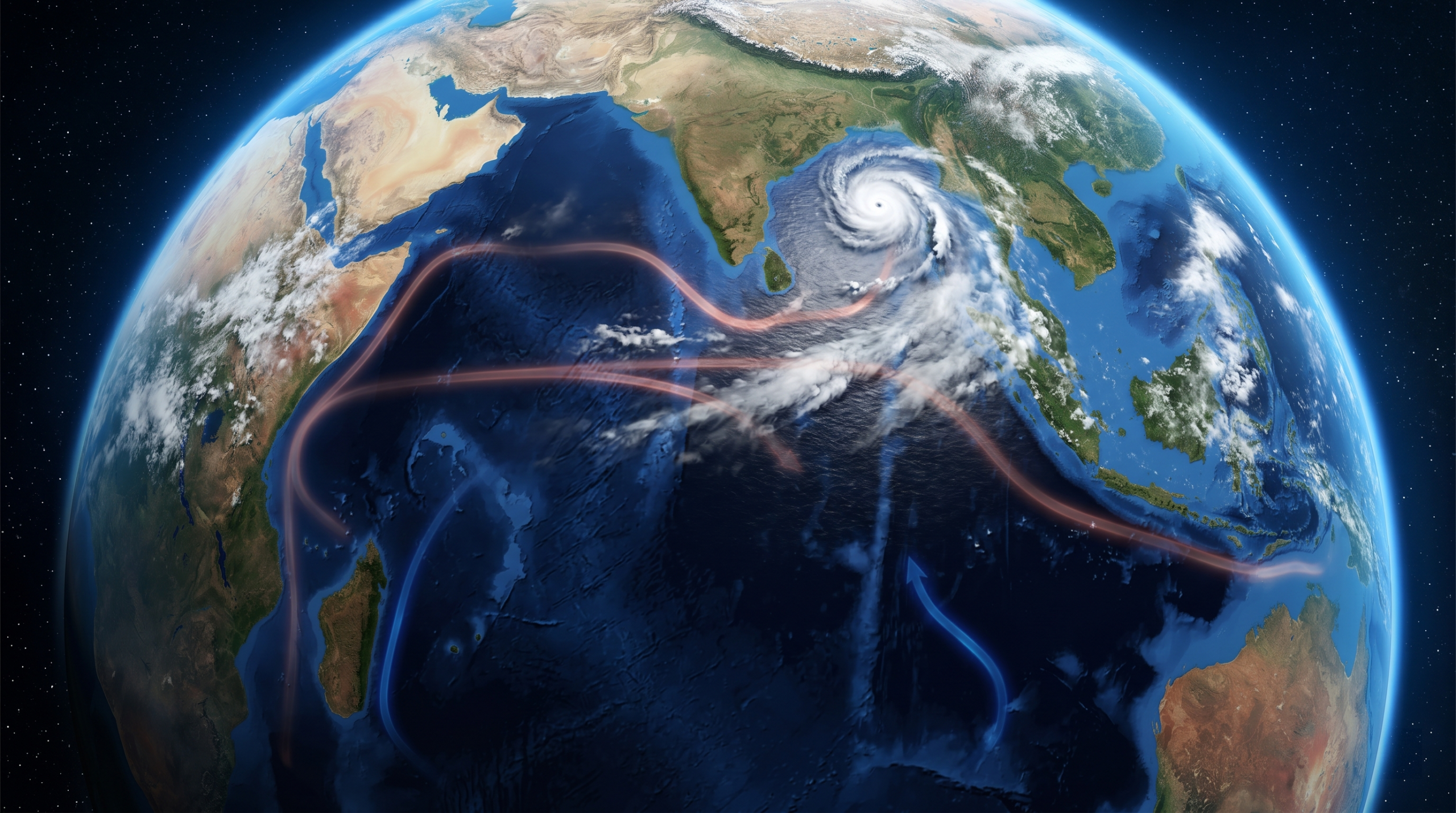
Oceans absorb over 90% of Earth’s excess heat, drives global weather patterns, and stores a quarter of human carbon emissions.
Yet most climate conversations focus on the atmosphere.
This article explains, from first principles, how the ocean stores heat, moves it around the planet, regulates carbon, and drives phenomena like ENSO (El Niño-Southern Oscillation), which shapes monsoons, droughts, and floods worldwide.
Here is a question most people never think to ask: why doesn’t Earth’s temperature swing wildly between day and night?
The Moon, which sits roughly the same distance from the Sun, sees temperature swings of over 250 degrees Celsius between its sunlit and shadowed sides.
Mars swings by 60 to 70 degrees in a single day. Earth, by contrast, barely moves.
In Delhi, a summer day might reach temperatures as high as 45°C and then cool down to 30°C at night.
That is a modest 15 degrees. Something is absorbing enormous amounts of energy during the day and releasing it slowly at night, season after season, decade after decade.
The atmosphere is not the primary element. The atmosphere is thin and light and has a poor memory for heat. The real thermal anchor of Earth’s climate is the ocean.
According to the IPCC’s Sixth Assessment Report, roughly 91% of all excess heat trapped by greenhouse gases since 1970 has gone into the ocean.
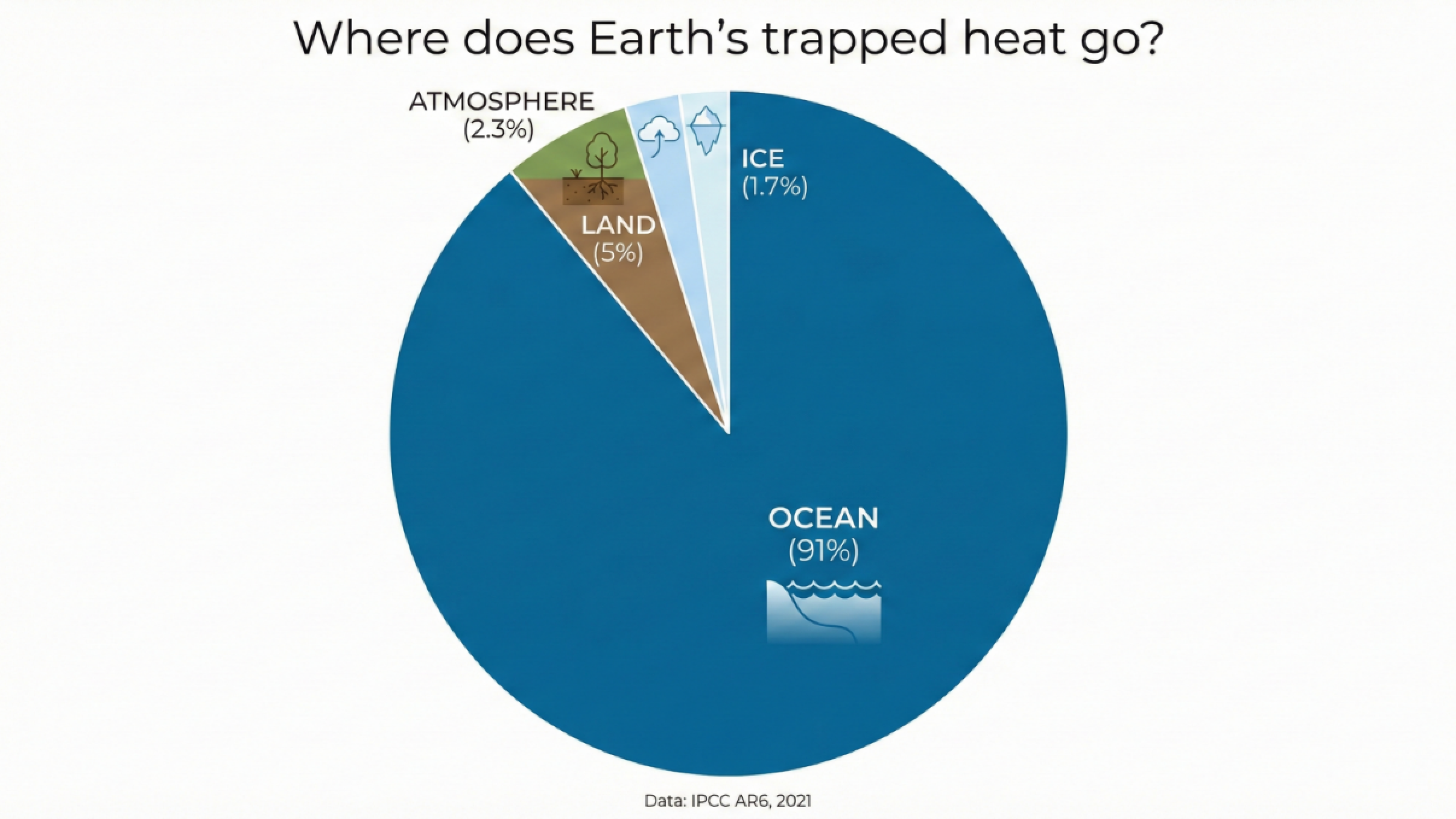
Not the air, land or the ice, the ocean. This single number reframes almost everything about how climate works, and it is where our story begins.
The ocean as Earth’s heat battery
To understand why the ocean dominates, you need to understand one property of water: heat capacity.
Heat capacity is the amount of energy it takes to raise the temperature of a substance by one degree. Water has an unusually high heat capacity compared to air, rock, or soil.
If you have ever noticed that a pot of water on a stove takes far longer to heat up than the metal pan beneath it, you have already observed this.
The water absorbs a lot of energy before its temperature changes much. The pan, meanwhile, gets scorching in seconds.
Now scale that up to an ocean covering 71% of Earth’s surface, averaging nearly 4 kilometers deep.
The top 2.5 meters of the ocean hold as much heat energy as the entire atmosphere above it. This is not a subtle difference.
It is the reason the ocean, not the air, is Earth’s climate battery.
But the ocean is not one uniform pool. It has layers, and those layers behave very differently.
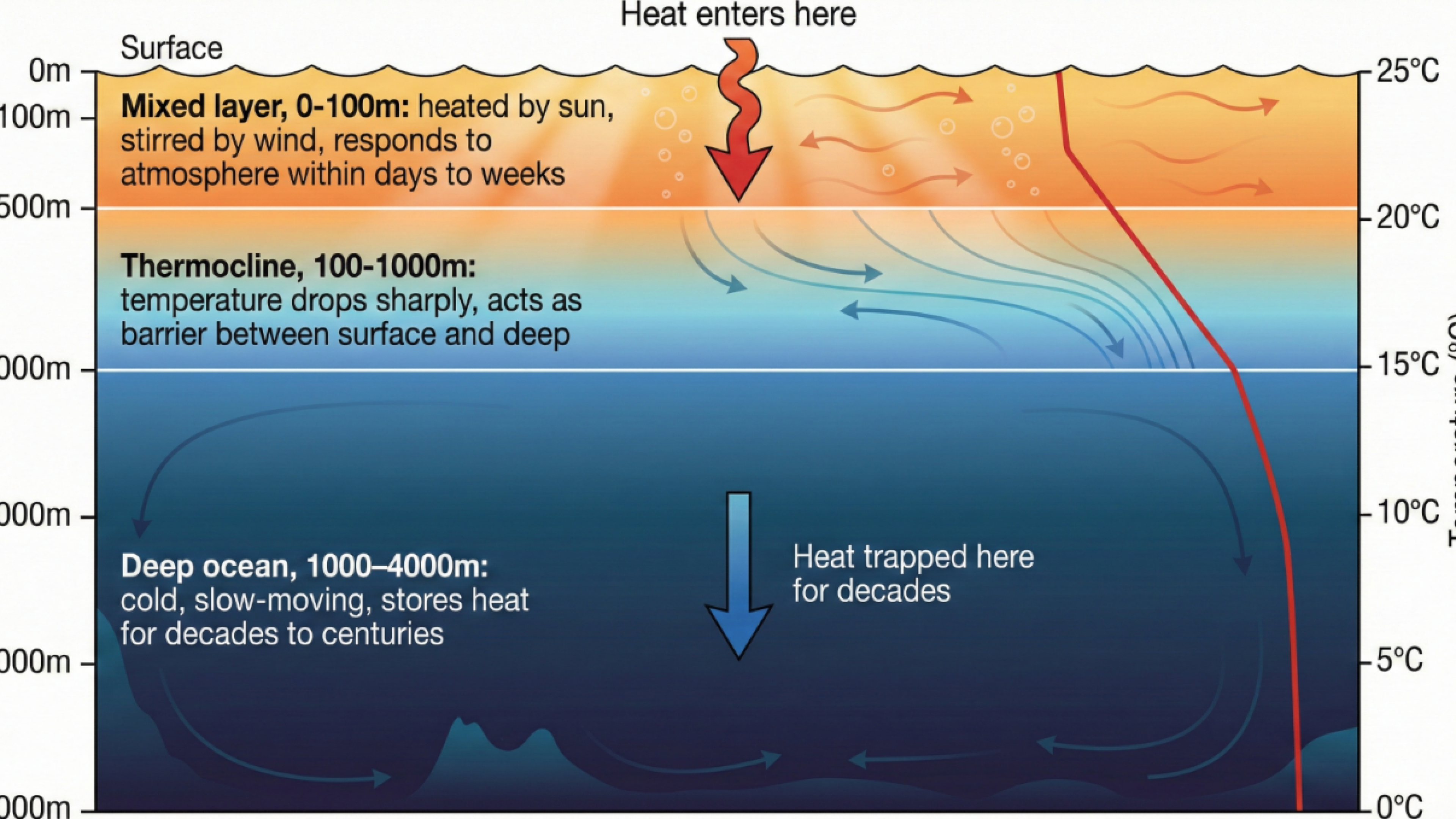
The top layer, called the mixed layer, stretches down roughly 50 to 200 meters depending on season and location.
Wind and waves constantly stir it, keeping its temperature fairly uniform.
This is the layer that talks to the atmosphere: it absorbs sunlight, exchanges heat through evaporation and radiation, and responds to weather on timescales of days to weeks.
Below the mixed layer sits the thermocline, a transition zone where temperature drops sharply with depth.
Think of it as a thermal barrier. Heat that makes it past the mixed layer and into the thermocline does not come back to the surface easily. It can stay trapped for decades.
Below the thermocline lies the deep ocean, cold and slow, where water temperatures hover around 2 to 4 degrees Celsius regardless of what is happening at the surface.
Heat that sinks into this layer stays locked away for centuries. This is what scientists mean when they talk about the ocean’s thermal inertia.
The deep ocean is a vault, and once energy enters it, the climate system has effectively committed to that warming for a very long time.
This layered structure also explains one of the most misunderstood episodes in recent climate science.
Between roughly 2000 and 2012, global surface temperatures appeared to plateau, leading some to claim that global warming had paused, It had not.
What happened was that strengthened winds and circulation patterns in the Pacific were pushing more heat than usual into the deeper ocean.
The surface looked stable while the depths were absorbing the difference. When scientists measured the full ocean, the heat was all there.
The lesson is straightforward: you cannot understand climate change by watching a thermometer in the air, you have to look at the water.
How the ocean and atmosphere talk to each other
Heat stored in the ocean does not stay put. It constantly exchanges energy with the atmosphere, and this two-way conversation between water and air drives much of Earth’s weather.
The exchange happens through several channels simultaneously. The most important is evaporation.
When the sun heats the ocean’s surface, water molecules escape into the air as vapours.
This does two things at once: it cools the ocean slightly (the departing molecules carry energy with them), and it loads the atmosphere with both moisture and latent heat.
When that vapour eventually condenses into clouds and rains, the stored energy is released, generating convection, storms, and large-scale circulation patterns.
Every tropical cyclone, every monsoon burst, and every thunderstorm over the Bay of Bengal is ultimately fuelled by heat the ocean transferred to the atmosphere through evaporation.
Wind adds another layer. Atmospheric winds drag across the sea surface, transferring momentum into the water.
This wind stress drives surface currents, stirs the mixed layer, and shapes the large-scale circulation patterns we will look at next.
The relationship runs both ways: warm ocean surfaces heat the air above them, creating low-pressure zones that pull in more wind, which stirs the ocean further.
There is also a greenhouse feedback loop at work here. A warmer ocean surface means more evaporation, which puts more water vapour in the atmosphere.
Water vapour is, in itself, a powerful greenhouse gas. More of it means the atmosphere traps more heat, warming the surface further and driving more evaporation.
This water vapour feedback is one of the strongest amplification mechanisms in the climate system.
The net result is a pattern scientists describe loosely as wet regions get wetter, and dry regions get drier.
Warmer oceans intensify the hydrological cycle: more evaporation from tropical seas, more rainfall in already-wet equatorial zones, and more moisture being pulled away from subtropical dry belts. It is a simplification, but the broad direction holds.
Rivers in the ocean: how currents move heat around the planet
If the ocean just sat there absorbing and releasing heat, the tropics would be unbearably hot and the poles unimaginably cold.
The temperature difference between the equator and high latitudes would be far more extreme than it actually is.
Circulation is physically carrying heat from where there is too much to where there is too little.
At the surface, the main players are the great subtropical gyres: enormous, roughly circular current systems driven by prevailing winds.
There is one in each major ocean basin. Within these gyres, the western boundary currents are the heavy lifters.
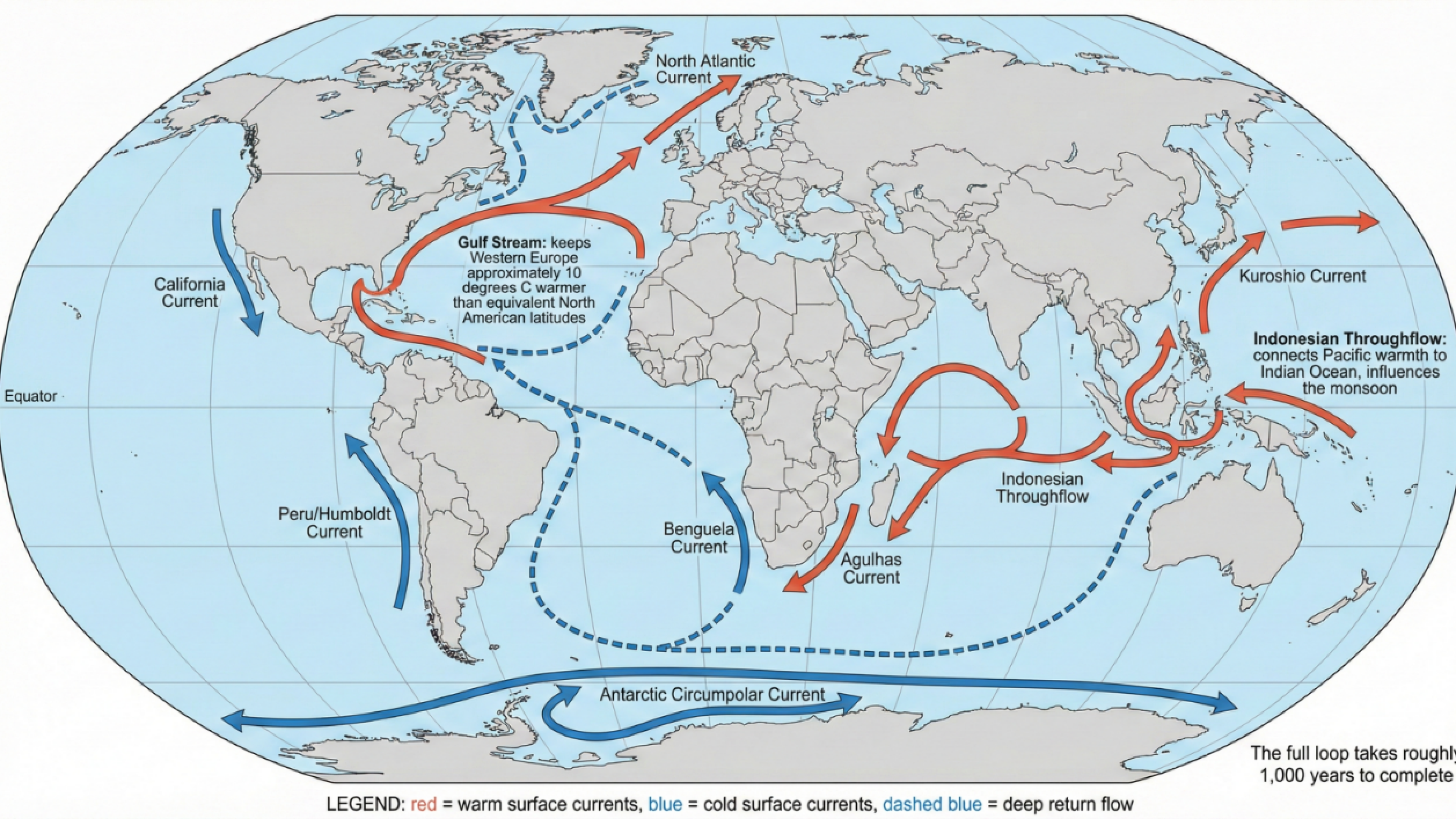
The Gulf Stream in the North Atlantic, the Kuroshio off Japan, and the Agulhas off southeast Africa.
These are swift, narrow, deep currents that carry huge volumes of warm tropical water toward the poles.
The Gulf Stream is probably the most famous example. It carries warm water from the Caribbean northeastward across the Atlantic, eventually feeding the North Atlantic Current that bathes the shores of Western Europe.
The climate effect is striking: Western Europe sits 10 degrees Celsius warmer in winter than cities at comparable latitudes on the North American east coast.
London and Labrador share similar latitudes, but their winters could not be more different.
However, surface currents only provide a partial picture. The ocean also has a deep, slow, global-scale circulation driven not by wind but by density differences in seawater.
This is the thermohaline circulation, sometimes called the global ocean conveyor belt, though that term oversimplifies it.
The Gulf Stream carries warm surface water poleward in the North Atlantic, where it dramatically cools at high latitudes.
Cold water is denser than warm water. At the same time, sea ice forming nearby expels salt (a process called brine rejection), making the surrounding water even saltier and denser.
This cold, salty, dense water sinks deep, forming what oceanographers call North Atlantic Deep Water.
It flows southward along the ocean floor, eventually reaching the Southern Ocean, where it mixes with other deep water masses and branches into the Pacific and Indian oceans.
Centuries later, this water gradually returns to the surface through upwelling and mixing, completing a loop that takes roughly a thousand years.
This deep overturning circulation is one of the most important heat conveyors on the planet.
The Atlantic limb alone, called the Atlantic Meridional Overturning Circulation, or AMOC, transports roughly 1 to 1.5 petawatts of heat northward.
That is 1,000,000,000,000,000 watts. For context, total human energy consumption is around 18 terawatts, roughly 60 to 80 times less.
The IPCC projects that the AMOC will very likely weaken over this century under all emissions scenarios.
A weaker AMOC would mean less heat reaching the North Atlantic, potentially cooling parts of Northern Europe even as the planet warms overall.
The regional consequences could be significant, though the exact timeline and magnitude remain areas of active research.
For India, the relevant circulation story runs through the Indian Ocean.
The Indonesian Throughflow, a current that funnels warm Pacific water through the straits of Indonesia into the Indian Ocean, plays a direct role in regulating sea surface temperatures in the Indian Ocean basin.
These temperatures, in turn, influence the strength and timing of the South Asian monsoon.
A warm western Pacific and Indian Ocean generally enhance monsoon rainfall; a cooler configuration can suppress it.
The ocean circulation that determines whether Mumbai gets adequate monsoon rain in July traces back, in part, to currents that began in the western Pacific months earlier.
Salt, ice, and the density engine
We have talked about temperature driving ocean circulation, but temperature alone does not determine where water sinks.
Salinity, the concentration of dissolved salts in seawater, is the other half of the equation.
Ocean water density depends on both temperature and salinity, and the fact is, colder water and saltier water are denser.
The interplay of these two properties, what oceanographers call thermohaline dynamics, governs which water masses sink and which stay at the surface.
In the North Atlantic, the dominant driver of sinking is thermal: surface water arriving from the tropics cools intensely in winter.
But the salt component matters too. When sea ice forms in polar regions, it rejects most of the dissolved salt, concentrating it in the water just below.
This brine rejection makes the remaining water denser, reinforcing the sinking. The roughly 15 sverdrups (million cubic metres per second) of North Atlantic Deep Water that forms each year is a product of both cooling and salt concentration.
Now here is where climate change complicates things. Greenland’s ice sheet is melting at an accelerating rate, dumping enormous volumes of freshwater into the North Atlantic.
Freshwater is lighter than salty water. It forms a buoyant cap on the surface, reducing the density contrast that drives sinking.
If enough freshwater enters the system, it could significantly weaken or disrupt deepwater formation, and with it, the entire overturning circulation.
Current models suggest this is a possibility, though there is not yet consensus on how close the system is to a tipping point.
Meanwhile, at both poles, another feedback loop is well underway.
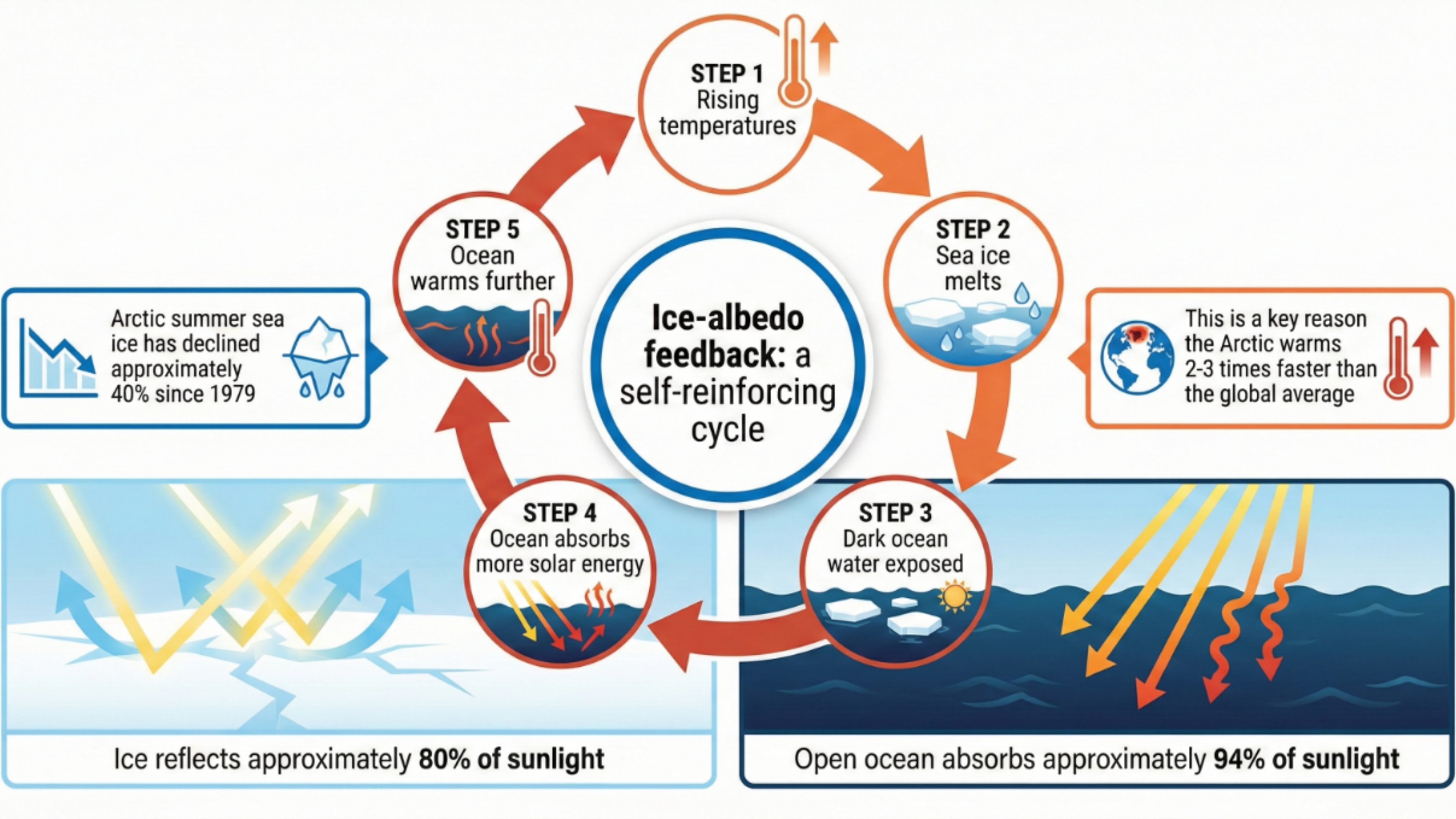
Sea ice is bright. It reflects roughly 80% of the sunlight that hits it back into space. Open ocean water, by contrast, is dark.
It absorbs about 94% of incoming sunlight. When warming melts sea ice, it exposes dark water, which absorbs more energy, which warms the ocean further, which melts more ice.
This is the ice-albedo feedback, and it is one of the most powerful self-reinforcing cycles in the climate system.
The numbers are stark. Arctic summer sea ice extent has declined by approximately 40% since satellite records began in 1979, and the decline tracks almost linearly with global temperature rise.
This feedback is the primary reason the Arctic is warming two to three times faster than the global average, a phenomenon known as Arctic amplification.
The freshwater from all this melting ice does not just dilute surface salinity.
It also stratifies the upper ocean, making it harder for surface heat to mix downward and harder for nutrients to mix upward.
The consequences ripple through the system: circulation patterns shift, ecosystems reorganise, and the ocean’s ability to absorb heat and carbon changes in ways that are still being quantified.
The ocean’s carbon problem
The ocean is not only a heat reservoir. It is also the planet’s largest active carbon sink.
Roughly 25 to 30% of all CO₂ that humans emit by burning fossil fuels ends up dissolved in the ocean.
Without this absorption, atmospheric CO₂ concentrations would be significantly higher, and the pace of warming would be faster.
In that sense, the ocean has been doing us an enormous, quiet favour.
It does this through two main mechanisms, working in parallel.
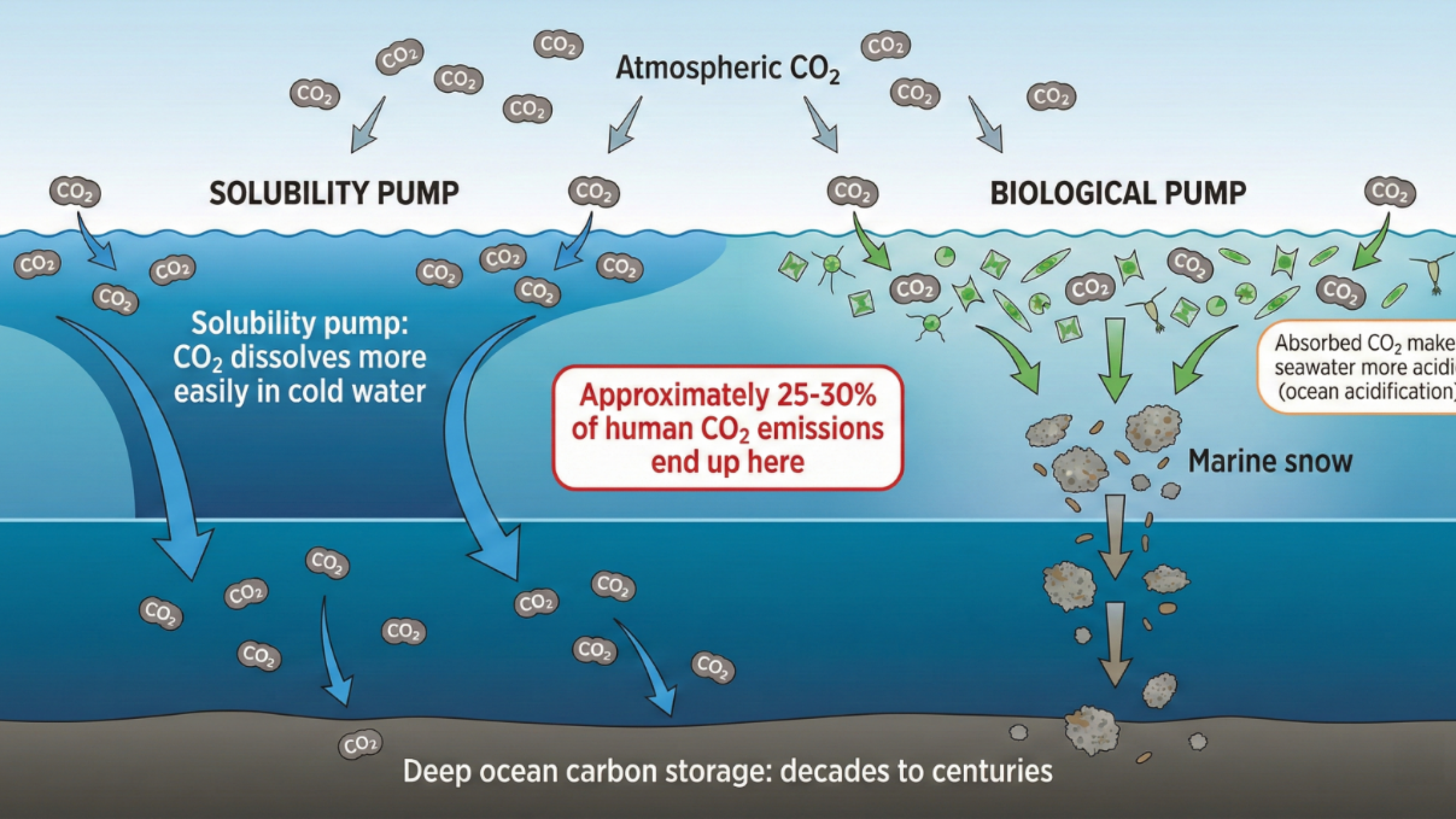
The first is the solubility pump. CO₂ dissolves in seawater according to a straightforward physical principle: cold water can hold more dissolved gas than warm water.
You have seen this every time a cold cola stays fizzy longer than a warm one.
In the climate system, this means the cold, high-latitude oceans around the Arctic and Antarctic are the primary zones of CO₂ uptake.
Surface water absorbs CO₂ from the atmosphere, cools as it moves poleward, absorbs more, and eventually sinks, carrying dissolved carbon into the deep ocean where it stays for decades to centuries.
The second is the biological pump. Phytoplankton, microscopic photosynthetic organisms floating in the sunlit surface layer, absorb CO₂ just as land plants do.
When they die, or when zooplankton that ate them produce waste, organic matter sinks toward the ocean floor as marine snow.
A fraction of this carbon reaches the deep ocean and is effectively sequestered. It is a slow, steady rain of carbon from the surface to the abyss.
But absorbing CO₂ comes at a cost. When CO₂ dissolves in seawater, it reacts with water to form carbonic acid, which releases hydrogen ions.
This lowers the pH of the ocean, a process called ocean acidification. Since the Industrial Revolution, ocean pH has dropped by about 0.1 units.
That sounds small, but pH is a logarithmic scale, so this represents roughly a 26% increase in hydrogen ion concentration.
The consequences for marine organisms that build shells or skeletons from calcium carbonate, including corals, molluscs, and certain plankton, are serious and well-documented.
There is troubling feedback here as well. As the ocean warms, it becomes more stratified: the warm surface layer becomes more distinct from the cold deep layer, reducing mixing.
Less mixing means fewer nutrients reach the surface (weakening the biological pump) and less cold water is exposed to the atmosphere (weakening the solubility pump).
In other words, the warmer the ocean gets, the less effective it may become at absorbing our carbon emissions.
Observations in recent years suggest the ocean carbon sink may already be weakening slightly, though the evidence is still being debated.
In Indian waters, the Arabian Sea and Bay of Bengal present contrasting biogeochemical regimes.
The Arabian Sea has some of the world’s most productive upwelling zones, supporting a robust biological pump.
The Bay of Bengal, heavily influenced by monsoon rainfall and river discharge, is more stratified.
Understanding how these regional systems respond to warming is an active area of research for Indian oceanographic institutions.
When the ocean drives the weather: a brief look at ENSO
Everything we have discussed so far, from heat storage to circulation to carbon absorption to ice feedbacks, operates in the background, shaping climate over years, decades, and centuries.
But the ocean also produces dramatic, shorter-term swings in global weather. The most important of these is ENSO: the El Niño-Southern Oscillation.
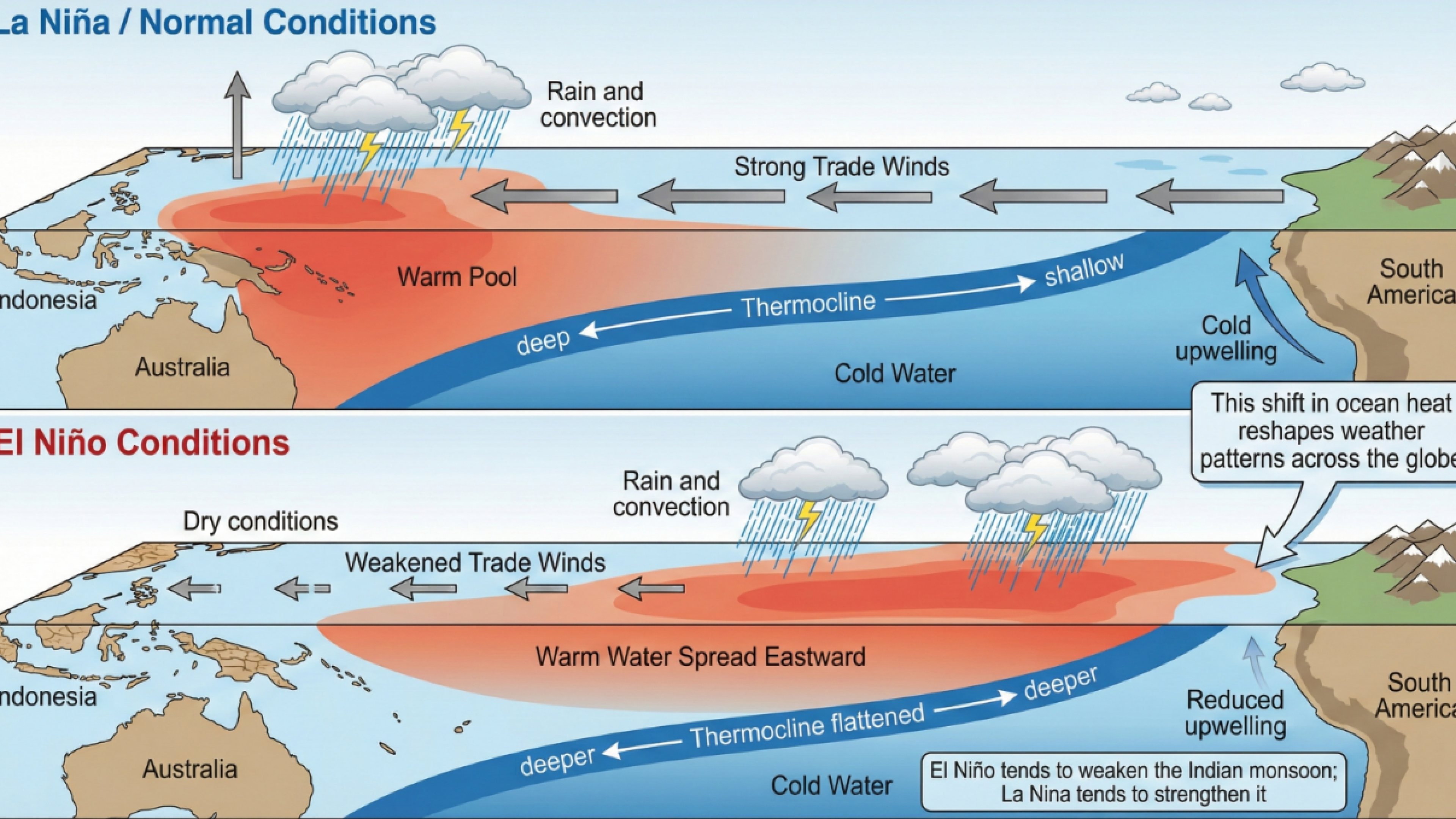
ENSO is a coupled ocean-atmosphere phenomenon centred in the tropical Pacific.
In its normal state, strong trade winds blow westward across the Pacific, pushing warm surface water toward Indonesia and Australia.
This piles up warm water in the western Pacific and tilts the thermocline: deep in the west, shallow in the east.
Along the South American coast, cold, nutrient-rich water wells up from below, keeping the eastern Pacific relatively cool.
During El Niño, this system weakens or reverses, and the trade winds slacken, which moves the warm water that was pooled in the west eastward.
Warm water that was pooled in the west sloshes eastward, the thermocline flattens, upwelling off South America diminishes, and sea surface temperatures in the central and eastern Pacific rise, shifting rainfall patterns and atmospheric circulation worldwide.
The mechanism is driven by a positive feedback loop called the Bjerknes feedback: warm water in the eastern Pacific weakens the trade winds, which reduces upwelling, which allows more warming.
The cycle eventually reverses through oceanic wave dynamics and heat redistribution, leading to La Niña, the cold phase, where the normal pattern intensifies.
The whole oscillation repeats every two to seven years.
The global consequences are enormous for a process confined to one ocean basin.
El Niño tends to weaken the Indian summer monsoon, shift the Pacific jet stream southward (bringing wetter winters to the American Southwest and drought to the Pacific Northwest), suppress Atlantic hurricane activity, and trigger drought across Indonesia and Australia.
La Niña broadly reverses these effects.
The 2015-16 El Niño, one of the strongest on record, coincided with the warmest year in recorded history, devastating floods in Peru, drought across southern Africa that left tens of millions food-insecure, and the worst air pollution episode ever recorded in Indonesia from peatland fires.
For India, ENSO is one of the strongest predictors of monsoon performance.
El Niño years carry a significantly elevated risk of monsoon deficit, with direct consequences for agriculture, water resources, and food prices.
Indian agencies like INCOIS and IMD monitor Pacific Ocean conditions closely as part of their seasonal monsoon forecasting.
ENSO also illustrates a deeper point about the ocean’s role in climate: the ocean has memory.
Subsurface heat anomalies, specifically the volume of warm water stored in the equatorial Pacific, serve as precursors to El Niño events months before they develop at the surface.
This ocean memory is what makes ENSO partially predictable, with useful forecasts possible up to about six months in advance.
There is much more to say about ENSO: its detailed mechanics, its regional impacts across continents, and what climate change might do to it.
We will cover that in a dedicated article. For now, the key point is that the ocean does not just store and transport heat.
It actively generates climate variability that touches every continent.
The climate machine, connected
Let’s now take a step back and look at the full picture, shall we?
The ocean absorbs and stores heat on timescales from days to millennia.
It transports that heat from the tropics to the poles through surface currents and deep overturning circulation.
It absorbs a quarter of our carbon emissions through physical and biological pumps, buffering the atmosphere at the cost of acidifying itself.
Its ice, when it melts, triggers self-reinforcing feedbacks that accelerate polar warming.
And through coupled phenomena like ENSO, it generates climate variability that determines whether a given year brings drought or flood to regions thousands of kilometres from the Pacific.
These are not separate processes but interconnected parts of a single planetary system.
The overturning circulation that carries heat also ventilates carbon to the deep ocean.
The stratification that traps heat also weakens the biological pump. The ice melt that amplifies Arctic warming also freshens the water that drives deep convection.
There are still things we do not understand well, and how ocean clouds will respond to warming remains the single largest uncertainty in climate projections.
Whether the AMOC has a tipping point, and how close it might be, is actively debated.
How the ocean carbon sink will evolve as waters warm and acidify is not yet clear. These are not minor footnotes.
They are questions whose answers will determine the pace and character of climate change over the coming century.
But the broad picture is well established. The ocean is not a backdrop to the climate story. It is the main character.
Every monsoon that waters Indian farmland, every cyclone that forms in the Bay of Bengal, every mild winter in London, and every drought in the Sahel traces back, at some level, to the ocean’s climate machinery.
The air gets the attention. The water does the heavy lifting.